Coronal Mass Ejections (CMEs) and Space Weather
A coronal mass ejection (CME) is a huge cloud of hot, electrically charged gas (plasma) and magnetic field that the Sun suddenly throws out into space from its outer atmosphere, the corona. A single CME can carry around a billion tonnes of material. It can travel at speeds from below 250 km per second to nearly 3,000 km per second.
If a CME hits the Earth, it can cause a geomagnetic storm, which can disturb satellites, radio, GPS and power grids, and create bright auroras (natural lights in the sky).
Why does the Sun throw out CMEs?
The Sun is not a calm ball of fire. Its surface is full of twisting magnetic fields, especially around dark patches called sunspots. Think of these field lines as rubber bands. As the Sun's gas moves and churns, the bands get twisted and stretched. When they snap and reconnect in a new shape (a process called magnetic reconnection), a huge amount of stored energy is released at once.
This can heat the gas, give off a burst of light (a solar flare), and push a giant bubble of plasma out into space (a CME).
Where did our understanding come from?
- 1859, the Carrington Event: British astronomer Richard Carrington saw a bright solar flare on 1 September 1859. The next day, the strongest geomagnetic storm in recorded history hit the Earth. Telegraph lines sparked and some caught fire, and auroras were seen far from the poles. Scientists now think it was caused by a CME.
- 1970s: CMEs were first clearly seen by coronagraphs in space, on NASA's OSO-7 and Skylab missions.
- 1989, the Quebec blackout: In March 1989, a geomagnetic storm caused the whole power grid of Quebec, Canada, to fail for about nine hours.
- 1995 onwards: The SOHO spacecraft at L1 has watched thousands of CMEs.
- May 2024, the "Gannon storm": On 10-11 May 2024, a series of CMEs caused a G5 (extreme) geomagnetic storm, the strongest since the "Halloween storms" of 2003. Auroras were seen far south of their usual range, including in parts of India's Ladakh region.
How does a CME travel and affect Earth?
Step by step:
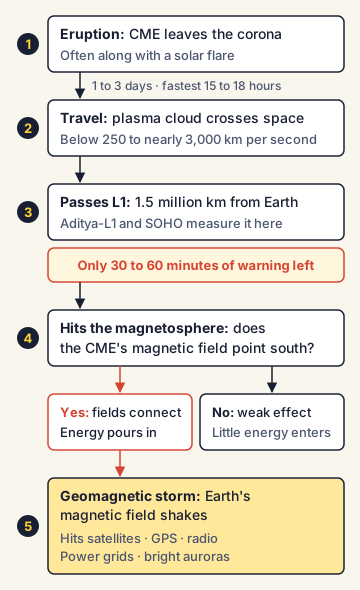
- Eruption: A CME bursts out from the corona, often (but not always) along with a solar flare.
- Travel: It moves outward through space. The fastest Earth-directed CMEs can reach Earth in about 15 to 18 hours; slower ones can take several days. One to three days is typical.
- Hitting the magnetic shield: Earth has a magnetic "shield" around it called the magnetosphere. If the CME's magnetic field points opposite to Earth's field (southward), the two connect, and energy pours into the magnetosphere.
- Geomagnetic storm: The Earth's magnetic field shakes. This creates electric currents in long power lines, pipelines and undersea cables. It also heats and swells the upper atmosphere.
What harm can a CME cause?
- Satellites: Charged particles can damage electronics. The swollen upper atmosphere increases drag (air friction) on low-orbit satellites and pulls them down.
- GPS and navigation: The ionosphere (the charged upper layer of the atmosphere) is disturbed, so GPS signals become less accurate.
- Radio: High-frequency radio used by ships and aircraft can black out.
- Power grids: Extra currents can overheat transformers and cause blackouts, as in Quebec in 1989.
- Astronauts: Radiation can be dangerous for astronauts in space.
How are geomagnetic storms measured?
The US agency NOAA uses a G-scale from G1 (minor) to G5 (extreme). It is linked to the Kp index, a number from 0 to 9 that shows how much Earth's magnetic field is disturbed. Kp 5 is G1, Kp 6 is G2, Kp 7 is G3, Kp 8 is G4 and Kp 9 is G5.
Why is it hard to predict CMEs hitting Earth?
Most CMEs are watched with coronagraphs from near the Earth. A coronagraph sees a flat, 2D picture, like a shadow on a wall. A CME coming straight at Earth looks like an expanding ring around the Sun, called a halo CME. From this flat view, it is hard to know its true speed and whether it is truly coming towards Earth or going away from it on the far side.
Measuring the gas's speed along our line of sight (towards or away from us) fills this gap. That is what Doppler measurements do.
The solar cycle
The Sun's activity rises and falls in a cycle of about 11 years. At its peak (solar maximum), there are more sunspots, flares and CMEs. The current cycle, Solar Cycle 25, began in December 2019. NASA and NOAA announced in October 2024 that the Sun had reached its solar maximum period.
India's position
India has a large fleet of satellites for communication, weather, earth observation and navigation (NavIC), so it has a big stake in space weather. Aditya-L1's VELC can watch CMEs start in the inner corona, and its in-situ instruments at L1 can measure a CME's particles and magnetic field before it reaches Earth. This gives some advance warning. ISRO tracked the May 2024 storm using its own spacecraft, including Aditya-L1 at L1 and Chandrayaan-2 orbiting the Moon.
Commonly confused concepts
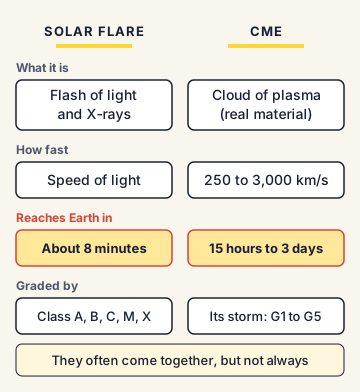
- Solar flare vs CME: A flare is a sudden flash of light and radiation (including X-rays). It travels at the speed of light and reaches Earth in about 8 minutes. A CME is a cloud of actual material (plasma). It travels much slower and takes hours to days. They often happen together, but not always.
- Solar wind vs CME: The solar wind flows out from the Sun all the time, gently. A CME is a sudden, much larger burst.
- Flare classes: Flares are graded by X-ray strength as A, B, C, M and X. Each class is 10 times stronger than the one before it. This is different from the G-scale, which grades geomagnetic storms on Earth.
- Geomagnetic storm vs solar storm: A "solar storm" is a general word for activity on the Sun. A geomagnetic storm is the disturbance of Earth's magnetic field caused by it.
Issues, criticism and the way forward
- Short warning time: Spacecraft at L1 can confirm a CME's magnetic direction only about 30 to 60 minutes before it hits Earth, because L1 is so close to Earth compared with the Sun.
- Uncertain forecasts: Predicting arrival time is still uncertain by several hours, and predicting the CME's magnetic direction days ahead is very hard.
- Vulnerable technology: As the world uses more satellites and longer power lines, the possible damage from a Carrington-size storm keeps growing.
- Way forward: Experts suggest watching CMEs from more angles (such as a future L5 mission), using Doppler and other spectroscopic data, building national space-weather centres, and making power grids and satellites tougher against storms.
Concepts to Know
- Plasma: The fourth state of matter (after solid, liquid and gas). It is gas so hot that its atoms have lost electrons, so it carries electric charge.
- Sunspot: A darker, cooler patch on the Sun's surface where strong magnetic fields block the flow of heat.
- Magnetic reconnection: When twisted magnetic field lines break and join again in a new shape, suddenly releasing stored energy.
- Magnetosphere: The region around Earth controlled by Earth's magnetic field. It acts as a shield against the solar wind.
- Aurora: Coloured lights in the sky near the poles, created when charged particles from the Sun hit gases in the upper atmosphere. Called the Northern Lights and Southern Lights.
- Ionosphere: A layer of the upper atmosphere, about 60 to 1,000 km high, filled with charged particles. It reflects some radio waves and affects GPS signals.
- CME speed: below 250 km/s to nearly 3,000 km/s; mass: around a billion tonnes
- Travel time to Earth: as little as 15-18 hours for the fastest; typically 1 to 3 days
- NOAA G-scale: G1 (Kp 5) to G5 (Kp 9)
- Flare classes: A, B, C, M, X; each 10 times stronger than the previous
- Carrington Event: 1-2 September 1859, strongest geomagnetic storm on record
- Quebec blackout: March 1989, about nine hours
- Gannon storm: 10-11 May 2024, G5, strongest since 2003
- Solar cycle: about 11 years; Solar Cycle 25 began December 2019; maximum period announced October 2024
- Flare light reaches Earth in about 8 minutes
● Tracked since October 20, 2026 · last seen October 20, 2026 · updates as the daily brief publishes