Disaster Response and Mitigation Funds
NDRF, SDRF, NDMF and SDMF
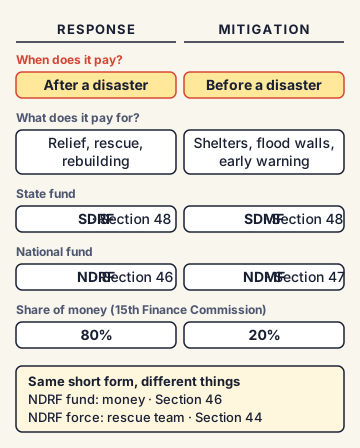
India pays for disaster work through four special funds created under the Disaster Management Act, 2005. Two are for response (helping people after a disaster): the State Disaster Response Fund (SDRF) and the National Disaster Response Fund (NDRF). Two are for mitigation (reducing damage before a disaster): the State Disaster Mitigation Fund (SDMF) and the National Disaster Mitigation Fund (NDMF). How much money goes into these funds is decided every five years on the advice of the Finance Commission.
Why are these funds needed?
Disasters are sudden, but money in a government budget is planned a year in advance. If a flood hits in July, a state cannot wait for a new budget to buy food, tents and medicines. So money is kept ready in a dedicated fund, like a family's emergency savings. Mitigation funds are newer: they make sure some money is set aside to prevent future damage, not just to clean up after it.
Where did they come from?
- 1990s, Calamity Relief Fund (CRF): States had a Calamity Relief Fund, built with money from the Centre and the state, on Finance Commission advice.
- 2000s, National Calamity Contingency Fund (NCCF): A central fund to help states in very severe disasters.
- 2005, Disaster Management Act: The Act provided for national and state response and mitigation funds.
- 2010, renaming: Following the 13th Finance Commission, the CRF became the SDRF and the NCCF became the NDRF, from 1 April 2010.
- 2021, mitigation funds made real: The 15th Finance Commission (2021–26) recommended separate mitigation funds at both levels and a fixed split between response and mitigation.
The legal sections
- Section 46: National Disaster Response Fund (NDRF)
- Section 47: National Disaster Mitigation Fund (NDMF)
- Section 48: State Disaster Response Fund and State Disaster Mitigation Fund (and district funds)
How does the money flow? Step by step
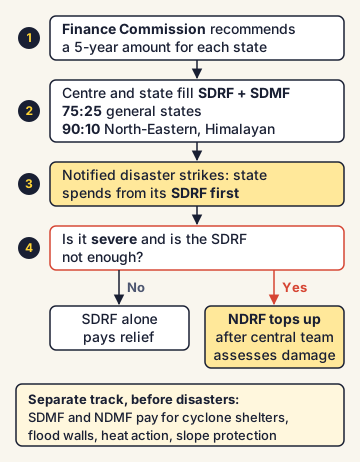
- The Finance Commission estimates each state's disaster risk and past spending, and recommends a five-year amount for each state's fund.
- The Centre and the state share the SDRF and SDMF: 75:25 for general states, and 90:10 for North-Eastern and Himalayan states.
- When a notified disaster strikes, the state first uses its SDRF, following Ministry of Home Affairs (MHA) rules on what relief can be paid (for example, fixed amounts for a damaged house or lost crop).
- If the disaster is of a severe nature and the SDRF is not enough, the state asks for help from the NDRF. A central team visits, assesses the damage, and a high-level committee approves the extra money.
- Mitigation funds pay for projects that reduce risk, such as cyclone shelters, flood walls, heat action measures and slope protection.
Which disasters are covered?
The MHA has a list of notified disasters eligible for SDRF and NDRF money. The long-standing list had 12: cyclone, drought, earthquake, fire, flood, tsunami, hailstorm, landslide, avalanche, cloudburst, pest attack, and frost and cold wave. States can also use up to 10% of their SDRF for local disasters that are not on the list, after notifying them. For 2026–31, the Sixteenth Finance Commission recommended adding heatwave and lightning, two hazards that kill many people every year.
The numbers: 15th vs 16th Finance Commission
- 15th Finance Commission (2021–26): States got about ₹1,60,153 crore (SDRF ₹1,28,122 crore + SDMF ₹32,031 crore). The national funds got ₹68,463 crore (NDRF ₹54,770 crore + NDMF ₹13,693 crore). The split was 80% response : 20% mitigation. Within the 80% response share: 40% for response and relief, 30% for recovery and reconstruction, and 10% for preparedness and capacity building.
- 16th Finance Commission (2026–31): States get about ₹2,04,401 crore (SDRF about ₹1,63,521 crore + SDMF about ₹40,880 crore). The national funds get about ₹79,406 crore. The total is about ₹2.84 lakh crore. Money is shared among states using a formula that gives 30% weight to a Disaster Risk Index (hazard, exposure and vulnerability) and 70% weight to past disaster spending.
Commonly confused concepts
- NDRF (the fund) vs NDRF (the force): The National Disaster Response Fund is money. The National Disaster Response Force is a specialised rescue force, also set up under the DM Act, 2005 (Section 44). Same short form, different things.
- Response vs mitigation funds: Response funds pay after a disaster (relief, rescue, rebuilding). Mitigation funds pay before a disaster to reduce damage (shelters, embankments, early warning).
- SDRF vs NDRF: The SDRF is the state's first line of money. The NDRF only tops up for severe disasters.
- Finance Commission vs NDMA: The Finance Commission (Article 280) decides how much money goes into the funds. The NDMA, chaired by the Prime Minister, sets policies and guidelines for disaster management.
Issues, criticism and the way forward
- Relief gets far more than prevention: Even with the 80:20 rule, about ₹4 goes to response for every ₹1 for mitigation. Experts point out that every rupee spent on prevention can save several rupees in losses.
- Low use of mitigation money: Reports show that only a small share of the 15th Finance Commission's national mitigation allocation was actually spent.
- Formula concerns: Some researchers argue that the 16th Finance Commission formula, which uses population in its risk index and gives heavy weight to past spending, favours large states. They say North-Eastern and Himalayan states, which suffer many deaths, get a small share.
- Delays: States often complain of slow release of central funds; the Centre points to unspent balances with states.
- Way forward: A larger mitigation share, quick and predictable fund release, better local risk data, risk insurance for poor households, and funding for community-led and nature-based protection like mangroves and wetlands.
Concepts to Know
- Finance Commission: A body set up every five years by the President under Article 280 of the Constitution. It recommends how tax money is shared between the Centre and the states, and also advises on disaster funding.
- Notified disaster: A disaster officially listed by the government as eligible for money from SDRF and NDRF.
- Mitigation: Steps that reduce the harm a disaster can cause, taken before it happens.
- Himalayan and North-Eastern states: Hill and border states that get a higher central share (90%) because of difficult terrain and limited resources.
- Disaster Risk Index: A score for each state based on how often hazards occur, how many people are exposed and how vulnerable they are.
- DM Act, 2005: Section 46 (NDRF), Section 47 (NDMF), Section 48 (SDRF and SDMF)
- CRF and NCCF became SDRF and NDRF from 1 April 2010 (13th Finance Commission)
- Cost sharing: 75:25 (general states), 90:10 (North-Eastern and Himalayan states)
- 15th FC (2021–26): states ₹1,60,153 crore; national ₹68,463 crore; 80:20 response to mitigation
- 16th FC (2026–31): states ₹2,04,401 crore; national ₹79,406 crore; total about ₹2.84 lakh crore
- 12 long-standing notified disasters; heatwave and lightning recommended for addition by the 16th FC
- Up to 10% of SDRF can be used for state-specific local disasters
● Tracked since October 14, 2026 · last seen October 14, 2026 · updates as the daily brief publishes