Disaster Management Act, 2005
The Disaster Management Act, 2005 is the main law that sets up India's system for dealing with disasters such as floods, earthquakes, cyclones and GLOFs. It creates a chain of authorities at the national, state and district levels, each with clear jobs. It also provides for a special rescue force, a training institute and dedicated funds. The Act shifts India's focus from only giving relief after a disaster to also preparing for and reducing risk before a disaster strikes.
Why was it needed?
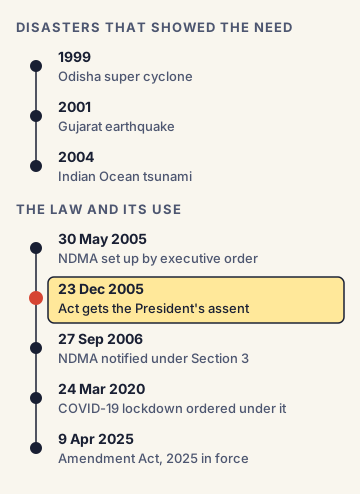
Before 2005, India mostly reacted to disasters after they happened. Relief was handled by the Ministry of Agriculture and state relief commissioners, without one clear plan. The 1999 Odisha super cyclone, the 2001 Gujarat earthquake and the 2004 Indian Ocean tsunami showed that India needed a proper system for planning, prevention and fast response.
Where did it come from?
The National Disaster Management Authority (NDMA) was first set up by an executive order on 30 May 2005, with the Prime Minister as chairperson. Parliament then passed the Disaster Management Act, which got the President's assent on 23 December 2005. The NDMA was re-notified under Section 3 of the Act on 27 September 2006. The Act has 11 chapters and 79 sections. It was amended in 2025 (details below).
How does it work? The three-level structure
- National level:
- NDMA (Section 3): Chaired by the Prime Minister, with up to nine other members, one of whom can be Vice-Chairperson. It lays down policies, plans and guidelines for disaster management.
- National Executive Committee (NEC) (Section 8): Chaired by the Union Home Secretary, with secretaries of key ministries. It helps the NDMA and coordinates the response.
- State level:
- State Disaster Management Authority (SDMA) (Section 14): Chaired by the Chief Minister. It prepares the state plan and follows national guidelines.
- District level:
- District Disaster Management Authority (DDMA) (Section 25): Chaired by the District Collector, District Magistrate or Deputy Commissioner. The local elected representative is the ex officio co-chairperson. The district is where most real response work happens.
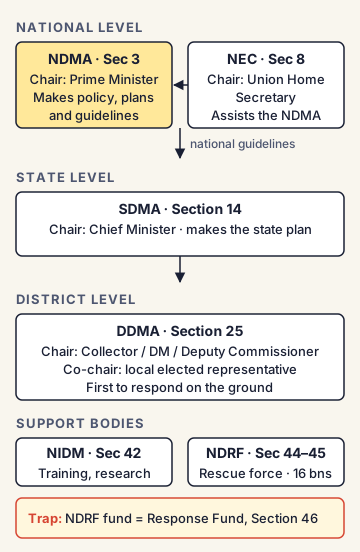
You can picture it like a school: the NDMA is the principal who sets the rules for the whole school, the SDMA is the class teacher who adapts them for the class, and the DDMA is the monitor who acts on the ground.
Other key bodies and funds
- National Institute of Disaster Management (NIDM) (Section 42): Does training, research and capacity building.
- National Disaster Response Force (NDRF) (Sections 44–45): A specialist force for rescue and response, under a Director General appointed by the Centre. It was raised in 2006 with 8 battalions and now has 16 battalions.
- National Disaster Response Fund (Section 46) and National Disaster Mitigation Fund (Section 47), with similar funds at the state and district levels (Section 48). Response funds pay for emergency relief; mitigation funds pay for work that reduces future risk.
Penalties and special powers
- Section 51: Obstructing an officer or refusing to follow directions under the Act can bring jail of up to one year, or a fine, or both. If it leads to loss of lives or immediate danger, jail can go up to two years.
- Section 54: Spreading a false alarm or warning about a disaster that causes panic can bring jail of up to one year, or a fine.
- Section 72: The Act has overriding effect: where another law conflicts with it, this Act prevails.
The Act's wide powers were used for the first time on a national scale during COVID-19. On 24 March 2020, the nationwide lockdown was ordered through directions issued under this Act.
The 2025 amendment
The Disaster Management (Amendment) Act, 2025 got the President's assent on 29 March 2025 and came into force on 9 April 2025. Its main changes:
- The NDMA and SDMAs now prepare the national and state disaster plans themselves (earlier the executive committees did this).
- It requires a National Disaster Database and State Disaster Databases, covering risk assessments, funds and losses.
- It allows states to create Urban Disaster Management Authorities (UDMAs) for state capitals and cities with municipal corporations (Section 41A), except Delhi and Chandigarh.
- It gives statutory status (backing in law) to the National Crisis Management Committee (NCMC), chaired by the Cabinet Secretary, and the High-Level Committee (HLC), which approves central aid to states.
- It adds attention to risks from extreme climate events.
India's position and the global picture
India follows the Sendai Framework for Disaster Risk Reduction 2015–2030, a UN agreement with seven targets and four priorities (understanding risk, strengthening risk governance, investing in risk reduction, and better preparedness with "Build Back Better"). India also released a National Disaster Management Plan (first in 2016) aligned with Sendai, and leads the Coalition for Disaster Resilient Infrastructure (CDRI), launched in 2019.
Commonly confused concepts
- NDMA vs NEC: The NDMA (chaired by the PM) makes policy. The NEC (chaired by the Union Home Secretary) helps carry it out.
- NDMA vs NCMC: The NCMC, chaired by the Cabinet Secretary, handles major crises at the highest level of government. Since 2025, it has a legal basis in the Act.
- NDRF (force) vs NDRF (fund): The same short form is used for the National Disaster Response Force (rescue personnel) and the National Disaster Response Fund (money). Read the question carefully.
- Response fund vs mitigation fund: Response funds are for relief after a disaster. Mitigation funds are for reducing risk before one, like strengthening embankments or lowering a dangerous glacial lake.
- "Disaster" is not in the Constitution's lists: Disaster management is not listed by name in the Seventh Schedule. Parliament made the Act mainly using its power over "social security and social insurance" (Entry 23 of the Concurrent List). The Second Administrative Reforms Commission (3rd Report) recommended adding a separate entry on disaster management to the Concurrent List.
Issues, criticism and the way forward
- Too much power at the top: Critics say the Act, and the 2025 amendment, give strong powers to the Centre and to bureaucrats. They argue local bodies and communities need a bigger say.
- Weak district capacity: Many DDMAs lack full-time staff, money and training, though they are the first responders.
- Rights of affected people: Some legal experts say the Act focuses on administration and does not clearly give affected people rights to relief, rehabilitation and compensation.
- Mitigation funds under-used: Money set aside for reducing risk is often spent slowly, while relief spending stays high.
- Way forward: Experts recommend stronger and better-funded district and urban authorities, faster use of mitigation funds, clear minimum standards of relief, risk-based planning for hazards like GLOFs, and full community participation.
Concepts to Know
- Mitigation: Steps taken before a disaster to reduce its damage, such as building stronger houses or draining a risky lake.
- Executive order: A decision made by the government without a law passed by Parliament.
- Statutory body: A body set up by a law passed by Parliament or a state legislature, so it has legal backing.
- Ex officio: Holding a post automatically because of another position you hold. For example, the local MP or MLA becomes DDMA co-chairperson by virtue of being the elected representative.
- Battalion: A large unit of a force. Each NDRF battalion has about 1,149 personnel.
- Assent: 23 December 2005; 11 chapters, 79 sections
- NDMA: set up by executive order on 30 May 2005; notified under Section 3 on 27 September 2006; PM chairs, up to 9 other members
- NEC (Section 8): Union Home Secretary; SDMA (Section 14): Chief Minister; DDMA (Section 25): Collector/DM
- NIDM: Section 42; NDRF (force): Sections 44–45, raised in 2006, now 16 battalions
- Funds: National Disaster Response Fund (Section 46), National Disaster Mitigation Fund (Section 47)
- Penalties: Section 51 (up to 1 year; up to 2 years if lives lost), Section 54 (false warning, up to 1 year)
- Section 72: overriding effect over other laws
- Amendment Act 2025: assent 29 March 2025, in force 9 April 2025; disaster databases, UDMAs (Section 41A), statutory NCMC and HLC
- Sendai Framework 2015–2030: 7 targets, 4 priorities
● Tracked since February 09, 2026 · last seen October 14, 2026 · updates as the daily brief publishes