Directive Principles of State Policy (DPSP)
The Directive Principles of State Policy (DPSPs) are a set of goals and guidelines in the Constitution that tell the government what kind of society it should work to build. They are found in Part IV of the Constitution, from Article 36 to Article 51. They ask the State to secure things like work, education, fair wages, health, equal justice and a clean environment for the people.
But they are not enforceable in court: you cannot file a case to force the government to follow them. Still, the Constitution calls them "fundamental in the governance of the country".
Why do they exist?
When India became independent, it was very poor. Most people had no secure job, little education and poor health care. The makers of the Constitution wanted the new State to fight this poverty. But they also knew the government did not have enough money to promise everything at once. So they made two kinds of rights:
- Fundamental Rights (Part III): rights the State must respect right now, and courts can enforce.
- Directive Principles (Part IV): goals the State must work towards step by step, as its money and capacity grow.
Think of it like a family's long-term plan. The parents promise their children food and safety today (like Fundamental Rights). They also set goals like a good college education and a house of their own, which they will reach as the family's income grows (like Directive Principles).
Where did they come from?
The idea came from three main sources:
- The Irish Constitution of 1937, which had "Directive Principles of Social Policy". The Irish themselves took the idea from the Spanish Constitution.
- The "Instrument of Instructions" under the Government of India Act, 1935, which were directions given to the Governor-General and Governors. Dr B.R. Ambedkar described the DPSPs as a similar instrument of instructions, but this time to the legislature and the government of free India.
- The Sapru Committee (1945), which suggested dividing rights into two groups: justiciable (enforceable in court) and non-justiciable (not enforceable). The Constituent Assembly followed this approach.
What do Articles 36 and 37 say?
- Article 36: The word "State" in Part IV has the same meaning as in Article 12 (Part III). It includes the Union government, Parliament, state governments, state legislatures, and local and other authorities.
- Article 37: The DPSPs shall not be enforceable by any court. But they are fundamental in the governance of the country, and it is the duty of the State to apply them in making laws.
The key Directive Principles
Textbooks often group them as socialist (welfare and equality), Gandhian (based on Gandhi's ideas) and liberal-intellectual (modern, rational ideas). This grouping is not in the Constitution itself; it is only a way to study them.
Socialist principles (welfare and economic justice):
- Article 38: The State shall promote the welfare of the people by securing a social order based on social, economic and political justice. Clause (2), added by the 44th Amendment (1978), asks the State to reduce inequalities in income, status and opportunities.
- Article 39: Six goals, including an adequate livelihood for all citizens (39(a)); that ownership and control of the material resources of the community are distributed to serve the common good (39(b)); that wealth does not get concentrated in a few hands (39(c)); equal pay for equal work for men and women (39(d)); protection of workers and children from abuse (39(e)); and healthy development of children (39(f), substituted by the 42nd Amendment).
- Article 39A: Equal justice and free legal aid to the poor (added by the 42nd Amendment, 1976).
- Article 41: The State shall, within the limits of its economic capacity and development, make effective provision for securing the right to work, to education and to public assistance in cases of unemployment, old age, sickness and disablement.
- Article 42: Just and humane conditions of work and maternity relief.
- Article 43: A living wage and a decent standard of life for all workers.
- Article 43A: Workers' participation in the management of industries (42nd Amendment).
- Article 47: Raise the level of nutrition and the standard of living, and improve public health.
Gandhian principles:
- Article 40: Organise village panchayats and give them powers to work as units of self-government.
- Article 43: Promote cottage industries in rural areas.
- Article 43B: Promote cooperative societies (added by the 97th Amendment, 2011).
- Article 46: Promote the educational and economic interests of Scheduled Castes, Scheduled Tribes and other weaker sections.
- Article 47: Prohibit intoxicating drinks and drugs that harm health (except for medical use).
- Article 48: Organise agriculture and animal husbandry on modern lines, and prohibit the slaughter of cows, calves and other milch and draught cattle.
Liberal-intellectual principles:
- Article 44: A Uniform Civil Code for all citizens.
- Article 45: Early childhood care and education for all children below six years (substituted by the 86th Amendment, 2002, which also made education for 6 to 14 year olds a Fundamental Right under Article 21A).
- Article 48A: Protect and improve the environment, forests and wildlife (42nd Amendment).
- Article 49: Protect monuments and places of national importance.
- Article 50: Separate the judiciary from the executive in public services.
- Article 51: Promote international peace and security.
Directives outside Part IV
A few directions to the State sit in other parts of the Constitution. Examples: Article 335 (claims of SCs and STs to government jobs), Article 350A (teaching in the mother tongue at the primary stage) and Article 351 (development of Hindi). They are also not enforceable in court.
How have DPSPs been put into action?
Since they cannot be enforced in court, they work through laws and schemes made by Parliament and state legislatures. Some examples:
- Article 41 (right to work): MGNREGA, 2005, and now the VB-G RAM G Act, 2025, turned the right to work into a legal right for rural households, through a law.
- Article 40 (panchayats): The 73rd Amendment (1992) gave constitutional status to Panchayati Raj.
- Article 39A (legal aid): The Legal Services Authorities Act, 1987 set up free legal aid bodies like NALSA.
- Article 39(d) (equal pay): The Equal Remuneration Act, 1976 (now part of the Code on Wages, 2019).
- Article 43 (living wage): The Minimum Wages Act, 1948 (now also part of the Code on Wages).
- Article 42 (maternity relief): The Maternity Benefit Act, 1961.
- Article 48A (environment): The Wildlife (Protection) Act, 1972 and the Environment (Protection) Act, 1986.
- Article 50: The Code of Criminal Procedure, 1973 separated judicial magistrates from the executive.
How have the courts seen the DPSPs?
The relationship between Fundamental Rights and DPSPs has changed a lot over time. This is a favourite UPSC topic.
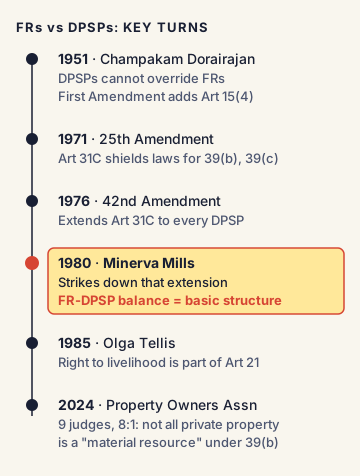
- Fundamental Rights come first (1951): In State of Madras v. Champakam Dorairajan (1951), the Supreme Court struck down a caste-based seat order in colleges. It said DPSPs cannot override Fundamental Rights. Parliament then passed the First Amendment (1951), which added Article 15(4) to allow special provisions for backward classes, SCs and STs.
- Protecting laws for 39(b) and 39(c): The 25th Amendment (1971) added Article 31C. It said a law made to carry out Article 39(b) or 39(c) could not be struck down for violating Articles 14 or 19.
- 42nd Amendment (1976): It extended Article 31C to laws made for any Directive Principle. This would have placed all DPSPs above key Fundamental Rights.
- The balance doctrine (1980): In Minerva Mills v. Union of India (1980), the Supreme Court struck down this extension. It held that the Constitution rests on a balance between Part III and Part IV, and giving total priority to one over the other would destroy its harmony. This harmony and balance is part of the basic structure of the Constitution. Article 31C was kept in its original form, covering only 39(b) and 39(c).
- Reading DPSPs into Fundamental Rights: Courts now use DPSPs to give fuller meaning to Fundamental Rights. In Olga Tellis v. Bombay Municipal Corporation (1985), the Court held that the right to life under Article 21 includes the right to livelihood. In Unni Krishnan v. State of Andhra Pradesh (1993), it held that education up to age 14 is part of the right to life.
- Limits on the right to work: In Delhi Development Horticulture Employees' Union v. Delhi Administration (1992), the Court explained that the right to work has been placed among the DPSPs because the country does not yet have the capacity to guarantee it as a Fundamental Right.
- Article 39(b) re-read (2024): In Property Owners Association v. State of Maharashtra (5 November 2024), a nine-judge bench held by an 8:1 majority that not every piece of private property is a "material resource of the community" under Article 39(b). It also held unanimously that Article 31C, in its original form, continues to exist.
Commonly confused concepts
- Fundamental Rights vs Directive Principles:
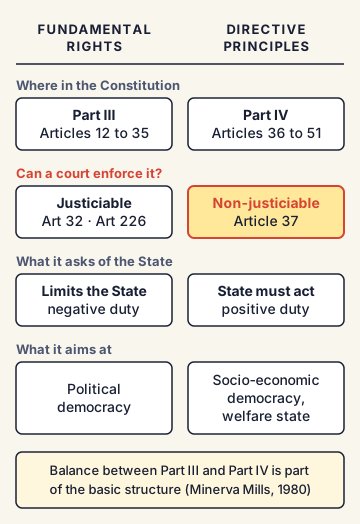
- FRs are in Part III (Articles 12 to 35); DPSPs are in Part IV (Articles 36 to 51).
- FRs are justiciable (a citizen can go to the Supreme Court under Article 32 or a High Court under Article 226); DPSPs are non-justiciable (Article 37).
- FRs mostly limit what the State can do (negative duties, like "do not discriminate"); DPSPs ask the State to do things (positive duties, like "provide work and education").
- FRs aim at political democracy; DPSPs aim at social and economic democracy and a welfare state.
- DPSPs vs Fundamental Duties: DPSPs are duties of the State (Part IV). Fundamental Duties are duties of citizens, listed in Part IVA, Article 51A, added by the 42nd Amendment (1976). Note: Article 51 (international peace) is a DPSP, while Article 51A is a Fundamental Duty.
- Article 41 vs Article 21A vs Article 45: Article 41 speaks of the right to work and education within economic capacity (DPSP). Article 21A makes free education for children of 6 to 14 years a Fundamental Right. Article 45 now covers children below six years (DPSP).
- Right to work as a DPSP vs a legal right under a law: Article 41 is not enforceable in court. But once Parliament passes a law like the VB-G RAM G Act, the right to work given by that law can be claimed, for example through the unemployment allowance.
Issues, criticism and the way forward
- "A cheque payable at the convenience of the bank": In the Constituent Assembly, member K.T. Shah criticised the DPSPs as being like a cheque that the bank pays only when it wishes. Critics still say that without court enforcement, governments can ignore them.
- No legal force: Some argue the DPSPs are only "pious wishes". Supporters reply that they guide lawmaking, help courts interpret laws, and let voters judge governments by them. Dr Ambedkar argued that a government that ignores them will have to answer to the people at election time.
- Conflict with Fundamental Rights: Early decades saw repeated clashes, especially over property and land reform, which led to many amendments and court cases. Minerva Mills settled the idea of balance, but debates continue (for example over Article 39(b) and private property).
- Uneven implementation: Some directives like panchayats, legal aid and job guarantees have strong laws. Others, like a Uniform Civil Code (Article 44) and full prohibition (Article 47), remain contested or only partly done.
- Money limits: Many DPSPs depend on the State's finances. Article 41 itself says "within the limits of its economic capacity". Welfare spending must be balanced against fiscal limits.
- Way forward: Experts suggest steadily turning key DPSPs into legal rights through laws (as done for work, food and education), proper funding, and regular review of how far each directive has been achieved.
Concepts to Know
- Justiciable: Something you can go to court to enforce. Fundamental Rights are justiciable; DPSPs are not.
- Welfare state: A State that takes active responsibility for the well-being of its people, through jobs, health, education and social security.
- Basic structure: The core features of the Constitution that Parliament cannot destroy even by amendment. The Supreme Court laid down this idea in Kesavananda Bharati v. State of Kerala (1973).
- Constituent Assembly: The body of elected representatives that wrote India's Constitution between 1946 and 1949.
- Material resources of the community: Resources like land, minerals, forests and other wealth that Article 39(b) wants used for the common good.
- Living wage: A wage that covers not only basic food and shelter but also education, health and a decent life. It is higher than a minimum wage.
- Part IV, Articles 36 to 51; Article 37: not enforceable by any court but fundamental in governance
- Sources: Irish Constitution (1937), Instrument of Instructions (Government of India Act, 1935), Sapru Committee (1945)
- Article 41: right to work, education and public assistance, within the limits of economic capacity and development
- 42nd Amendment (1976) added Articles 39A, 43A and 48A and substituted 39(f); 44th Amendment (1978) added Article 38(2); 86th Amendment (2002) substituted Article 45; 97th Amendment (2011) added Article 43B
- Champakam Dorairajan (1951): DPSPs cannot override FRs; led to First Amendment and Article 15(4)
- 25th Amendment (1971) inserted Article 31C for laws under 39(b) and 39(c)
- Minerva Mills (1980): balance between Part III and Part IV is part of the basic structure
- Olga Tellis (1985): right to livelihood is part of Article 21
- Property Owners Association (5 November 2024): nine judges, 8:1, not all private property is a "material resource of the community"
● Tracked since October 09, 2026 · last seen October 09, 2026 · updates as the daily brief publishes