Dharti Aaba Janjatiya Gram Utkarsh Abhiyan (DAJGUA)
The Dharti Aaba Janjatiya Gram Utkarsh Abhiyan, or DAJGUA, is the Centre's biggest scheme to improve life in tribal villages. It aims to fill the gaps in basic services, such as houses, roads, electricity, tap water, health care, schools and jobs, in about 63,000 tribal villages. It does this not by creating new money pools but by making 17 ministries work together in the same villages.
It is named after Birsa Munda, whose title was "Dharti Aaba". It was first announced as PM-JUGA (Pradhan Mantri Janjatiya Unnat Gram Abhiyan).
Why was it needed?
Scheduled Tribes are about 8.6% of India's population (Census 2011), but they lag behind on almost every measure: income, schooling, health and access to services. Many tribal villages are remote, in forests and hills. Schemes for roads, houses or water exist, but they often do not reach these villages, because each ministry works alone and tribal villages are hard to reach.
DAJGUA tries to fix this by bringing all schemes to the same village at the same time. Think of it like a family planning a house. Instead of the plumber, electrician and mason each coming on different days without a plan, one supervisor brings them together so the house is finished properly.
Where did it come from?
- It was announced in the Union Budget 2024-25 as PM-JUGA.
- The Union Cabinet approved it on 18 September 2024.
- It was launched on 2 October 2024 (Gandhi Jayanti) from Hazaribagh, Jharkhand, and renamed Dharti Aaba Janjatiya Gram Utkarsh Abhiyan.
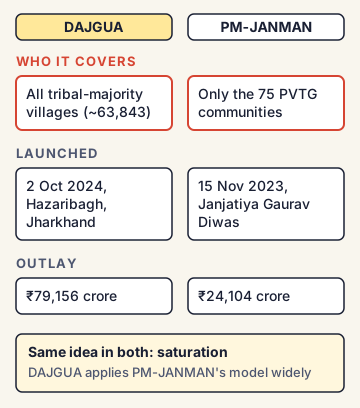
- It builds on the experience of PM-JANMAN (2023), which targets Particularly Vulnerable Tribal Groups (PVTGs) with an outlay of ₹24,104 crore. DAJGUA applies the same "saturation" idea to all tribal villages. It also revamps the older Pradhan Mantri Adi Adarsh Gram Yojana (PMAAGY).
Which villages does it cover?
Villages with a population of 500 or more where at least 50% of people are tribal, and villages in Aspirational Districts with a tribal population of 50 or more. In all, it covers about 63,843 villages in 549 districts across 30 States and Union Territories, benefiting more than 5 crore tribal people.
How does it work?
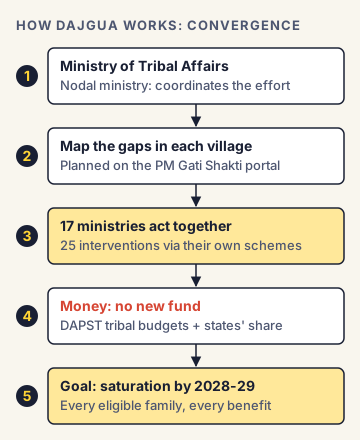
- The Ministry of Tribal Affairs is the nodal ministry. It coordinates the whole effort.
- Gaps in each village (no road, no electricity, no anganwadi, and so on) are mapped. The PM Gati Shakti portal, a digital map of infrastructure, is used for planning and monitoring.
- 17 line ministries then deliver 25 interventions in these villages, using their own schemes.
- Money comes from each ministry's tribal budget, called the Development Action Plan for Scheduled Tribes (DAPST), plus the states' share.
- The aim is saturation: every eligible family in the village gets every eligible benefit, within five years (2024-25 to 2028-29).
What does it provide?
The 25 interventions fall under a few goals:
- Basic infrastructure: pucca houses (PMAY-Gramin), all-weather roads (PMGSY), electricity to homes, solar power where the grid cannot reach, tap water (Jal Jeevan Mission), and LPG connections (PM Ujjwala Yojana).
- Health: Mobile Medical Units for remote villages, Ayushman cards, and better diagnosis and care for sickle cell disease, a blood disorder common in many tribal groups.
- Education: better schools, hostels for tribal students, and more anganwadis.
- Livelihood: about 100 Tribal Multipurpose Marketing Centres (TMMCs) to help tribals sell forest produce and crafts at fair prices; tribal homestays under the Swadesh Darshan scheme to earn from tourism; support for agriculture, fisheries and animal husbandry.
- Forest rights: special help for about 22 lakh holders of land titles (pattas) under the Forest Rights Act, 2006, so they can use other schemes on their forest land.
Outlay
The total outlay is ₹79,156 crore: ₹56,333 crore from the Centre and ₹22,823 crore from the states.
Commonly confused concepts
- DAJGUA vs PM-JANMAN: PM-JANMAN (launched 15 November 2023, on Janjatiya Gaurav Diwas) is only for the 75 PVTG communities, the most vulnerable tribal groups. DAJGUA covers all tribal-majority villages, a much larger group.
- DAJGUA vs Eklavya Model Residential Schools (EMRS): EMRS is a single scheme for quality residential schools for tribal children. DAJGUA is a convergence umbrella across many sectors.
- DAPST vs Tribal Sub-Plan (TSP): Both mean money set aside for tribals in budgets. The Tribal Sub-Plan was the older name (from the 1970s). At the central level, it is now called the Development Action Plan for STs (DAPST), under which ministries must earmark a share of their budgets for tribals.
Issues, criticism and the way forward
- Coordination is hard: Getting 17 ministries and many state departments to work on the same village plan is difficult. Delays in one department hold up others.
- Reaching remote villages: Many target villages are in forests, hills or former conflict areas, where building roads and staffing clinics is slow and costly.
- Spending vs outcomes: Past tribal budgets were often under-spent or diverted. Critics say the real test is whether houses, water and clinics actually work, not just whether money is spent.
- Voice of tribals: Experts say gram sabhas and tribal communities must help plan the work, as the PESA Act and Forest Rights Act require, so that projects suit local needs.
- Way forward: Use real-time monitoring on the Gati Shakti portal, social audits by gram sabhas, and focus on staff (teachers, doctors, health workers), not only buildings.
Concepts to Know
- Convergence: Bringing many existing schemes together in one place for the same people, instead of starting a new scheme.
- Saturation: Making sure that every eligible person in an area gets the benefit, leaving no one out.
- Particularly Vulnerable Tribal Groups (PVTGs): The 75 most vulnerable tribal communities, marked by very low literacy, a declining or stagnant population, and pre-agricultural ways of life.
- Aspirational Districts: Over 100 of India's least developed districts, picked by NITI Aayog in 2018 for focused improvement on health, education, farming and basic infrastructure.
- Patta: A legal document that shows a person's right over a piece of land. Under the Forest Rights Act, forest dwellers get pattas for the forest land they have been living on and farming.
- Approved by the Union Cabinet: 18 September 2024; launched 2 October 2024 at Hazaribagh, Jharkhand
- First announced in Budget 2024-25 as PM-JUGA
- Outlay: ₹79,156 crore (Centre ₹56,333 crore; states ₹22,823 crore)
- Coverage: about 63,843 villages, 549 districts, 30 States/UTs, more than 5 crore tribal people
- Eligibility: villages with 500+ population and at least 50% tribal; villages in Aspirational Districts with 50+ tribal population
- 25 interventions by 17 ministries; nodal ministry: Ministry of Tribal Affairs
- Duration: 5 years (2024-25 to 2028-29); monitored through the PM Gati Shakti portal
● Tracked since November 15, 2026 · last seen November 17, 2026 · updates as the daily brief publishes