Forest Villages and their Conversion into Revenue Villages
Forest villages are settlements located inside forests that were set up and run by the Forest Department, not by the regular civil administration. Most were created in colonial times to house workers who cut trees, made plantations and did other forest work. Because the land legally belongs to the Forest Department, people in these villages did not own their homes or fields.
Converting a forest village into a revenue village means bringing it under the normal land records and administration, so that its people get ownership rights and full access to government services.
Why does this matter?
Think of living for 100 years in a house, but the land still being recorded in someone else's name. You cannot get a loan on it, cannot officially build a pucca house, and someone can ask you to leave. That is the situation of many forest village families. A revenue village is one recorded in the land records of the Revenue Department.
It has a village map, land ownership records (like a khasra or patta), and is covered by the regular panchayat, schemes and services. Forest villages often missed out on roads, electricity, schools and health centres, because building anything on forest land needed special forest permission.
Where did they come from?
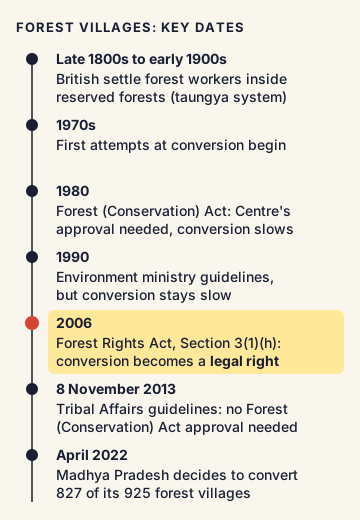
- In the late 19th and early 20th centuries, the British forest administration needed cheap, permanent labour deep inside forests. So it settled workers in small villages inside reserved forests.
- Many such settlements were linked to the taungya system, a plantation method promoted by Dietrich Brandis, the first Inspector General of Forests in India. In taungya, workers were allowed to grow food crops between rows of young trees for a few years, in return for planting and caring for those trees. In Uttar Pradesh, the communities of these settlements are still called Van Taungiyas.
- For decades, many residents were made to work for the department with little or no wages in return for being allowed to stay.
- Attempts to convert forest villages began in the 1970s. But the Forest (Conservation) Act, 1980 required the Centre's approval for any use of forest land for non-forest purposes, which slowed the process. The Union environment ministry issued guidelines in 1990 on settling the issue, but conversion remained slow.
What does the Forest Rights Act say?
The FRA, 2006 made conversion a legal right of the residents.
- Section 3(1)(h) recognises "rights of settlement and conversion of all forest villages, old habitation, unsurveyed villages and other villages in forests, whether recorded, notified or not into revenue villages".
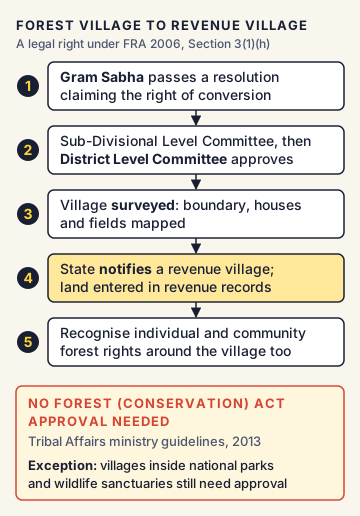
- The Ministry of Tribal Affairs issued guidelines on 8 November 2013. They clarified that conversion under Section 3(1)(h) does not need approval under the Forest (Conservation) Act, 1980.
- The same guidelines said conversion of villages inside national parks and wildlife sanctuaries still needs approval.
How does conversion work, step by step?
- The Gram Sabha of the forest village passes a resolution claiming the right of conversion.
- The claim goes to the Sub-Divisional Level Committee (the committee at the sub-division level that checks claims first) and then the District Level Committee, which approves the right under the FRA.
- The village is surveyed and its boundary, houses and fields are mapped.
- The state government issues a notification declaring it a revenue village, and the land is entered in revenue records.
- Individual and community forest rights in and around the village should also be recognised, so that converting the village does not cut people off from the forests they use.
India's position and Indian examples
- Madhya Pradesh has the largest number: 925 forest villages. In April 2022, the state decided to convert 827 of them into revenue villages. Later official reviews reported around 790 villages notified as revenue villages.
- Chhattisgarh has converted over 400 forest villages; West Bengal, Odisha, Assam and Uttar Pradesh also have forest villages at different stages of conversion.
- In Uttar Pradesh, Van Taungiya villages in Gorakhpur and Maharajganj districts were converted only after long struggles.
Commonly confused concepts
- Forest village vs revenue village: a forest village sits on forest land under the Forest Department; a revenue village is on the land records of the Revenue Department with ownership rights.
- Forest village vs "unsurveyed village" vs "old habitation": unsurveyed villages and old habitations were never mapped or recorded at all, while forest villages were recorded by the Forest Department. The FRA covers all three in Section 3(1)(h).
- Conversion vs relocation: conversion lets people stay and gain rights where they live. Relocation moves them out of the forest (for example, out of the core of a tiger reserve), which needs their free and informed consent under the FRA and the Wildlife (Protection) Act.
- Section 3(1)(h) vs Section 3(2): 3(1)(h) is about the village's legal status. 3(2) lets the Central Government allow forest land to be used for basic government facilities like schools, dispensaries and roads. The land used must be less than one hectare in each case (for each project, not for the whole village), and not more than 75 trees per hectare can be cut.
Issues, criticism and the way forward
- Gram Sabha sidelined: critics say boundaries are often drawn by the Forest Department using satellite images, without proper Gram Sabha involvement, leaving out fields and common lands.
- Rights left out: converting the village alone does not settle community forest rights. Experts say both should be recognised together.
- Slow pace: decades after independence, many forest villages are still not converted, and even notified villages wait for land records to be updated.
- Way forward: follow the FRA process with full Gram Sabha participation, map boundaries on the ground with villagers, recognise individual and community rights together, and fix clear deadlines for updating land records.
Concepts to Know
- Reserved forest: A forest where most activities are banned unless allowed, under the Indian Forest Act, 1927. It has the highest level of protection among forest types under that law.
- Khasra / patta: Land record documents. A khasra is the plot number record; a patta is a document showing a person's right over land.
- District Level Committee (DLC): The committee under the FRA, headed by the District Collector, that gives final approval to forest rights claims.
- Notification: An official announcement published in the government's gazette, which gives a decision legal force.
- Legal basis: Section 3(1)(h), Forest Rights Act, 2006
- Ministry of Tribal Affairs guidelines: 8 November 2013; no Forest (Conservation) Act approval needed, except inside national parks and sanctuaries
- Forest (Conservation) Act, 1980 earlier required the Centre's approval to use forest land for non-forest purposes, which slowed conversion; environment ministry guidelines of 1990
- Madhya Pradesh: 925 forest villages; 827 decided for conversion (April 2022)
- Taungya system linked to Dietrich Brandis; Van Taungiyas of Uttar Pradesh
● Tracked since November 17, 2026 · last seen November 17, 2026 · updates as the daily brief publishes