Birsa Munda and the Munda Ulgulan (1899-1900)
Birsa Munda was a young tribal leader from the Chotanagpur region (today's Jharkhand) who led a major uprising against British rule in 1899-1900. The uprising is called the Ulgulan, which means "the Great Tumult". His followers called him "Dharti Aaba", meaning "Father of the Earth". He died in British custody in 1900, aged only about 25, but became one of India's most honoured tribal heroes. Since 2021, his birthday, 15 November, is celebrated every year as Janjatiya Gaurav Diwas.
Who were the Mundas and what was their land system?
The Mundas are a tribal community of the Chotanagpur plateau, in today's Jharkhand and nearby areas. They followed a system called khuntkatti. Under it, the land was owned jointly by the lineage (the descendants of the families who first cleared the forest). The village managed the land together. No outsider could own it. For the Mundas, land was not just property. It was tied to their ancestors, their gods and their identity.
What went wrong under British rule?
In the 1800s, this system was slowly broken. Three groups pushed into tribal land:
- Outsiders (called "dikus"): moneylenders, traders and landlords from the plains. They lent money at very high interest and then grabbed land when tribals could not repay.
- The colonial state: British land laws and courts did not understand joint ownership. Written land records often went in favour of outsiders. Forest laws also cut tribal access to forests they had always used.
- Forced labour (beth begari): Tribals were made to work for landlords without pay.
So the khuntkatti system was being replaced by a landlord-tenant system. Tribals were turning into labourers on their own ancestral land. Earlier protests through courts and petitions, called the Sardari Larai (the "fight of the chiefs"), had failed.
Who was Birsa?
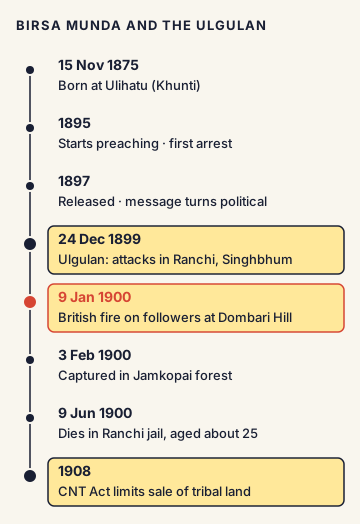
Birsa was born on 15 November 1875, most accounts say at Ulihatu (now in Khunti district, Jharkhand). He grew up poor. He studied for a time at a German missionary school in Chaibasa and briefly became a Christian. He later left the mission. Around 1895, he began preaching a new faith among the Mundas. He asked people to give up alcohol, witchcraft and animal sacrifice, to live clean lives, and to believe in one god.
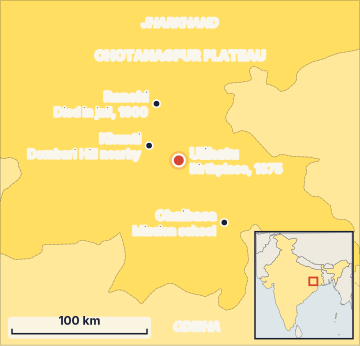
His followers came to be known as Birsaits. Many believed he had healing powers. Thousands gathered to hear him. He was first arrested in 1895 and jailed for about two years.
How did the Ulgulan unfold?
- After his release in 1897, Birsa's message became openly political. He spoke of ending the rule of the British, the landlords and the moneylenders, and of bringing back a Munda Raj.
- On 24 December 1899, his followers attacked symbols of this power: police stations, churches, and the houses of landlords and officials, in the Ranchi and Singhbhum areas. They mainly used bows, arrows and swords.
- On 9 January 1900, British forces fired on a large gathering of Birsa's followers at Dombari Hill (also called Sail Rakab), near Khunti. Many people were killed. The exact number is not known.
- Birsa escaped but was caught in early 1900 (most accounts give 3 February 1900) in the Jamkopai forest area.
- He died in Ranchi jail on 9 June 1900. The British said he died of cholera. Many people doubt this.
What came out of the Ulgulan?
The revolt forced the British to look again at tribal land. Survey and settlement work recorded khuntkatti rights. Then came the Chotanagpur Tenancy Act, 1908 (CNT Act). It recognised khuntkatti rights and put strong limits on the transfer of tribal land to non-tribals. The CNT Act is still in force in Jharkhand. Together with the Santhal Parganas Tenancy Act, 1949, it remains the main shield for tribal land in the state.
How is he remembered today?
- Janjatiya Gaurav Diwas: In 2021, the Union Government declared 15 November as Janjatiya Gaurav Diwas, to honour Birsa Munda and other tribal freedom fighters.
- 150th birth anniversary: 15 November 2024 to 15 November 2025 was observed as Janjatiya Gaurav Varsh (Tribal Pride Year).
- Jharkhand was created as a separate state on 15 November 2000, his birth anniversary.
- His portrait hangs in the Central Hall of Parliament. He is the only tribal leader to be honoured this way.
- Ranchi's airport, Birsa Munda Airport, is named after him.
How is the Ulgulan different from other tribal revolts?
Students often mix up the big tribal uprisings of eastern India:
- Santhal Hul (1855-56): led by the brothers Sidhu and Kanhu Murmu in the Rajmahal hills (Santhal Pargana). It led to the creation of the Santhal Pargana district.
- Kol uprising (1831-32): in Chotanagpur, by the Kols (including Mundas and Hos), against land transfers to outsiders.
- Munda Ulgulan (1899-1900): led by Birsa Munda. It mixed religious reform with a fight for land and self-rule. It led to the CNT Act, 1908.
- Tana Bhagat movement (1914 onwards): among the Oraons of Chotanagpur. It began as religious reform and later joined Gandhi's national movement.
Why does this matter today? (The Mains angle)
The issues behind the Ulgulan are still alive.
- Land alienation: Tribal land is still lost through debt, illegal sales, and land taken for mines, dams and industry. Many displaced tribals do not get fair compensation.
- Forest rights: The Forest Rights Act, 2006 was passed to undo the "historical injustice" done to forest dwellers by colonial forest laws, a grievance that Birsa's followers also had.
- Self-rule: The Fifth Schedule of the Constitution and the PESA Act, 1996 give tribal areas and gram sabhas special powers over land and resources. Critics say these are poorly implemented in many states.
- Unrest: Experts note that loss of land and forest rights, poverty and weak government presence in tribal areas helped Left Wing Extremism spread in central India. The way forward suggested by many experts is to implement land and forest laws properly, give gram sabhas real power, and deliver services in remote tribal villages.
Concepts to Know
- Chotanagpur plateau: A rocky upland region in eastern India, covering most of today's Jharkhand and parts of Odisha, Chhattisgarh and West Bengal. It is rich in forests and minerals and is home to many tribal communities.
- Khuntkatti: A Munda land system in which land is owned jointly by the descendants of the families who first cleared it. No single person can sell it to outsiders.
- Diku: A word tribals of Chotanagpur used for outsiders, such as moneylenders, traders and landlords, who took over their land.
- Beth begari: Forced, unpaid labour that tribals had to do for landlords and officials.
- Millenarian movement: A movement whose followers believe that a great change is coming soon, which will end their suffering and create a just world. The Ulgulan had this nature, as followers believed Birsa would bring a new age.
- Fifth Schedule: A part of the Constitution that gives special protection to "Scheduled Areas" with large tribal populations in states outside the North-East. The Governor has special powers there, and a Tribes Advisory Council advises the state.
- Birsa Munda: born 15 November 1875 (Ulihatu, Khunti district, Jharkhand); died 9 June 1900 in Ranchi jail
- Title: "Dharti Aaba" (Father of the Earth); followers called Birsaits
- Ulgulan ("Great Tumult"): 1899-1900; attacks began 24 December 1899; Dombari Hill firing on 9 January 1900
- Result: Chotanagpur Tenancy Act, 1908 recognised khuntkatti rights and limited transfer of tribal land
- Janjatiya Gaurav Diwas: 15 November, declared in 2021
- Janjatiya Gaurav Varsh (150th birth anniversary year): 15 November 2024 to 15 November 2025
- Jharkhand formed on 15 November 2000
● Tracked since November 15, 2026 · last seen November 15, 2026 · updates as the daily brief publishes