Curative Petition
The Supreme Court's Last Remedy
A curative petition is the very last legal chance to ask the Supreme Court to correct its own final judgment. It can be filed only after the Court has already decided the case and has also rejected a review petition against it. The Court allows it only in very rare cases, for example when a basic rule of fair hearing was broken, or when a judge had a hidden link to the case that could make the decision look biased. The Constitution does not mention the curative petition by name. The Supreme Court created it in 2002.
Why does it exist?
The Supreme Court is the highest court in India. There is no court above it to appeal to. So if the Supreme Court itself makes a serious mistake, the person harmed seems to have nowhere to go. The law values finality: a case must end at some point, or courts would never finish any matter.
But the Court also accepted that finality cannot protect a decision that causes a gross miscarriage of justice (a very serious wrong). The curative petition balances these two values. It keeps the door almost closed, but not fully locked.
Where did it come from?
The idea was born in the case of Rupa Ashok Hurra v. Ashok Hurra (2002). A five-judge Constitution Bench delivered the judgment on 10 April 2002. The question before it was simple: after the Supreme Court has given a final judgment and rejected a review, can the same judgment be challenged again? The Court said a fresh writ petition under Article 32 cannot be filed against its own judgment.
But it also said that, to prevent abuse of its process and to cure a gross miscarriage of justice, it can reconsider its judgment through a new route. It named this route the curative petition. The Court drew this power from its inherent powers, meaning powers that a court has simply because it is a court and must do justice.
What are the two steps before it?
A case in the Supreme Court can move through three stages after a judgment:
- Judgment: The Court decides the case.
- Review petition (Article 137): A party can ask the same bench to look again at its judgment. This must normally be filed within 30 days (Order XLVII of the Supreme Court Rules, 2013). The grounds are narrow: a new and important fact that could not be produced earlier, a mistake apparent on the face of the record, or any other sufficient reason. Review petitions are usually decided "by circulation", which means the judges read the papers in their chambers without an open-court hearing.
- Curative petition: Only after the review is dismissed can a party file a curative petition.
Think of it like a school exam. The result is the judgment. Asking the same teacher to re-check your paper is the review. Going to a panel of the senior-most teachers, because the original checker was your rival's relative, is the curative petition.
On what grounds is it allowed?
In Rupa Ashok Hurra, the Court gave two main examples where it may step in:
- Violation of natural justice: for example, a person whose rights were affected was never heard, or a party was never served notice of the case and the Court went ahead as if notice had been given.
- Apprehension of bias: a judge who took part in the decision did not disclose a connection with the subject or with the parties, which gives reason to fear bias, and the judgment hurts the petitioner.
The Court said these grounds are not a closed list, but curative petitions must be treated as "a rarity rather than regular". In 2024 the Court added that it can also step in where the Court acted beyond its jurisdiction and this led to a grave miscarriage of justice.
How does it work, step by step?
The rules are in Order XLVIII of the Supreme Court Rules, 2013, which says curative petitions are governed by the 2002 judgment.
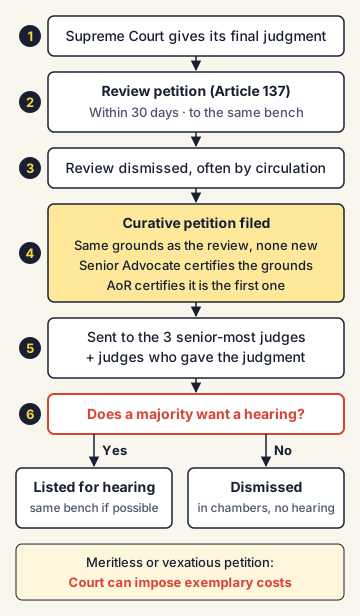
- The petitioner must state that the same grounds were raised in the review petition and that the review was dismissed by circulation. A brand new ground cannot be raised for the first time here.
- A Senior Advocate must certify that the petition meets the conditions laid down in Rupa Ashok Hurra. This is a filter: a senior lawyer puts their reputation on the line.
- The Advocate-on-Record (the lawyer who is officially allowed to file cases in the Supreme Court) must certify that this is the first curative petition in the matter. Only one is allowed.
- It must be filed within a reasonable time after the review is dismissed. No fixed number of days is set.
- The petition is first circulated to a bench of the three senior-most judges of the Supreme Court, plus the judges who gave the original judgment, if they are available.
- Only if a majority of these judges feel it needs a hearing is it listed for hearing, as far as possible before the same bench. Otherwise it is dismissed in chambers, without oral arguments.
- If the petition is found to be without merit or vexatious (filed only to harass or delay), the Court can impose exemplary costs (a heavy fine) on the petitioner.
Real examples
Most curative petitions fail. A few well-known ones:
- Navneet Kaur v. State of NCT of Delhi (2014): The Court allowed a curative petition and changed a death sentence to life imprisonment, because of the convict's mental illness and the long delay in deciding his mercy petition. This is the best-known case of a curative petition succeeding.
- Yakub Memon (2015): The curative petition against his death sentence was dismissed because its grounds did not fit the Rupa Ashok Hurra conditions.
- Bhopal Gas Tragedy (2023): On 14 March 2023, a Constitution Bench dismissed the Union government's curative petition, filed in 2010, that sought more compensation from Union Carbide. The Court said a settlement can be reopened only for fraud, and no fraud was pleaded.
- Delhi Metro Rail Corporation v. DAMEPL (2024): On 10 April 2024, a three-judge bench allowed a curative petition. It set aside the Court's own 2021 judgment that had restored an arbitration award of roughly ₹8,000 crore against the Delhi Metro. The Court called that award "patently illegal".
Commonly confused concepts
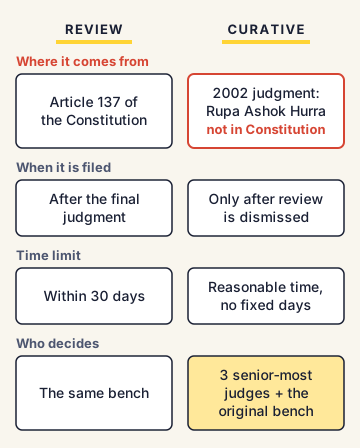
- Review petition vs curative petition: A review comes from Article 137 of the Constitution and must be filed within 30 days. A curative petition is not named in the Constitution; it comes from a 2002 judgment and the Court's inherent powers. Review goes to the same bench; a curative petition goes to the three senior-most judges plus the original bench.
- Curative petition vs Special Leave Petition (SLP): An SLP under Article 136 asks the Supreme Court for permission to appeal against a judgment of a lower court or tribunal. A curative petition challenges the Supreme Court's own final judgment.
- Curative petition vs mercy petition: A mercy petition is not a court case. It is a request to the President (Article 72) or the Governor (Article 161) to pardon or reduce a sentence. It is often filed after the curative petition fails in death-penalty cases.
- Article 142 vs Article 32: Article 32 lets a person go to the Supreme Court when a Fundamental Right is violated. Article 142 lets the Supreme Court pass any order needed to do "complete justice" in a case before it. A curative petition draws on the Court's inherent power, read with these articles.
Issues, criticism and the way forward
- Finality vs justice: Critics say each extra layer delays justice and lets rich litigants drag cases on for years. Supporters say one last safety valve is necessary when there is no higher court.
- Unclear limits: The 2024 Delhi Metro ruling widened the grounds to include acting beyond jurisdiction. Some legal experts worried this could turn the curative route into a second appeal. Others felt it simply corrected a clear error.
- Decided in chambers: Since most curative petitions are decided without an open hearing, some argue the process is not transparent enough.
- Death-penalty delays: In death-penalty cases, convicts often file review, curative and mercy petitions one after another. Courts have tried to set time limits so that delays do not become cruel for the convict or unfair to the victims.
- Way forward: Experts have suggested clearer written rules on grounds and timelines, and better disclosure rules for judges, so that bias claims are settled before a case is heard rather than after.
Concepts to Know
- Inherent powers: Powers a court has without any specific law granting them, because it must be able to do justice and stop misuse of its own process.
- Natural justice: Basic rules of a fair hearing. The two main ones are: no one should be a judge in their own cause, and both sides must be heard before a decision.
- Advocate-on-Record (AoR): A lawyer who has passed a special Supreme Court exam and is the only kind of lawyer allowed to file cases directly in the Supreme Court.
- Senior Advocate: A lawyer given this title by the Supreme Court or a High Court because of their skill and standing at the Bar.
- Circulation: A way of deciding a petition where the judges read the papers in their chambers, without calling lawyers to argue in open court.
- Miscarriage of justice: A serious failure of the legal system, such as an innocent person being punished or a party being treated very unfairly.
- Created by Rupa Ashok Hurra v. Ashok Hurra, five-judge bench, judgment of 10 April 2002
- Procedure: Order XLVIII of the Supreme Court Rules, 2013
- Filed only after a review petition (Article 137; 30-day limit under Order XLVII) is dismissed
- Needs a Senior Advocate's certificate and an AoR certificate that it is the first curative petition
- First circulated to the three senior-most judges plus the judges who gave the original judgment
- Listed for hearing only if a majority of that bench agrees; usually decided in chambers
- Successful examples: Navneet Kaur (2014), DMRC v. DAMEPL (10 April 2024); dismissed: Yakub Memon (2015), Bhopal Gas Tragedy (14 March 2023)
● Tracked since October 08, 2026 · last seen October 08, 2026 · updates as the daily brief publishes