Judicial Recusal
The Rule Against Bias (Nemo Judex in Causa Sua)
Recusal means a judge stepping away from hearing a case because there is a reason that may make the judge look biased, or actually be biased. The idea rests on an old rule of natural justice called nemo judex in causa sua, which is Latin for "no one should be a judge in their own cause".
In India there is no written law that lists when a judge must recuse. It is mostly left to the judge's own conscience, guided by court judgments and a code of conduct for judges.
Why does recusal matter?
A court decision is accepted by people only if they trust that the judge was fair. Think of a cricket match where the umpire's son plays for one of the teams. Even if the umpire gives perfectly fair decisions, the other team will always doubt them. Recusal protects this trust. A well-known English saying captures it: "justice should not only be done, but should manifestly and undoubtedly be seen to be done". That line comes from an English case of 1924, R v. Sussex Justices, ex parte McCarthy.
What is natural justice?
Natural justice is a set of basic fairness rules that every judge or authority deciding someone's rights must follow, even if no law writes them down. There are two main rules:
- Nemo judex in causa sua (rule against bias): the decision-maker must have no personal interest in the outcome.
- Audi alteram partem (hear the other side): each party must get a fair chance to present its case.
Recusal comes from the first rule. Courts in India treat these rules as part of the right to fair procedure under Article 14 (equality before law) and Article 21 (life and personal liberty).
What kinds of bias can force recusal?
Courts usually recognise three types:
- Pecuniary (money) bias: the judge has a financial interest in the case, such as owning shares in a company that is a party. Even a small money interest is usually enough.
- Personal bias: the judge has a relationship with a party or lawyer, such as a family tie, friendship or old enmity.
- Subject-matter bias: the judge has already taken a fixed position on the very issue, for example by advising one side on it earlier as a lawyer.
Which test do Indian courts use?
In Ranjit Thakur v. Union of India (1987), the Supreme Court said the question is not what the judge feels inside. The question is whether the party before the court has a reasonable apprehension (a sensible fear) of bias. In simple words, the judge must look at the case through the eyes of the litigant, not through their own mind.
Later judgments, such as State of Punjab v. Davinder Pal Singh Bhullar (2011), framed it as a "real likelihood" test: would a reasonable, fair-minded person who knows all the facts seriously fear bias? Actual bias does not have to be proved.
What does the judges' code of conduct say?
On 7 May 1997, a Full Court meeting of the Supreme Court adopted the Restatement of Values of Judicial Life, a 16-point code of conduct. The Chief Justices' Conference of 1999 adopted it for the whole judiciary. Two points are directly about family:
- A judge should not let a close family member (spouse, son, daughter, son-in-law, daughter-in-law or other close relative) who is a lawyer appear before them, or be linked in any way with a case they hear.
- A judge shall not hear and decide a matter in which a member of their family, a close relation or a friend is concerned.
Internationally, the Bangalore Principles of Judicial Conduct (2002) list six values for judges: independence, impartiality, integrity, propriety, equality, and competence and diligence. They are not binding, but Indian courts often refer to them.
How does recusal work in practice?
There is no fixed procedure. Usually it happens in one of two ways:
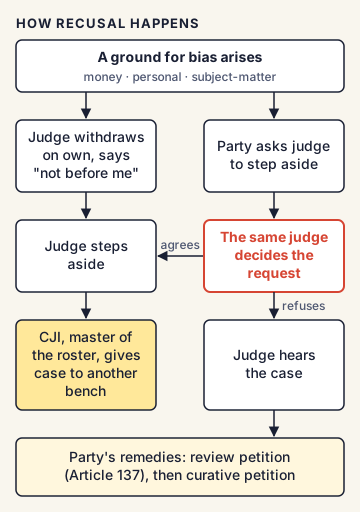
- The judge withdraws on their own, often saying only "not before me", and the CJI (as "master of the roster", the person who decides which bench hears which case) assigns the case to another bench.
- A party asks the judge to step aside. The judge in question decides this request personally. If the judge refuses, the party has limited options, such as a review petition or, after that, a curative petition.
Judges do not have to give reasons for recusing. In the NJAC case (2015), Justice Kurian Joseph wrote that judges should give reasons, as part of being transparent. That view has not become a binding rule.
Important cases on recusal
- Supreme Court Advocates-on-Record Association v. Union of India (2015, the NJAC case): a party asked Justice J.S. Khehar to step aside, since he was part of the collegium whose power was at stake. He refused. He said that every senior judge had the same institutional interest, and that recusing because of a party's request could let litigants pick their judges.
- Indore Development Authority v. Manoharlal (2019): Justice Arun Mishra refused to recuse from a Constitution Bench even though he had earlier written a judgment on the same question. He said having a view on a legal point is not bias, and that giving in to such demands could amount to "bench hunting".
What is the doctrine of necessity?
Sometimes every possible judge has the same interest. For example, a case about judges' salaries or about how judges are appointed affects all judges. If all of them recused, nobody would be left to decide. In such cases the doctrine of necessity lets a judge hear the case despite the interest, because otherwise the case could not be decided at all.
What happens if a biased judge has already decided a case?
A judgment given by a judge who should have recused can be challenged. The Supreme Court can:
- Recall its own order on an application, when there was a basic flaw in how it was made, and hear the case again.
- Hear a review petition under Article 137, filed usually within 30 days.
- Hear a curative petition, recognised in Rupa Ashok Hurra v. Ashok Hurra (2002). A five-judge bench said it can be used in rare cases, for example where natural justice was violated or where a judge failed to disclose a link that created an apprehension of bias.
Commonly confused concepts
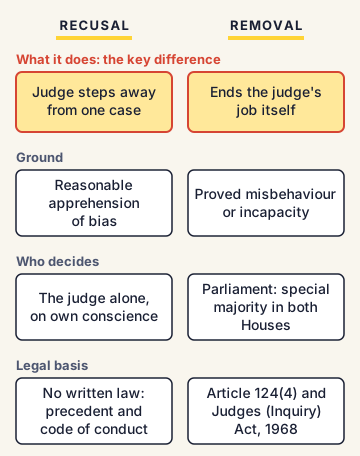
- Recusal vs removal: Recusal is a judge stepping away from one case. Removal (impeachment) ends the judge's job. Removal needs proved misbehaviour or incapacity and a special majority in both Houses of Parliament, under Article 124(4) and the Judges (Inquiry) Act, 1968.
- Recusal vs transfer of a case: Recusal is the judge's choice to step aside. A transfer is the CJI moving a case to a different bench as master of the roster.
- Review vs curative petition: A review petition (Article 137) is heard by the same judges, usually without open court hearing. A curative petition comes only after a review is dismissed. It is first circulated to the three senior-most judges and the judges who decided the case, if available.
- Bias vs a prior view on law: A judge who earlier wrote a judgment on a legal point is not biased for that reason alone. Bias is about a personal, money or family link, or a closed mind on the facts.
Issues, criticism and the way forward
- No written rules: Recusal depends almost fully on each judge's choice. This leads to uneven practice. Critics suggest a clear written code listing when recusal is required, as some other countries have.
- Judge decides their own recusal: The same judge whose fairness is questioned decides whether to step aside. Some experts suggest such requests should go to another bench or the CJI.
- No reasons given: Silent recusals leave people guessing. Others argue that giving reasons can invite needless controversy.
- Disclosure: Many experts say judges should openly disclose any possible conflict (such as a relative working for a party) at the start of a case. The parties can then object or agree.
- Bench hunting: If recusal is too easy, a party can force a judge out simply to get a different bench. Courts must balance fairness against this misuse.
Concepts to Know
- Natural justice: Basic fairness rules that any judge or authority must follow: no bias, and hear both sides. They apply even if no law mentions them.
- Standing counsel: A lawyer who regularly represents a particular government body or organisation in a court, usually on a fixed engagement.
- Master of the roster: The power of the Chief Justice to decide which judges sit together and which cases each bench hears.
- Recall application: A request asking a court to cancel its own order and hear the matter again, because the order was made in a basically flawed way.
- Curative petition: The last remedy in the Supreme Court after a review petition fails. It is allowed only in rare cases, such as bias or a breach of natural justice.
- Litigant: A person or body who is a party to a court case.
- Nemo judex in causa sua: "no one should be a judge in their own cause"; audi alteram partem: "hear the other side"
- No statute governs recusal of judges in India; it is a matter of judicial conscience and precedent
- Ranjit Thakur v. Union of India (1987): test is the reasonable apprehension of bias in the mind of the party
- Restatement of Values of Judicial Life: adopted by Supreme Court Full Court on 7 May 1997; 16 points; adopted by the Chief Justices' Conference, 1999
- Bangalore Principles of Judicial Conduct (2002): six values
- NJAC case (2015): Justice J.S. Khehar refused recusal; doctrine of necessity discussed
- Indore Development Authority v. Manoharlal (2019): Justice Arun Mishra refused recusal
- Rupa Ashok Hurra v. Ashok Hurra (2002): curative petition recognised; bias is one ground
- Review petition: Article 137; removal of judges: Article 124(4) and Judges (Inquiry) Act, 1968
● Tracked since March 20, 2026 · last seen October 07, 2026 · updates as the daily brief publishes