Cryosphere
The Frozen Parts of the Earth System
The cryosphere is the name for all the parts of the Earth where water is frozen solid. It includes snow, glaciers, ice sheets, ice caps, sea ice, ice on lakes and rivers, and frozen ground called permafrost. The word comes from the Greek word kryos, which means cold. Scientists treat the cryosphere as one of the main parts of the Earth's climate system, along with the air (atmosphere), the oceans (hydrosphere), the land (lithosphere) and living things (biosphere).
Why does the cryosphere matter?
The frozen parts of the Earth do three big jobs. First, they act like a giant mirror that sends sunlight back to space and keeps the planet cool. Second, they store most of the world's fresh water, which slowly melts and feeds rivers. Third, they lock away huge amounts of carbon in frozen soil. If the cryosphere shrinks, all three jobs weaken at the same time: the Earth heats up faster, river flows become unreliable, sea levels rise, and more greenhouse gas enters the air.
What are its main parts?
Students should know each part separately, because UPSC often asks about the differences:
- Snow cover: Fresh snow lying on land. It covers a large area in winter but melts in summer, so it changes a lot with the seasons.
- Glaciers: Large bodies of ice formed from snow that piles up over many years, gets pressed into ice and slowly flows downhill under its own weight. Mountain glaciers, like those in the Himalayas, are the main example.
- Ice caps: Dome-shaped ice masses that cover less than 50,000 sq km of land, usually on high ground or islands.
- Ice sheets: Ice masses bigger than 50,000 sq km. Only two exist today: the Antarctic Ice Sheet and the Greenland Ice Sheet.
- Ice shelves: Floating platforms of ice that extend from an ice sheet into the sea, while still being attached to the land ice.
- Sea ice: Ice formed when sea water itself freezes. It floats on the Arctic Ocean and the Southern Ocean around Antarctica.
- Lake and river ice: Ice that forms on fresh water bodies in cold winters.
- Permafrost: Ground (soil, rock or sediment) that stays at or below 0°C for at least two years in a row.
How much water and ice does it hold?
The two ice sheets together hold over 68% of the Earth's fresh water, according to the US National Snow and Ice Data Center (NSIDC). If all of the Antarctic ice melted, sea level would rise by about 58 metres. If all of the Greenland ice melted, sea level would rise by about 7.4 metres. These numbers will not happen in our lifetime, but even a small share of this ice melting can flood coastal cities.
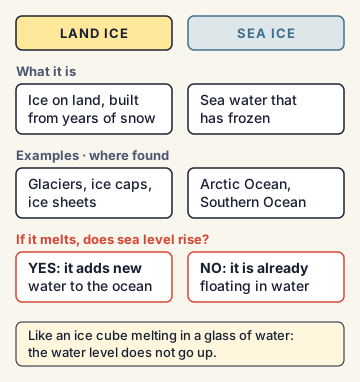
An important point: melting sea ice does not raise sea level, because it is already floating in the water. It is like an ice cube melting in a glass of water: the water level does not go up. Melting land ice (glaciers and ice sheets) does raise sea level, because it adds new water to the ocean.
How does the cryosphere cool the Earth? The albedo effect
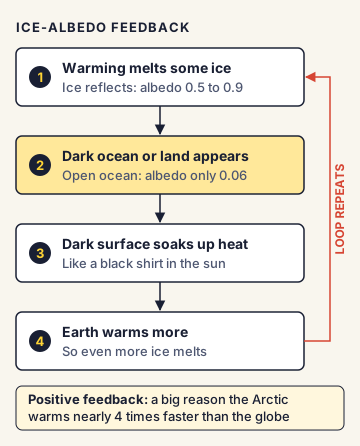
Albedo is a measure of how much sunlight a surface reflects. It runs from 0 (reflects nothing) to 1 (reflects everything). Fresh snow has an albedo of about 0.8 to 0.9, so it reflects most of the sunlight that falls on it. Sea ice reflects about 0.5 to 0.7. Open ocean water is very dark, with an albedo of only about 0.06, so it absorbs almost all sunlight.
Think of wearing a white shirt versus a black shirt in the summer sun: the white shirt keeps you cooler.
Why is warming faster in cold regions? Feedback loops
When warming melts some ice, a darker surface (ocean or bare land) appears. That darker surface absorbs more heat, which melts more ice. This chain is called the ice-albedo feedback. It is a "positive feedback", which means a change that pushes itself further in the same direction, like a rolling snowball getting bigger. A second loop works through permafrost: warming thaws frozen soil, microbes break down the dead plant matter locked inside, and they release carbon dioxide and methane. These gases cause more warming, which thaws more permafrost.
What is Arctic amplification?
Because of these feedbacks, the Arctic warms much faster than the planet as a whole. This is called Arctic amplification (or polar amplification). Earlier studies said the Arctic warms about twice as fast as the global average. A 2022 study by scientists at the Finnish Meteorological Institute (Rantanen and others) found that between 1979 and 2021 the Arctic warmed nearly four times as fast as the whole globe. Some parts, like the Barents Sea north of Norway and Russia, warmed up to seven times faster.
Where did global attention to the cryosphere come from?
Scientists have studied polar ice for over a century, but climate bodies began focusing on it more closely in recent decades:
- The Intergovernmental Panel on Climate Change (IPCC) released a Special Report on the Ocean and Cryosphere in a Changing Climate (SROCC) in September 2019. It was the first IPCC report focused fully on oceans and frozen regions.
- In 2019, the Hindu Kush Himalaya Assessment led by ICIMOD (the International Centre for Integrated Mountain Development, based in Kathmandu) warned that more than a third of the region's glaciers would be lost by 2100 even if warming is held to 1.5°C, and two-thirds if it reaches 2°C.
- The International Cryosphere Climate Initiative (ICCI), a network of polar and mountain scientists, publishes a State of the Cryosphere report every year, usually just before or during the UN climate summit (COP).
- In December 2022, the UN General Assembly declared 2025 as the International Year of Glaciers' Preservation and made 21 March the annual World Day for Glaciers, starting in 2025. UNESCO and the World Meteorological Organization (WMO) led this effort.
Why does the Himalayan cryosphere matter so much to India?
The Hindu Kush Himalaya (HKH) region holds the largest store of ice outside the two poles, so it is often called the "Third Pole". Its glaciers and snow feed ten major river basins, including the Indus, Ganga and Brahmaputra. More than 2 billion people in Asia depend on these rivers in some way. In the short run, faster melting can mean more floods and new, dangerous glacial lakes.
In the long run, once the glaciers shrink, rivers may carry less water in the dry season, which affects drinking water, farming and hydropower.
India's position and Indian examples
India studies the cryosphere through the National Centre for Polar and Ocean Research (NCPOR) in Goa, which works under the Ministry of Earth Sciences.
- Antarctica: India's first station, Dakshin Gangotri, was set up in 1983 (now no longer used). India now runs two permanent stations: Maitri (1989) and Bharati (2012). The Indian Antarctic Act, 2022 is India's law to regulate Indian activities in Antarctica.
- Arctic: India's research station Himadri opened in July 2008 at Ny-Ålesund in Svalbard, Norway. India became an Observer at the Arctic Council in 2013 and released its Arctic Policy in 2022.
- Himalaya: HIMANSH, a high-altitude research station at about 4,000 metres in the Chandra basin of Lahaul-Spiti, Himachal Pradesh, was opened in October 2016 to study glaciers such as Bada Shigri and Samudra Tapu.
- India has seen cryosphere-linked disasters, such as the Chamoli disaster of February 2021 in Uttarakhand and the South Lhonak lake outburst flood of October 2023 in Sikkim.
Commonly confused concepts
- Glacier vs ice sheet vs ice cap: All are land ice. An ice sheet is larger than 50,000 sq km (only Antarctica and Greenland). An ice cap is a smaller dome under 50,000 sq km. A glacier is a moving river-like body of ice, often in a mountain valley.
- Sea ice vs ice shelf vs iceberg: Sea ice is frozen sea water. An ice shelf is land ice floating on the sea but still attached to the land. An iceberg is a piece that has broken off a glacier or ice shelf and floats freely.
- Arctic vs Antarctic: The Arctic is mostly a frozen ocean surrounded by land (Russia, Canada, Greenland, Norway and others). Antarctica is a continent of land covered by a thick ice sheet and surrounded by ocean.
- Permafrost vs seasonal frozen ground: Permafrost stays frozen for at least two years in a row. Seasonally frozen ground thaws every summer.
- Third Pole vs the two poles: "Third Pole" is a nickname for the Himalaya and nearby ranges, because of the ice stored there. It is not a geographic pole.
Issues, criticism and the way forward
- Tipping points: Scientists warn that some losses, like the collapse of parts of the West Antarctic Ice Sheet, may become impossible to stop once a certain temperature is passed. Even if the Earth later cools, the ice may not come back for centuries.
- Data gaps in the Himalaya: Many Himalayan glaciers are hard to reach, so long-term field data is limited. India has only a few "benchmark" glaciers studied in detail.
- Disaster risk: New glacial lakes are forming as glaciers retreat. Many are near hydropower projects and villages. Early warning systems are still limited.
- Methane from permafrost: Methane is a much stronger greenhouse gas than carbon dioxide over short periods. Thawing permafrost could release it in ways that are hard to control or measure.
- Way forward: Experts suggest deep and fast emission cuts to keep warming close to 1.5°C, more monitoring stations and satellite study, regional data sharing among Himalayan countries, early warning systems for glacial lakes, and climate-safe planning of roads, dams and towns in mountain areas.
Concepts to Know
- Albedo: How much sunlight a surface reflects back. A white surface like snow has high albedo; a dark surface like the ocean has low albedo.
- Positive feedback: A process where a change causes more of the same change, so it keeps growing on its own.
- Ice sheet: A huge, thick layer of land ice covering more than 50,000 sq km. Only Antarctica and Greenland have them today.
- Sea level equivalent: How much the global sea level would rise if a given body of ice melted completely.
- ICIMOD: The International Centre for Integrated Mountain Development, an organisation based in Kathmandu, Nepal, that studies the Hindu Kush Himalaya. India is one of its eight member countries.
- COP (Conference of the Parties): The yearly meeting of countries that have joined the UN climate treaty (UNFCCC), where climate action is negotiated.
- Cryosphere parts: snow, glaciers, ice caps, ice sheets, ice shelves, sea ice, lake and river ice, permafrost
- Ice sheet: more than 50,000 sq km; only two exist (Antarctica, Greenland)
- Ice sheets hold over 68% of Earth's fresh water (NSIDC)
- Sea level equivalent: Antarctica about 58 m; Greenland about 7.4 m
- Albedo: fresh snow about 0.8 to 0.9; sea ice 0.5 to 0.7; open ocean about 0.06
- Arctic warmed nearly 4 times faster than the globe, 1979 to 2021 (Rantanen et al., 2022)
- IPCC SROCC released September 2019
- 2025: International Year of Glaciers' Preservation; 21 March: World Day for Glaciers (from 2025), declared by UNGA in December 2022
- India: NCPOR (Goa); Maitri (1989), Bharati (2012), Himadri (July 2008, Ny-Ålesund, Svalbard), HIMANSH (October 2016, Lahaul-Spiti); Arctic Council Observer since 2013; Arctic Policy 2022; Indian Antarctic Act 2022
● Tracked since November 02, 2026 · last seen November 02, 2026 · updates as the daily brief publishes