Permafrost
The Frozen Ground Holding Mountains Together
Permafrost is ground (soil, rock, gravel or sand) that stays at or below 0°C for at least two years in a row. It is not defined by ice. It is defined only by temperature. Permafrost is found in very cold places: the Arctic (Siberia, Alaska, northern Canada), Antarctica, and high mountains such as the Himalayas and the Tibetan Plateau. In many of these places, frozen water inside the ground works like glue, binding loose rock and soil together.
Why does it matter?
Permafrost matters for three big reasons. First, it holds slopes and foundations firm, like cement holds bricks. Second, it locks away a huge store of old plant and animal remains, which are full of carbon. Third, ice inside permafrost slowly feeds streams and springs in dry seasons in cold deserts like Ladakh. When permafrost thaws, all three of these jobs start to fail at the same time.
How is permafrost built, layer by layer?
Think of permafrost like a frozen cake with a soft top.
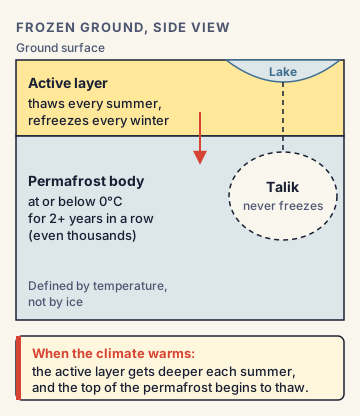
- Active layer: The top layer of ground thaws every summer and freezes again every winter. It can be a few tens of centimetres thick in the far Arctic and several metres thick in warmer places.
- Permafrost body: Below the active layer is the part that stays frozen all year, sometimes for thousands of years.
- Talik: A pocket of ground inside or below permafrost that does not freeze. Taliks often form under lakes and rivers.
When the climate warms, the active layer gets deeper each summer. Slowly, the top of the permafrost itself begins to thaw.
What types of permafrost are there?
Scientists group permafrost by how much of the land it covers:
- Continuous: more than 90% of the ground is frozen (very cold areas)
- Discontinuous: about 50 to 90%
- Sporadic: about 10 to 50%
- Isolated patches: less than 10%
There is also a split by place. Polar permafrost lies in the Arctic and Antarctic, mostly on flat land. Mountain (alpine) permafrost lies high up on steep slopes, like in the Himalayas. Mountain permafrost is patchy and harder to map, but its thaw is more dangerous for people, because it sits above steep valleys where people live and build.
How big is it?
In the Northern Hemisphere, permafrost regions cover about 23 million square kilometres. The land actually underlain by permafrost is between about 12 and 17 million square kilometres. Permafrost soils hold around 1,400 to 1,600 gigatonnes of carbon (1 gigatonne = 100 crore tonnes). This is almost twice the carbon now in the atmosphere. In the Hindu Kush Himalaya, permafrost covers roughly 1 million square kilometres.
This is many times the area covered by glaciers in the same region. India's share is estimated at about 40,000 square kilometres, mostly in Ladakh, Jammu and Kashmir, Himachal Pradesh, Uttarakhand and Sikkim.
How does permafrost thaw cause disasters in mountains?
In high mountains, ice fills the cracks of rock walls. This ice holds blocks of rock together.
- As the air warms, heat moves slowly into the rock.
- The ice in the cracks melts, and water enters the cracks.
- The water adds pressure and makes the rock surfaces slippery.
- One day, a big block of rock and ice breaks off and falls.
A falling mass of rock and ice can turn into a fast debris flow (a moving river of mud, rocks and water) that rushes down the valley. Thaw also loosens the soil of slopes, causing landslides. It can weaken the natural walls (moraines) that hold back glacial lakes, which can then burst.
A real Indian example: Chamoli, 2021
On 7 February 2021, about 27 million cubic metres of rock and glacier ice fell from the north face of Ronti Peak in Chamoli district, Uttarakhand. About one fifth of this mass was ice. It turned into a huge debris flow down the Rishiganga and Dhauliganga valleys. More than 200 people were killed or went missing, and two hydropower projects (Rishiganga and Tapovan Vishnugad) were badly damaged.
A study in the journal Science found that a crack in the rock under a hanging glacier had been widening for years before the collapse. Scientists see such events as a warning of what a warming, thawing high Himalaya can produce.
What is the climate link (the feedback loop)?
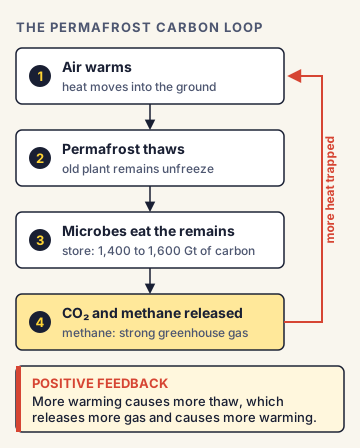
When permafrost thaws, microbes start eating the old frozen plant remains. They release carbon dioxide and methane into the air. Methane is a very strong greenhouse gas. More greenhouse gases cause more warming, which causes more thaw. This self-feeding cycle is called a positive feedback. The IPCC's Special Report on the Ocean and Cryosphere in a Changing Climate (2019) said with very high confidence that permafrost temperatures have risen to record levels since the 1980s. It found an average rise of 0.29°C between 2007 and 2016 across polar and high-mountain regions.
What happens to buildings and roads?
Many buildings, pipelines and roads in cold regions stand on permafrost. When it thaws, the ground sinks unevenly. In May 2020, a diesel tank collapsed near Norilsk in Arctic Russia when its supports sank. About 21,000 tonnes of diesel spilled into rivers. The company blamed permafrost thaw, though others said poor upkeep was also to blame. In the Himalayas, roads, tunnels and power projects built on or below frozen slopes face similar risks.
India's position and Indian examples
- Indian scientists have mapped thousands of rock glaciers in Jammu, Kashmir and Ladakh. A rock glacier is a slow-moving tongue of rock debris with ice inside. Its presence tells scientists that permafrost exists there.
- In Ladakh, studies suggest ice melting from frozen ground may be an important water source in dry years.
- Ground temperature data in the Indian Himalaya is still very limited. Most knowledge comes from satellite images and models, not from direct measurement.
- The National Mission for Sustaining the Himalayan Ecosystem (one of eight missions under India's 2008 National Action Plan on Climate Change) supports studies of glaciers and the frozen parts of the Himalaya.
Commonly confused concepts
- Permafrost vs glacier: A glacier is a moving body of ice on the surface that you can see. Permafrost is frozen ground, mostly hidden below the surface. A place can have permafrost with no glacier at all.
- Permafrost vs seasonal frost: Seasonal frost freezes in winter and fully thaws in summer. Permafrost stays frozen for two or more years.
- Active layer vs permafrost: The active layer thaws every summer. Permafrost is the layer below it that does not.
- Rock glacier vs debris-covered glacier: A debris-covered glacier is a true glacier of ice with a cover of stones. A rock glacier is mostly rock with ice mixed inside; it is a sign of permafrost.
- Permafrost thaw vs land subsidence (as in Joshimath): Joshimath's sinking is linked to the town sitting on old landslide debris, river erosion and heavy construction. It is not caused by permafrost. Both make ground unstable, but for different reasons.
Issues, criticism and the way forward
- Too little data: India has very few ground stations that measure permafrost temperature. Without data, risky slopes cannot be identified in time.
- Building without checking the ground: Roads, tunnels and dams are often planned using past climate conditions. Experts say designs must consider how slopes will change over the next 50 to 100 years.
- Hidden hazard: Unlike a glacial lake, permafrost thaw is invisible until a slope fails. This makes early warning difficult.
- Global carbon risk: Thawing Arctic permafrost could release large amounts of greenhouse gas, making global climate targets harder.
- Way forward: Experts suggest mapping mountain permafrost and rock glaciers, setting up ground temperature monitoring, adding permafrost risk to environmental impact assessments of Himalayan projects, and using satellites to watch for cracks and slope movement on high peaks.
Concepts to Know
- Cryosphere: All the frozen water on Earth: glaciers, ice sheets, snow, sea ice, lake and river ice, and permafrost.
- Moraine: A heap of rocks, sand and mud that a glacier pushes and leaves behind. Moraines often act as weak natural dams for glacial lakes.
- Debris flow: A fast-moving mix of water, mud, rocks and boulders that flows down a valley like wet concrete. It is far more destructive than a normal flood.
- Methane: A greenhouse gas. Over 20 years, it traps much more heat than the same amount of carbon dioxide.
- Positive feedback: A cycle where a change causes effects that make the same change bigger, like a snowball rolling downhill and getting larger.
- Gigatonne: One billion tonnes (100 crore tonnes).
- Permafrost = ground at or below 0°C for at least 2 consecutive years (defined by temperature, not by ice)
- Types by extent: continuous (more than 90%), discontinuous (50 to 90%), sporadic (10 to 50%), isolated (less than 10%)
- Northern Hemisphere permafrost regions: about 23 million sq km; land actually underlain: about 12 to 17 million sq km
- Carbon in permafrost: about 1,400 to 1,600 gigatonnes, nearly twice the carbon in the atmosphere
- Hindu Kush Himalaya permafrost: about 1 million sq km; India's share about 40,000 sq km
- IPCC SROCC (2019): permafrost temperatures at record highs; average rise of 0.29°C (2007 to 2016)
- Chamoli disaster: 7 February 2021, about 27 million cubic metres of rock and ice from Ronti Peak, more than 200 dead or missing
- Norilsk (Russia) diesel spill: May 2020, about 21,000 tonnes, linked to sinking tank supports
● Tracked since October 12, 2026 · last seen October 12, 2026 · updates as the daily brief publishes