CORSIA (Carbon Offsetting and Reduction Scheme for International Aviation)
CORSIA is a worldwide plan to stop carbon emissions from international flights from growing without control. It is run by the International Civil Aviation Organization (ICAO), the United Nations body for civil aviation. Under CORSIA, if an airline's international flights emit more carbon dioxide (CO₂) than an agreed limit, the airline must "cancel out" the extra by buying carbon credits, or reduce its duty by using cleaner fuel. It is the first global market-based climate scheme for a single industry.
Why was CORSIA needed?
Aviation produces about 2% of the world's CO₂ emissions, and air travel keeps growing quickly. Domestic flights fall inside each country's own climate promises under the Paris Agreement. But international flights cross many countries, so no single country "owns" their emissions. The Kyoto Protocol (1997) had handed this problem to ICAO. Without a common global rule, each country or region could make its own rules, which would be costly and unfair for airlines that fly everywhere.
Where did it come from?
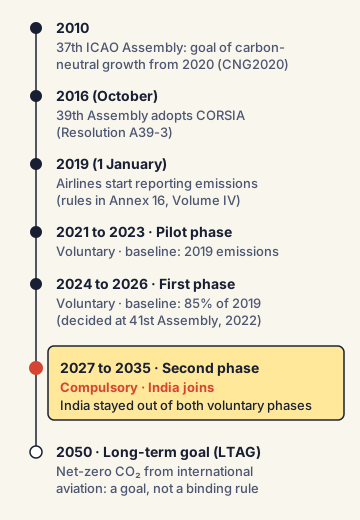
- In 2010, the 37th ICAO Assembly set a goal of carbon-neutral growth from 2020 (often called CNG2020). This means: after 2020, total emissions from international flights should not rise above a fixed level.
- In October 2016, the 39th ICAO Assembly adopted CORSIA through Resolution A39-3, as the tool to reach this goal.
- In June 2018, the ICAO Council adopted the detailed rules (called Standards and Recommended Practices, SARPs) in Annex 16, Volume IV of the Chicago Convention. They became applicable on 1 January 2019, when airlines started reporting their emissions.
- In June 2020, because COVID-19 had crashed air traffic, the ICAO Council decided to use only 2019 emissions as the baseline for the pilot phase (instead of the average of 2019 and 2020).
- In October 2022, the 41st ICAO Assembly made the scheme stricter: from 2024, the baseline became 85% of 2019 emissions. The same Assembly adopted a long-term goal of net-zero carbon emissions from international aviation by 2050.
How does CORSIA work, step by step?
Think of it like a family that agrees not to spend more than a fixed monthly budget. If it overspends, it must make up for it somewhere else.
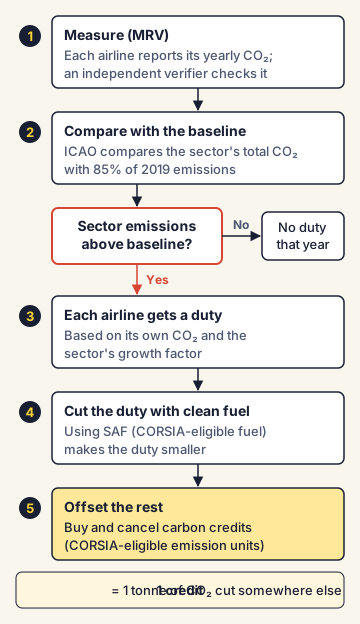
- Measure: Every airline that emits more than 10,000 tonnes of CO₂ a year on international flights must monitor, report and get its emissions checked by an independent verifier every year. This is called MRV (Monitoring, Reporting and Verification).
- Compare with the baseline: ICAO compares the total emissions of the sector with the baseline (85% of 2019 emissions from 2024 onward).
- Work out the duty: If the sector's emissions are above the baseline, each airline gets an offsetting duty. This is based on the airline's own emissions and a "growth factor" that reflects how much the whole sector has grown.
- Offset: The airline buys and cancels (surrenders) CORSIA-eligible emission units, that is, carbon credits from approved projects. One credit stands for one tonne of CO₂ cut or removed somewhere else, for example by a solar plant or a forest project.
- Cut the duty with clean fuel: An airline can reduce its offsetting duty by using CORSIA-eligible fuels, mainly Sustainable Aviation Fuel (SAF), which produce lower lifecycle emissions.
The three phases
- Pilot phase (2021 to 2023): voluntary; only flights between countries that chose to join.
- First phase (2024 to 2026): voluntary.
- Second phase (2027 to 2035): compulsory for all ICAO member countries above a traffic threshold, with some exemptions.
Who is exempted?
- Least Developed Countries (LDCs), Small Island Developing States (SIDS) and Landlocked Developing Countries (LLDCs), unless they choose to join.
- Countries with less than 0.5% of world international air traffic in 2018 (measured in revenue tonne-kilometres), unless they fall in the group that together makes up 90% of traffic.
- Airlines emitting 10,000 tonnes of CO₂ or less a year on international flights, small aircraft below 5,700 kg take-off weight, and humanitarian, medical and firefighting flights.
The route-based rule
CORSIA covers a flight only if both the departure and arrival countries are in the scheme. So a flight between India and a country that is exempt is not covered. This avoids unfair treatment between airlines flying the same route.
How the duty is shared (growth factors)
Under the 2022 review, an airline's duty is worked out 100% on the sector's growth until 2032. For 2033 to 2035, it is 85% on the sector's growth and 15% on the airline's own growth. This means fast-growing airlines pay a little more in the last years.
India's position
India did not join the voluntary phases. India argued that developing countries with growing aviation markets should not carry the same burden as rich countries that grew their aviation earlier. This follows the principle of Common But Differentiated Responsibilities (CBDR). India will join from the compulsory phase in 2027. The Directorate General of Civil Aviation (DGCA) has issued a Civil Aviation Requirement (CAR) on CORSIA, and Indian airlines already report their emissions.
As of 2026, the government has said it will back CORSIA with SAF blending targets of 1% (2027), 2% (2028) and 5% (2030) for international flights.
Commonly confused concepts
- CORSIA vs EU Emissions Trading System (EU ETS): CORSIA is a global offsetting scheme: airlines buy credits for emissions above a baseline. The EU ETS is a regional cap-and-trade system: there is a fixed cap on emissions, and companies buy and sell permits within that cap. The EU ETS covers flights within Europe (the European Economic Area), while flights between Europe and other participating countries come under CORSIA.
- Offsetting vs reducing: Offsetting means paying for a cut somewhere else; the plane still emits the same CO₂. Reducing means the airline itself emits less, for example by using SAF or newer, efficient aircraft.
- CORSIA vs Paris Agreement NDCs: NDCs (Nationally Determined Contributions) are each country's own climate promises and cover domestic flights. International flights are handled by ICAO through CORSIA.
- CORSIA vs LTAG: CORSIA is a scheme with rules running until 2035. LTAG (the Long-Term Aspirational Goal) is the 2050 net-zero target, which is a goal, not a binding rule for any single country.
Issues, criticism and the way forward
- Weak ambition: Critics say CORSIA only controls growth above a baseline and does not cut existing emissions. Offsetting lets planes keep emitting the same amount.
- Quality of credits: Some carbon credits may not represent real, extra cuts. ICAO's Technical Advisory Body approves eligible credit programmes to address this.
- Supply and cost of credits: In the compulsory phase, demand for eligible credits will rise sharply, which could push up prices.
- Burden on developing countries: Fast-growing markets like India may pay more, as their airlines grow faster than the sector average.
- Way forward: Experts suggest strong domestic SAF production, clear national rules for carbon credits (including how India authorises credits for use abroad under Article 6 of the Paris Agreement), and better efficiency in air traffic management.
Concepts to Know
- Carbon credit: A certificate showing that one tonne of CO₂ was cut or removed somewhere. A company that pollutes can buy it to make up for its own emissions.
- Offsetting: Making up for your own emissions by paying for an equal cut in emissions somewhere else.
- Baseline: The reference level used for comparison. In CORSIA, it is 85% of the CO₂ emitted by international flights in 2019 (from 2024 onward).
- Revenue Tonne-Kilometre (RTK): A measure of airline traffic. One RTK means one tonne of paying load (passengers or cargo) carried for one kilometre.
- Common But Differentiated Responsibilities (CBDR): A climate principle that all countries must act, but richer countries that polluted more in the past should do more.
- Lifecycle emissions: All the emissions from a fuel over its full life: growing or collecting the raw material, making the fuel, transporting it and burning it.
- Adopted by the 39th ICAO Assembly in October 2016 (Resolution A39-3)
- Rules in Annex 16, Volume IV of the Chicago Convention; adopted June 2018; emissions reporting from 1 January 2019
- Phases: pilot 2021 to 2023 and first phase 2024 to 2026 (both voluntary); second phase 2027 to 2035 (compulsory)
- Baseline: 2019 emissions for the pilot; 85% of 2019 emissions from 2024 (decided at the 41st Assembly, 2022)
- Exempt: LDCs, SIDS, LLDCs; countries below 0.5% of 2018 international RTKs; operators at or below 10,000 tonnes CO₂ a year; aircraft below 5,700 kg
- Growth factor: 100% sectoral until 2032; 85% sectoral and 15% individual for 2033 to 2035
- Route-based: covers a flight only if both countries participate
- India joins from the compulsory phase in 2027; DGCA has issued a CAR on CORSIA
● Tracked since July 30, 2026 · last seen October 21, 2026 · updates as the daily brief publishes