International Civil Aviation Organization (ICAO)
The International Civil Aviation Organization, or ICAO, is the United Nations body that sets the worldwide rules for civil aviation. It writes the safety, security, navigation and environmental standards that airports, airlines and air traffic controllers follow everywhere. It was created by the Chicago Convention of 1944, and its headquarters is in Montreal, Canada. As of 2025, it has 193 member states, including India.
Why does it exist?
Aviation is international by nature. A plane made in one country, owned by an airline in another and flown by pilots trained in a third must land safely at airports all over the world. Someone has to make sure the runway lights, radio language, pilot licences and safety checks mean the same thing everywhere. ICAO is that common referee and rule-writer. It does not run airlines or airports itself; it helps countries agree on shared standards.
Where did it come from?
- 1919: the Paris Convention created ICAN, the first international air body.
- 7 December 1944: the Chicago Convention was signed and provided for a new organisation.
- 6 June 1945: the Provisional ICAO (PICAO) began work.
- 4 April 1947: the Convention came into force and ICAO was formally born. Its first Assembly met in Montreal in May 1947.
- October 1947: ICAO became a specialised agency of the United Nations, linked to the UN Economic and Social Council (ECOSOC).
- 7 December is celebrated as International Civil Aviation Day. ICAO declared it in 1992 (first observed in 1994, the 50th anniversary), and the UN General Assembly recognised it in 1996.
How is ICAO organised?
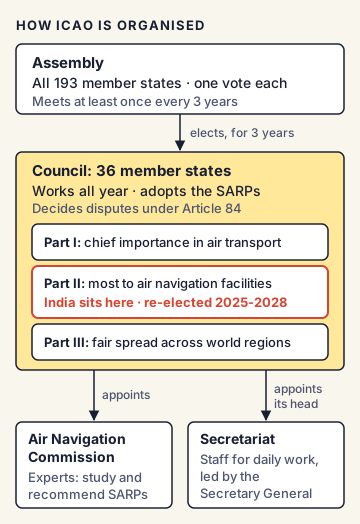
- Assembly: all 193 member states, each with one vote. It meets at least once every three years, elects the Council and sets policy and the budget.
- Council: the permanent governing body of 36 member states, elected by the Assembly for three years. It adopts the standards (SARPs), settles disputes under Article 84 and appoints the Secretary General. Its seats are filled in three parts:
- Part I: states of chief importance in air transport.
- Part II: states that contribute most to facilities for international air navigation.
- Part III: states that give the Council a fair spread across world regions.
- Air Navigation Commission: a body of experts that studies and recommends technical standards to the Council.
- Secretariat: the staff that does the daily work, headed by the Secretary General, with regional offices around the world.
How does ICAO make rules?
ICAO's rules are called Standards and Recommended Practices (SARPs), and they sit in the 19 Annexes to the Chicago Convention.
- Experts propose a new standard or a change.
- The Air Navigation Commission studies it and member states are consulted.
- The Council adopts it.
- It becomes binding unless most member states object. A country that cannot follow a standard must formally tell ICAO about the "difference" (Article 38).
Some well-known Annexes: Annex 1 (personnel licensing), Annex 2 (rules of the air), Annex 11 (air traffic services), Annex 13 (aircraft accident investigation), Annex 15 (aeronautical information services, including NOTAMs), Annex 17 (security) and Annex 19 (safety management).
What else does ICAO do?
- Safety audits: it checks how well each country's aviation regulator follows the standards.
- Security: it guides airport screening and the response to hijacking and other threats.
- Environment: it runs CORSIA (Carbon Offsetting and Reduction Scheme for International Aviation), adopted in 2016, under which airlines offset growth in carbon emissions from international flights.
- Disputes: under Article 84, the Council can decide disputes between states. In May 2025 it held Russia responsible for the 2014 downing of Malaysia Airlines Flight MH17, the first time it decided such a dispute on its merits.
India's position and Indian examples
- India is a founder member: it signed the Convention on 7 December 1944, the day it was opened.
- India has always been on the ICAO Council. At the 42nd Assembly in Montreal (27 September 2025), India was re-elected to Part II for 2025-2028, with more votes than in 2022.
- In February 2023, the Union Cabinet approved ratifying three protocols to the Convention: one inserting Article 3 bis, and two that would enlarge the Council and the Air Navigation Commission.
- India's DGCA is audited by ICAO under its safety oversight programme. ICAO's Annex 15 rules govern the NOTAMs that both India and Pakistan use to announce their closures.
Commonly confused concepts
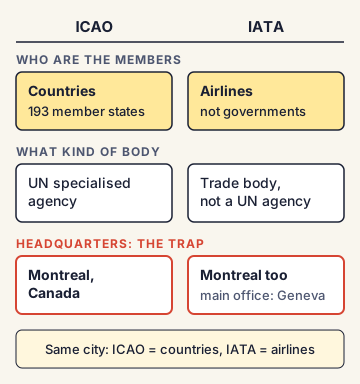
- ICAO vs IATA: ICAO is an inter-governmental UN agency of countries. IATA (International Air Transport Association) is a trade body of airlines, with its headquarters also in Montreal and a main office in Geneva.
- ICAO vs IMO: ICAO makes rules for the sky; the International Maritime Organization (IMO), based in London, makes rules for ships.
- ICAO vs DGCA: ICAO writes global standards; India's DGCA is the national regulator that applies them inside India.
- Assembly vs Council: the Assembly has all members and meets every three years. The Council has 36 members and works all year round.
Issues, criticism and the way forward
- No enforcement power: ICAO can set standards and decide disputes, but it cannot force a country to obey. Russia rejected the MH17 decision and appealed to the ICJ.
- Politics and airspace closures: ICAO has little power over airspace closures that countries make for security reasons, such as the India-Pakistan closures or the closures over conflict zones.
- Representation: many countries want the Council enlarged so that developing regions get a bigger voice. The protocol to enlarge it needs enough ratifications to come into force.
- Climate: critics say CORSIA's offsets are weak and that aviation needs deeper cuts in emissions. ICAO has set a long-term goal of net-zero carbon emissions from international aviation by 2050.
Concepts to Know
- Specialised agency: an independent international body linked to the UN by a special agreement, which handles one subject, such as health (WHO) or aviation (ICAO).
- Standards and Recommended Practices (SARPs): standards are rules countries are expected to follow; recommended practices are good practices they are encouraged to follow.
- Carbon offsetting: making up for your own carbon emissions by paying for projects that cut or absorb the same amount of emissions elsewhere, such as planting trees.
- Safety oversight: the work a national regulator does to check that airlines, airports and pilots follow safety rules.
- Created by the Chicago Convention (signed 7 December 1944); came into being 4 April 1947; UN specialised agency since October 1947
- Headquarters: Montreal, Canada; 193 member states (as of 2025)
- Assembly: all members, one vote each, meets at least once every 3 years
- Council: 36 members, 3-year term, in three parts; India in Part II, re-elected 27 September 2025 at the 42nd Assembly for 2025-2028
- 19 Annexes of SARPs; Annex 15 covers aeronautical information services, including NOTAMs
- International Civil Aviation Day: 7 December (ICAO 1992; UNGA recognition 1996)
- CORSIA adopted 2016; MH17 ruling against Russia May 2025
● Tracked since March 01, 2026 · last seen October 18, 2026 · updates as the daily brief publishes