Commonwealth of Nations
History, Structure and India's Role
Updated 6 Nov 2026: Added the 28th CHOGM in Antigua and Barbuda (November 2026), the new Chair-in-Office, and the UK's agreement to dialogue on the slave trade.
The Commonwealth of Nations is a voluntary club of 56 independent countries. Almost all of them were once ruled by Britain. Members are equal, no country can give orders to another, and any member can leave whenever it wants. The group works on shared values such as democracy, human rights, the rule of law and development.
Why does it exist?
When the British Empire broke up, Britain and its former colonies still had many links: the English language, similar legal and parliamentary systems, trade, students and families living in each other's countries. The Commonwealth gives them a friendly, informal place to keep talking and helping each other. For small countries, it is especially useful. A tiny island nation gets a seat at the same table as India, Canada or the UK, and gets help with things like trade talks, climate finance and debt.
Where did it come from?
The Commonwealth grew out of the British Empire in steps:
- Balfour Declaration (1926): At the Imperial Conference, Britain and its "dominions" (self-governing colonies such as Canada and Australia) agreed they were equal in status and not under each other.
- Statute of Westminster (1931): A British law that turned this equality into law. The "British Commonwealth" was born.
- London Declaration (1949): India wanted to become a republic, with its own President as head of state, but still stay in the group. The London Declaration of April 1949 allowed this. Members accepted the British monarch only as a symbol, the "Head of the Commonwealth". The word "British" was dropped, and the modern Commonwealth of Nations began. This is why India is called the reason the modern Commonwealth exists.
How does it work?
The Commonwealth has no binding treaty and no army. It runs on agreed principles and regular meetings:
- Head of the Commonwealth: A symbolic role. King Charles III holds it. Leaders agreed at CHOGM 2018 in London that he would follow Queen Elizabeth II, which shows the post is not automatically hereditary.
- CHOGM (Commonwealth Heads of Government Meeting): The top summit, usually held every two years in a different member country. The host's leader becomes the "Chair-in-Office" until the next summit. The first CHOGM was held in Singapore in 1971. The 28th CHOGM was held in St John's, Antigua and Barbuda, from 1 to 4 November 2026. The one before it was in Apia, Samoa, in 2024. So, as of November 2026, Antigua and Barbuda's Prime Minister Gaston Browne is the Chair-in-Office.
- Commonwealth Secretariat: The main office, set up in 1965 and based at Marlborough House in London. It is led by the Secretary-General.
- CMAG (Commonwealth Ministerial Action Group): A group of foreign ministers created in 1995. It acts like the Commonwealth's "discipline committee". It can suspend a member that breaks core values, for example after a military coup.
The key documents
Students should remember these, in order:
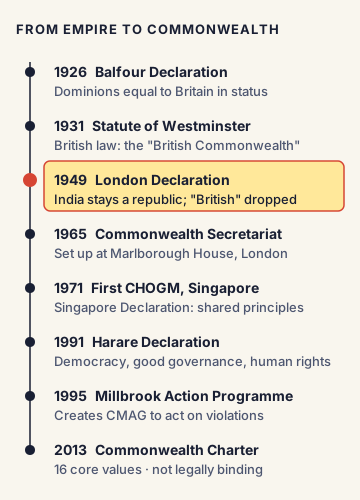
- Singapore Declaration (1971): First statement of shared principles: world peace, individual liberty, opposition to racism and to colonial rule.
- Harare Declaration (1991): Made democracy, good governance and human rights the core political values.
- Millbrook Action Programme (1995): Created CMAG to act when the Harare values are seriously broken.
- Commonwealth Charter (2013): One document listing all 16 core values. It is not legally binding.
Who can join?
Membership is voluntary. Rules adopted at the 2007 Kampala summit say a new member should, as a general rule, have a historic constitutional link to an existing member, accept Commonwealth values and the Head of the Commonwealth, and use English for Commonwealth business. Exceptions are allowed. Mozambique (1995), Rwanda (2009), and Gabon and Togo (2022) joined without ever being British colonies. Gabon and Togo became the 55th and 56th members at the Kigali summit in 2022.
Who are the members?
The Commonwealth has 56 members with a combined population of about 2.7 billion people. More than 60% are aged 29 or under. 33 members are "small states", usually with populations of 1.5 million or less. Members fall into three types:
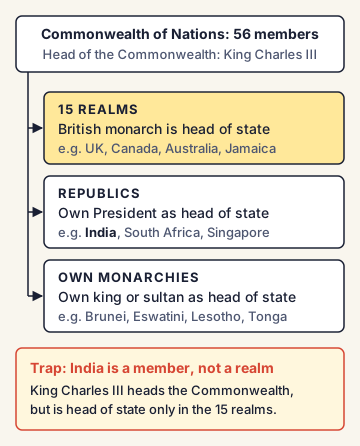
- Commonwealth realms: 15 countries, including the UK, Canada, Australia, New Zealand and Jamaica, where the British monarch is still the head of state.
- Republics: Countries like India, South Africa and Singapore, with their own elected or appointed head of state.
- Own monarchies: Countries like Brunei, Eswatini, Lesotho and Tonga, which have their own kings or sultans.
Barbados stopped being a realm and became a republic on 30 November 2021, but it stayed in the Commonwealth.
Exits and suspensions
Countries have left and come back many times. Ireland left in 1949. South Africa left in 1961 because of apartheid and returned in 1994. Pakistan left in 1972 (after the Commonwealth recognised Bangladesh) and returned in 1989. Zimbabwe left in 2003. The Gambia left in 2013 and returned in 2018. The Maldives left in 2016 and returned in 2020. Gabon was partly suspended after a 2023 coup; CMAG lifted the suspension in July 2025 after elections.
India's position and Indian examples
India is the largest member by population, so it holds roughly half of all Commonwealth citizens. India's choice in 1949 to stay as a republic created the modern Commonwealth. India hosted CHOGM in New Delhi in 1983 and the Commonwealth Games in Delhi in 2010. Ahmedabad was confirmed in November 2025 as host of the 2030 Commonwealth Games, the centenary edition.
India sees the Commonwealth as a useful platform to reach small island and African states, push for climate finance and present itself as a voice of the Global South.
Commonly confused concepts
- Commonwealth of Nations vs Commonwealth realm: The first is the whole 56-member group. A realm is one of only 15 members where the British monarch is head of state. India is a member, but not a realm.
- Head of the Commonwealth vs head of state: King Charles III is Head of the Commonwealth for all 56 members, but he is head of state only in the 15 realms. India's head of state is the President of India.
- High Commissioner vs Ambassador: Commonwealth members send "High Commissioners" to each other. They send "Ambassadors" to non-Commonwealth countries. The job is the same; only the name differs.
- Commonwealth vs Commonwealth of Independent States (CIS): The CIS is a separate group of former Soviet republics formed in 1991. It has nothing to do with the British Commonwealth.
Issues, criticism and the way forward
- Relevance: Critics say the Commonwealth has no binding power and no big money, so it is mostly a talking shop. Supporters reply that its informal style lets very different countries talk easily.
- Colonial past: Many members are now demanding that Britain face up to slavery and colonial exploitation. This tension is growing, especially among Caribbean and African members. In the CHOGM 2026 communique (the joint statement issued after the summit), leaders welcomed the UK government's agreement to a structured, time-bound dialogue with affected parties on the transatlantic slave trade. A time-bound dialogue is a set of planned talks with a time limit. As of November 2026, this is only a promise to talk. It is not an apology, and it is not an agreement to pay reparations (making up for a past wrong, often with money).
- Uneven discipline: CMAG suspends some members after coups but is accused of going easy on others where democracy and human rights are weak.
- Shrinking realms: More realms, like Barbados in 2021, may become republics. This changes the monarchy's role but not Commonwealth membership.
- Way forward: Experts suggest focusing on what members share: trade (the Secretariat aims to raise intra-Commonwealth trade from about US$900 billion towards US$2 trillion), climate help for small island states, debt relief, youth and digital skills.
Concepts to Know
- Dominion: A colony of the British Empire that ran its own internal affairs, like Canada or Australia in the early 1900s.
- Republic: A country whose head of state is an elected or appointed person (like a President), not a king or queen.
- Apartheid: The system of strict racial separation and discrimination by law in South Africa from 1948 to the early 1990s.
- Small Island Developing States (SIDS): Small island countries, like those in the Caribbean and Pacific, that face special risks from climate change, sea-level rise and tiny economies.
- Coup: When the army or another group takes power by force, removing the elected government.
- Members: 56; combined population about 2.7 billion; 33 small states; 15 realms
- Balfour Declaration 1926; Statute of Westminster 1931; London Declaration April 1949 (allowed India to stay as a republic)
- Secretariat set up 1965, at Marlborough House, London
- First CHOGM: Singapore, 1971 (Singapore Declaration)
- 28th CHOGM: St John's, Antigua and Barbuda, 1 to 4 November 2026; Chair-in-Office as of November 2026: Gaston Browne
- Harare Declaration 1991; Millbrook Action Programme and CMAG 1995; Commonwealth Charter 2013
- Membership rules updated at Kampala, 2007
- Non-British-colony members: Mozambique (1995), Rwanda (2009), Gabon and Togo (2022)
- Barbados became a republic on 30 November 2021 and stayed a member
- India hosted CHOGM 1983 (New Delhi) and Commonwealth Games 2010 (Delhi); Ahmedabad to host the 2030 Games
- Secretary-General (as of November 2026): Shirley Ayorkor Botchwey of Ghana, since 1 April 2025
- 6 Nov 2026Added the 28th CHOGM in Antigua and Barbuda (November 2026), the new Chair-in-Office, and the UK's agreement to dialogue on the slave trade.
● Tracked since July 11, 2026 · last seen November 05, 2026 · updates as the daily brief publishes