Reparations for Transatlantic Slavery and Colonialism
Reparations are acts by which a country or group makes up for a serious wrong it did in the past. They can include money, but also a formal apology, returning stolen objects, cancelling debts, or paying for health and education in the harmed communities. The biggest reparations debate today is about the transatlantic slave trade, in which European powers forcibly carried millions of Africans to the Americas as slaves. Caribbean and African countries now ask former slave-trading nations, especially Britain, to repair this harm.
Why does it exist?
Slavery ended in law nearly two centuries ago, but its effects did not end. Countries that were built on slave plantations were left poor, with weak schools, poor health systems and economies built around one crop like sugar. Many descendants of enslaved people still face poverty and racism. The argument for reparations is simple: when someone causes lasting harm, they should help repair it.
Think of it like a factory that polluted a river for 200 years: even after it stops, people ask it to pay for the clean-up.
What was the transatlantic slave trade?
From the early 1500s to the 1860s, European ships carried captured Africans across the Atlantic Ocean to work on plantations in the Caribbean, Brazil and North America. This was part of the "triangular trade":
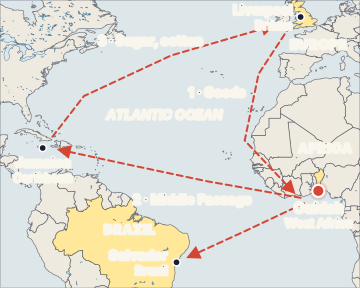
- Ships carried goods like cloth and guns from Europe to West Africa.
- There, they bought captured Africans and carried them across the Atlantic. This leg was called the "Middle Passage", where many died from disease and cruelty.
- Ships returned to Europe with sugar, cotton and tobacco produced by enslaved workers.
The Slave Voyages database estimates that about 12.5 million Africans were put on ships and about 10.7 million survived to land in the Americas. British ships carried about 3.3 million, roughly a quarter of the total.
How did slavery end in the British Empire?
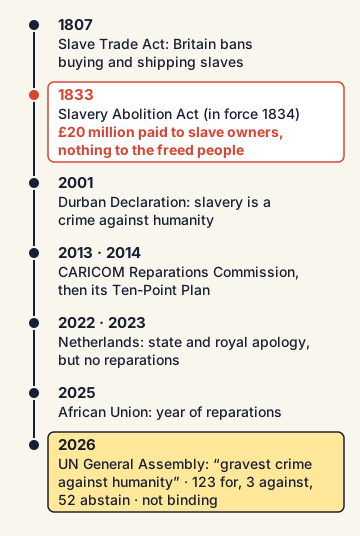
Britain banned the slave trade through the Slave Trade Act of 1807. It then abolished slavery itself through the Slavery Abolition Act of 1833, which came into force in 1834. But the government paid compensation to slave owners, not to enslaved people. It paid £20 million, about 40% of the British government's yearly spending at the time.
Part of this was raised as a loan, and the last government bonds linked to it were redeemed in 2015. The freed people got nothing; many were forced to keep working unpaid for years as "apprentices".
Where did the modern reparations demand come from?
- Durban Declaration (2001): At the UN World Conference against Racism in Durban, South Africa, countries accepted that slavery and the slave trade are a crime against humanity. The text did not create any legal duty to pay.
- CARICOM Reparations Commission (2013): The Caribbean Community (CARICOM) set up this body. In 2014 its leaders adopted a Ten-Point Plan asking for a full formal apology, debt cancellation, help with public health and education, cultural institutions, and a repatriation programme for those who wish to return to Africa.
- African Union (2025): The AU declared 2025 the year of "Justice for Africans and People of African Descent through Reparations".
- UN General Assembly (25 March 2026): A resolution moved by Ghana called the enslavement and trafficking of Africans "the gravest crime against humanity" and urged states to consider apologies and a reparations fund. It passed with 123 votes for, 3 against and 52 abstentions. Like all General Assembly resolutions, it is not legally binding.
How could reparations work?
Reparations do not have to be one big cheque. Common forms include:
- Acknowledgement and apology: A formal statement by the state accepting responsibility.
- Development support: Funds for hospitals, schools, research, and skills in the harmed regions.
- Debt cancellation: Writing off loans owed by poor former colonies.
- Restitution: Returning stolen artefacts, remains and archives.
- Memory and education: Museums, school syllabus changes and memorial days, such as the UN's International Day of Remembrance of the Victims of Slavery on 25 March.
Examples from around the world
- Netherlands: The Dutch Prime Minister formally apologised for the state's role in slavery on 19 December 2022. King Willem-Alexander apologised on 1 July 2023, the 150th anniversary of abolition in Suriname. The government did not agree to pay reparations.
- Germany and Namibia: In 2021, Germany recognised that its colonial forces committed genocide against the Herero and Nama peoples (1904–1908) and promised €1.1 billion of development projects over 30 years. Germany called it a gesture, not legal reparations, and many affected communities rejected it.
- United Kingdom: The UK has expressed "deep sorrow" over slavery but has not made a formal state apology and says it does not pay reparations.
India's position and Indian examples
India was not part of the transatlantic slave trade, but it has its own colonial wounds. After slavery was abolished, the British needed new cheap workers for plantations. From 1834, more than a million Indians were sent as "indentured labourers" (workers bound by a contract for several years) to Mauritius, Fiji, Trinidad, Guyana, South Africa and other colonies.
They were called "girmitiyas", from the word "agreement". Conditions were so harsh that it was called "a new system of slavery". The system was ended in 1917 after a long Indian protest movement. India also has a separate debate about the wealth drained from India under colonial rule and about returning artefacts like the Kohinoor.
At the UN, India generally supports Global South calls for historical justice, but it has not made formal reparation claims against Britain.
Commonly confused concepts
- Reparations vs compensation: Compensation is money for a specific loss. Reparations are wider: they include apology, development, debt relief and memory, not just cash.
- Apology vs "expression of regret": A formal apology accepts responsibility. An expression of regret or sorrow only says something bad happened, without legal admission. Governments often choose regret to avoid legal claims.
- Abolition of the slave trade (1807) vs abolition of slavery (1833): The first banned buying and shipping slaves. The second freed people who were already enslaved.
- Slavery vs indentured labour: A slave was owned as property for life, and children were born into slavery. An indentured labourer signed a contract for a fixed period (often five years) and was paid wages, although in practice many were cheated and badly treated.
- Crime against humanity vs genocide: A crime against humanity is a widespread or systematic attack on civilians (like enslavement). Genocide is acts done with the intent to destroy a national, ethnic, racial or religious group.
Issues, criticism and the way forward
- Arguments for: Former slave-trading nations grew rich partly from slave labour, while the harmed regions still suffer the effects. International law accepts that wrongful acts create a duty to repair. Even a symbolic apology can heal relations.
- Arguments against: Opponents say today's taxpayers should not pay for crimes committed centuries ago, and that it is hard to fix who should pay and who should receive. They also worry about legal liability and the huge sums some studies claim.
- Legal gap: Slavery was legal under the laws of those times. International law generally does not apply new rules backwards, so courts have not ordered payments.
- Way forward: Many experts suggest non-cash forms first: formal apologies, debt relief, climate and development funds for Caribbean and African states, return of artefacts, and joint research and education. Dialogue platforms like the Commonwealth and the UN are seen as the places to agree a framework.
Concepts to Know
- Plantation: A very large farm growing one cash crop, such as sugar, cotton or tobacco, for sale abroad. Colonial plantations used slave labour.
- CARICOM (Caribbean Community): A group of 15 Caribbean countries that work together on trade, foreign policy and development.
- Repatriation: Sending people (or objects) back to their country of origin.
- Restitution: Giving back something that was wrongly taken, such as a stolen statue or manuscript.
- Non-binding resolution: A decision of a body like the UN General Assembly that shows world opinion but cannot be enforced by law.
- About 12.5 million Africans shipped; about 10.7 million landed (1500s–1860s); British ships carried about a quarter
- Slave Trade Act 1807; Slavery Abolition Act 1833 (in force 1834)
- £20 million compensation paid to slave owners, about 40% of UK government annual spending in 1833
- Durban Declaration (2001): slavery and the slave trade a crime against humanity
- CARICOM Reparations Commission 2013; Ten-Point Plan 2014
- AU theme for 2025: reparations
- UNGA resolution, 25 March 2026: "gravest crime against humanity"; 123 for, 3 against, 52 abstentions
- Dutch state apology 19 December 2022; royal apology 1 July 2023
- Germany-Namibia 2021: €1.1 billion over 30 years
- Indian indenture: began 1834 (Mauritius), ended 1917
● Tracked since November 02, 2026 · last seen November 02, 2026 · updates as the daily brief publishes