Committee for Control and Supervision of Experiments on Animals (CCSEA)
How India Regulates Animal Experiments
The Committee for Control and Supervision of Experiments on Animals (CCSEA) is the national body that controls how animals are used in scientific experiments in India. It registers every laboratory that keeps or tests on animals, makes rules for how experiments must be done, and inspects labs to check that animals are not made to suffer without need.
It is a statutory body: it gets its power from a law, Section 15 of the Prevention of Cruelty to Animals Act, 1960. Until recently it was called CPCSEA (Committee for the Purpose of Control and Supervision of Experiments on Animals).
Why does it exist?
New medicines, vaccines and medical devices are often first tested on animals such as mice, rats, rabbits and monkeys before they are tried on people. This testing is allowed by law because it can save human and animal lives. But without rules, animals could be kept in poor cages, cut open without pain relief, or used again and again.
CCSEA exists to balance two goals: allowing useful science, and making sure animals do not suffer more than is truly necessary. Think of it like a traffic police for labs: it does not stop the traffic of research, but it makes sure everyone follows the rules of the road.
What does the law say? (Chapter IV of the PCA Act, 1960)
The rules on experiments sit in Chapter IV of the Act, in Sections 14 to 20:
- Section 14: Experiments on animals are not illegal if they are done to gain new knowledge about the body, to save or prolong life, to reduce suffering, or to fight disease in humans, animals or plants.
- Section 15: The Central Government, on the advice of the Animal Welfare Board of India, may set up a committee of officials and non-officials to control and supervise experiments. This is CCSEA. Section 15A lets it form sub-committees.
- Section 17: CCSEA must make sure animals are not put through unnecessary pain before, during or after experiments. It can make rules for this, but only after previous publication (a draft must first be published for comments).
- Section 18: CCSEA can authorise officers to enter and inspect any place where experiments are done, at any reasonable time, and ask for records.
- Section 19: If rules are broken, CCSEA can, after hearing the institution, ban it from doing experiments for a fixed time or forever, or allow experiments only under special conditions.
- Section 20: Breaking such an order is punishable with a fine of up to ₹200. If it happens in an institution, the person in charge is held guilty.
What must the rules aim for? (Section 17(2)) The Act itself lists the goals that every rule must serve. This list is important, because critics test any new rule against it:
- The person in charge of an institution is responsible for its experiments.
- Experiments are done with care and humanity, and operations are done under anaesthesia strong enough to stop the animal feeling pain, as far as possible.
- An animal injured so badly under anaesthesia that recovery would mean serious suffering is normally put to death while still unconscious.
- Experiments are avoided where books, models or films would work equally well, for example in medical colleges.
- Larger animals are avoided when the same result can be got from small lab animals like guinea pigs, rabbits, frogs and rats.
- Experiments are not done merely to gain manual skill (Section 17(2)(f)).
- Animals are properly looked after before and after experiments, and proper records are kept.
Where did it come from?
The PCA Act was passed in 1960, and the committee was first formed under Section 15 soon after, reportedly in 1964 [Unverified]. The first detailed rules were the Experiments on Animals (Control and Supervision) Rules, 1968. The Act was amended in 1982 to let the committee require registration of labs and reports from them. Stronger rules came with the Breeding of and Experiments on Animals (Control and Supervision) Rules, 1998, later amended in 2001 and 2006.
For years the committee worked under the Ministry of Environment, Forest and Climate Change. Today the animal welfare subject, including CCSEA and the Animal Welfare Board of India, is handled by the Department of Animal Husbandry and Dairying in the Ministry of Fisheries, Animal Husbandry and Dairying (set up in 2019). The committee's name was changed from CPCSEA to CCSEA, as reported in January 2023.
How does the system work today?
The system has two levels, a central one and one inside each lab:
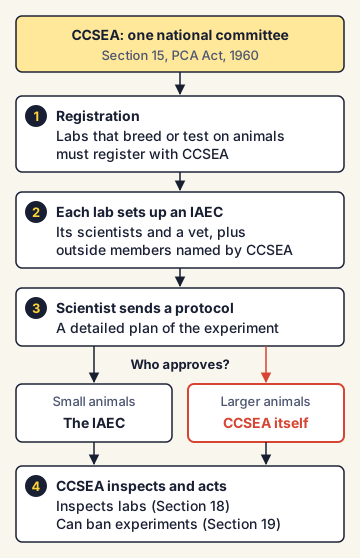
- Registration: Every establishment that breeds animals for research or does experiments on them must register with CCSEA.
- Institutional Animal Ethics Committee (IAEC): Each registered establishment sets up its own IAEC. It includes the institution's scientists and a veterinarian, plus outside members nominated by CCSEA, such as a "main nominee" and a "socially aware" (non-scientist) nominee. The outside members are meant to give an independent view.
- Approval: A scientist who wants to do an experiment sends a protocol (a detailed plan) to the IAEC. Under the 1998 rules, experiments on small animals were approved by the IAEC, while experiments on larger animals needed CCSEA's own approval.
- Inspection and action: CCSEA inspects facilities and can suspend or cancel registration, or ban experiments under Section 19.
The 3Rs: the core ethical idea
Animal research rules across the world rest on the 3Rs, put forward by William Russell and Rex Burch in their 1959 book The Principles of Humane Experimental Technique:
- Replacement: use methods without animals wherever possible (cell cultures, computer models, "organ-on-a-chip" devices).
- Reduction: use the smallest number of animals that still gives reliable results.
- Refinement: change methods so that animals feel the least possible pain and stress (better pain relief, better housing).
Section 17(2)(d) and (e) of India's 1960 Act already reflect the spirit of Replacement and Reduction, decades before the term became popular.
India's other steps away from animal testing
- Cosmetics: In May 2014, Rule 148-C was added to the Drugs and Cosmetics Rules, 1945, banning testing of cosmetics on animals in India. In October 2014, Rule 135-B banned the import of cosmetics tested on animals (in force from 13 November 2014). These bans continue under the Cosmetics Rules, 2020.
- Medicines: In March 2023, an amendment to the New Drugs and Clinical Trials Rules, 2019 (G.S.R. 175(E)) allowed non-animal methods, such as cell-based tests, organ chips and computer modelling, to be used in drug testing, alongside animal studies.
Commonly confused concepts
- CCSEA vs Animal Welfare Board of India (AWBI): AWBI (Section 4 of the PCA Act) is an advisory body on animal welfare in general. CCSEA (Section 15) deals only with animals used in experiments. AWBI advises the government on setting up CCSEA.
- CCSEA vs IAEC: CCSEA is one national committee. An IAEC is a local committee inside each registered lab.
- PCA Act vs Wildlife (Protection) Act, 1972: The PCA Act protects animals from cruelty, whether domestic or wild. The Wildlife Act protects wild species and their habitats through Schedules. A wild animal used in a lab needs to satisfy both laws.
- Cosmetic testing ban vs drug testing: Animal testing of cosmetics is banned in India. Animal testing of medicines is still allowed, though non-animal methods are now accepted too.
- CCSEA (new name) vs CPCSEA (old name): Same body. Older papers and lab registration numbers still carry "CPCSEA".
Issues, criticism and the way forward
- Independence of oversight: Animal welfare groups argue that letting a lab's own committee approve most experiments, where employees form the majority, reduces independent checks. Supporters of easier rules say central approval for every experiment slows research.
- Weak penalties: The fine under Section 20 is only up to ₹200, set in the original Act. Many experts say this does not deter violations.
- Old law, new science: Drug makers and regulators abroad are moving towards non-animal methods (often called New Approach Methodologies). Critics say Indian rules should push labs harder to use them.
- Research needs: Scientists and industry point out that many vaccines and medicines still cannot be tested without animals, and that clear, fast approvals help India's pharmaceutical sector.
- Way forward suggested by experts: keep independent nominees with real power in ethics committees, make inspections surprise checks, raise penalties, publish yearly data on animals used, and fund validated alternatives to animal tests.
Concepts to Know
- Statutory body: An organisation created by or under a law passed by Parliament or a state legislature, which gets its powers from that law.
- Anaesthesia and analgesia: Anaesthesia makes an animal (or person) unconscious or numb so it feels no pain during an operation. Analgesia means pain relief, such as painkillers given afterwards.
- Non-recovery experiment: An experiment done fully under anaesthesia, at the end of which the animal is put to death without waking up.
- Lagomorphs: The group of animals that includes rabbits and hares. Rodents are rats, mice, guinea pigs and similar animals.
- Protocol: A written plan of an experiment, listing the animals, numbers, steps, pain relief and end point.
- Euthanasia: Putting an animal to death in a painless way to end or avoid suffering.
- CCSEA: statutory body under Section 15 of the PCA Act, 1960; formerly CPCSEA; now under the Department of Animal Husbandry and Dairying, Ministry of Fisheries, Animal Husbandry and Dairying
- Chapter IV of the PCA Act (Sections 14–20) covers experiments on animals
- Section 17(1): rules only after previous publication; Section 17(2): goals including anaesthesia, avoiding larger animals, no experiments merely for manual skill
- Section 18: inspection; Section 19: power to ban experiments; Section 20: fine up to ₹200
- Rules: 1968 Rules; Breeding of and Experiments on Animals (Control and Supervision) Rules, 1998 (amended 2001, 2006)
- 3Rs (Replacement, Reduction, Refinement): Russell and Burch, 1959
- Cosmetics: Rule 148-C (May 2014) bans testing; Rule 135-B (in force 13 November 2014) bans import of animal-tested cosmetics
- New Drugs and Clinical Trials Rules amended in March 2023 to allow non-animal testing methods
● Tracked since November 02, 2026 · last seen November 02, 2026 · updates as the daily brief publishes