Prevention of Cruelty to Animals Act, 1960
The Prevention of Cruelty to Animals Act, 1960 (often called the PCA Act) is India's main law that protects animals from unnecessary pain and suffering. It lists acts that count as cruelty, sets punishments, and created the Animal Welfare Board of India (AWBI) to advise the government. It covers almost all animals: pets, farm animals, working animals, performing animals and animals used in experiments.
Why was this law needed?
Animals cannot complain or go to court. Without a law, nothing would stop a person from overloading a bullock, starving a dog or beating a horse. The law puts a duty on every person who keeps an animal to look after it. It also lets the state punish those who are cruel. It reflects a value in our Constitution: compassion for living creatures.
Where did it come from?
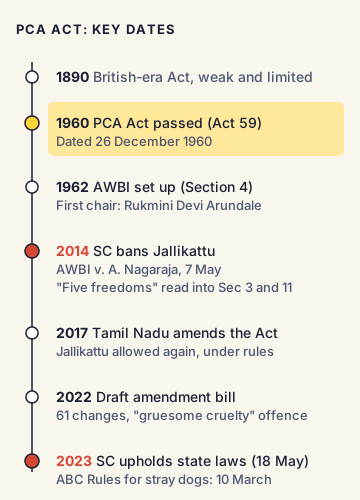
British India had an older law, the Prevention of Cruelty to Animals Act, 1890, which was weak and limited. After independence, there was a push for a stronger law. The well-known dancer and animal welfare activist Rukmini Devi Arundale, then a member of the Rajya Sabha, played a key role. Parliament passed the new law as Act 59 of 1960, dated 26 December 1960.
The Animal Welfare Board of India was set up under it in 1962, with Rukmini Devi Arundale as its founding chairperson. The Act was amended later, including in 1982.
What is the constitutional basis?
- Entry 17 of the Concurrent List (List III, Seventh Schedule) is "Prevention of cruelty to animals". This means both Parliament and state legislatures can make laws on it.
- Article 51A(g) (a Fundamental Duty) asks every citizen to protect the natural environment and "to have compassion for living creatures".
- Article 48 (a Directive Principle) asks the state to organise agriculture and animal husbandry on modern lines and to protect cattle breeds.
The key parts of the Act
The Act is arranged in chapters. The sections UPSC can ask about are:
- Section 2(a): "Animal" means any living creature other than a human being. This is a very wide definition.
- Section 3: Every person who has the care or charge of an animal has a duty to take all reasonable steps for its well-being and to prevent unnecessary pain or suffering.
- Section 4: Sets up the Animal Welfare Board of India. Section 5 describes its members (including six Members of Parliament: four from the Lok Sabha and two from the Rajya Sabha) and says the Central Government nominates its Chairman. Section 9 lists its functions.
- Section 11: Lists acts of cruelty, such as beating, kicking, overloading, torturing, starving, keeping an animal in a too-small cage, using an unfit animal for work, and abandoning an animal.
- Section 12: Punishes phooka or doom dev (cruel methods used on milch animals to get more milk).
- Sections 14 to 20 (Chapter IV): Deal with experiments on animals. Experiments for medical and scientific progress are allowed, but Section 15 lets the Centre set up a committee to control and supervise them. This is the Committee for Control and Supervision of Experiments on Animals (CPCSEA).
- Sections 21 to 27 (Chapter V): Deal with performing animals (animals used in shows or films). Under Section 22, no one can exhibit or train a performing animal unless registered, and the Centre can notify animals that must not be used for performance at all.
- Section 28: Killing an animal in a manner required by the religion of any community is not an offence under this Act.
- Section 38: Lets the Central Government make rules.
What are the punishments?
Under Section 11, the first offence is punished with a fine of at least ₹10, which may go up to ₹50. For a repeat offence within three years, the fine is at least ₹25 and up to ₹100, or jail for up to three months, or both. These amounts were fixed long ago and are now seen as far too small. Under Section 31, some serious offences are cognizable, which means the police can arrest without a warrant.
What does Section 11 not cover?
Section 11(3) lists exceptions. It does not apply to dehorning, castration, branding or nose-roping of animals done in the prescribed way; killing of animals for food, unless it causes unnecessary pain; killing of animals under the authority of another law; and experiments covered by Chapter IV.
How does it work in practice?
The Act is enforced through rules and local bodies:
- Societies for the Prevention of Cruelty to Animals (SPCAs) at district level, and police, act on complaints.
- Rules made under the Act cover specific areas, for example rules on transport of animals, livestock markets, slaughterhouses, performing animals, and dog breeding.
- The Animal Birth Control Rules, 2023 were notified on 10 March 2023. They replaced the 2001 rules on dogs. They make local bodies (municipalities and panchayats) responsible for sterilising and vaccinating stray dogs, through organisations recognised by the AWBI.
- The AWBI is now headquartered at Ballabhgarh, Faridabad (Haryana), having moved from Chennai. It works under the Ministry of Fisheries, Animal Husbandry and Dairying.
Key court cases
- Animal Welfare Board of India v. A. Nagaraja (2014): On 7 May 2014, the Supreme Court banned Jallikattu (bull-taming in Tamil Nadu) and bullock-cart races. It held that these violate Sections 3 and 11 of the Act. It also read the "five freedoms" of animals into Sections 3 and 11: freedom from hunger, thirst and malnutrition; from fear and distress; from physical and thermal discomfort; from pain, injury and disease; and freedom to express normal behaviour.
- Tamil Nadu amendment (2017): In January 2017, Tamil Nadu amended the PCA Act for the state to allow Jallikattu under rules. Karnataka and Maharashtra did the same for Kambala and bullock-cart races.
- Animal Welfare Board of India v. Union of India (2023): On 18 May 2023, a five-judge Constitution Bench upheld these state amendments. It said states have the power to make such laws under Entry 17 of the Concurrent List. It left the question of whether Jallikattu is part of Tamil Nadu's culture to the legislature.
Commonly confused concepts
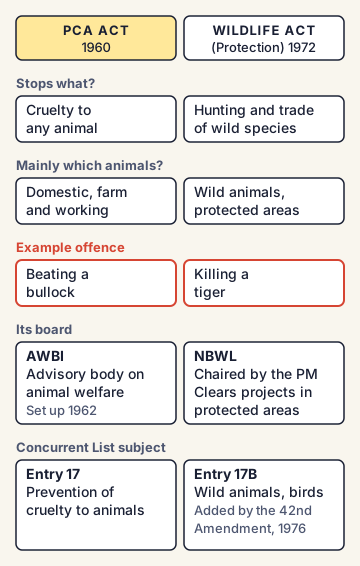
- PCA Act, 1960 vs Wildlife (Protection) Act, 1972: The PCA Act is about cruelty to any animal, mainly domestic, farm and working animals. The Wildlife (Protection) Act is about protecting wild species from hunting and trade, and about protected areas. Killing a tiger is a wildlife crime; beating a bullock is a PCA Act offence.
- AWBI vs NBWL: The AWBI is an advisory body on animal welfare under the PCA Act. The National Board for Wildlife (NBWL) is a body under the Wildlife (Protection) Act, chaired by the Prime Minister, which approves projects in protected areas.
- Entry 17 vs Entry 17B (Concurrent List): Entry 17 is "Prevention of cruelty to animals". Entry 17B, "Protection of wild animals and birds", was added by the 42nd Amendment (1976).
- CPCSEA vs Institutional Animal Ethics Committee: The CPCSEA is the national committee under Section 15. Each lab that uses animals has its own ethics committee, registered with and reporting to it.
Issues, criticism and the way forward
- Very low fines: A fine of ₹10 to ₹50 does not deter anyone today. In 2022, the Ministry released a draft Prevention of Cruelty to Animals (Amendment) Bill, 2022 with 61 changes. It proposed a new category of "gruesome cruelty" (including bestiality) with fines of ₹50,000 to ₹75,000 or the cost of the animal, and jail of one to three years, and up to five years' jail for killing an animal. As of October 2026, this has not become law [Unverified].
- Weak enforcement: SPCAs are inactive in many districts, and police often do not register cases.
- Tradition vs welfare: Sports like Jallikattu and Kambala show a clash between cultural practice and animal welfare. The 2023 judgment allowed them under rules, but critics say cruelty still happens.
- Exemptions: Section 28 (religious killing) and Section 11(3) (food and farming practices) leave large areas outside the law.
- Factory farming: Intensive poultry and pig farms are expanding. Experts say rules on space, transport and slaughter need stronger enforcement.
- Way forward: Raise penalties, make more offences cognizable, fund and revive SPCAs, train police, and link animal welfare to public health under One Health.
Concepts to Know
- Concurrent List: A list of subjects in the Seventh Schedule of the Constitution on which both Parliament and state legislatures can make laws. If they clash, the central law usually prevails.
- Fundamental Duties: Duties of citizens listed in Article 51A. Courts cannot directly enforce them, but they guide how laws are read.
- Cognizable offence: An offence for which the police can register a case and arrest without a court's warrant.
- Statutory body: A body created by a law passed by Parliament or a state legislature. The AWBI is a statutory body under the PCA Act.
- Jallikattu: A traditional sport in Tamil Nadu, held around the Pongal festival, in which people try to hold on to the hump of a running bull.
- Act 59 of 1960, dated 26 December 1960; replaced the 1890 Act
- Section 2(a): animal = any living creature other than a human being
- Section 3: duty of persons in charge of animals; Section 11: cruelty; Section 12: phooka/doom dev
- Section 4: AWBI (set up 1962; first chairperson Rukmini Devi Arundale; HQ now Ballabhgarh, Haryana)
- Section 15: CPCSEA (experiments); Section 22: performing animals; Section 28: religious killing exempt; Section 38: rule-making
- Penalty (Section 11): first offence ₹10 to ₹50; repeat within 3 years ₹25 to ₹100 and/or jail up to 3 months
- Constitutional basis: Entry 17, Concurrent List; Article 51A(g); Article 48
- AWBI v. A. Nagaraja: 7 May 2014 (five freedoms; Jallikattu banned); Constitution Bench upheld state amendments: 18 May 2023
- Animal Birth Control Rules, 2023: notified 10 March 2023
- Draft PCA (Amendment) Bill, 2022: 61 amendments; "gruesome cruelty" fine ₹50,000 to ₹75,000
● Tracked since October 22, 2026 · last seen October 22, 2026 · updates as the daily brief publishes