Chirality
Molecular Handedness and Enantiomers
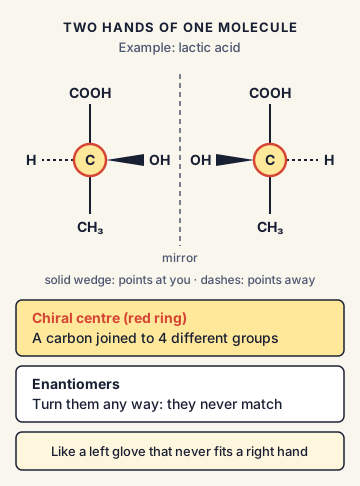
Chirality is the property of an object that cannot be placed exactly on top of its mirror image. Your two hands are the best example: they are mirror images, but a left glove never fits a right hand. Many molecules are like this too. Such a molecule exists in two forms, a "left-handed" one and a "right-handed" one, and these two forms are called enantiomers.
Why does handedness matter at all?
The two enantiomers of a molecule have the same atoms, joined in the same order. They have the same melting point, boiling point and weight. Yet inside a living body they can behave very differently. This is because our body is itself built from handed molecules. The receptors and enzymes in our cells are like right-handed gloves. A right-handed molecule may fit perfectly, while its left-handed twin fits badly or does something else entirely.
Where does the word come from?
The word "chirality" comes from the Greek word cheir, meaning hand. The British scientist Lord Kelvin introduced the term in the 1890s (the year is usually given as 1894; some sources say 1904, when his lectures were published). The idea itself is older:
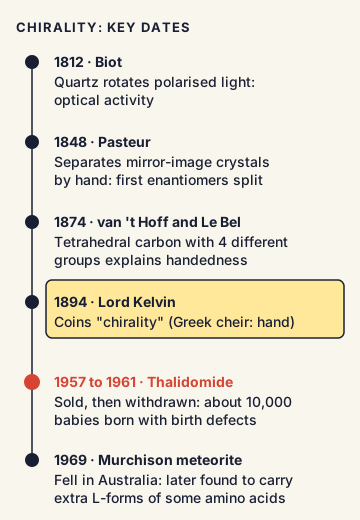
- 1812–1815: French physicist Jean-Baptiste Biot saw that some substances (quartz, and later solutions of sugar, camphor and tartaric acid) rotate polarised light. This is called optical activity.
- 1848: Louis Pasteur looked at crystals of a salt of tartaric acid under a lens. He found two types of crystals that were mirror images of each other and separated them by hand with tweezers. Each type rotated light in the opposite direction. This was the first separation of enantiomers.
- 1874: Jacobus van 't Hoff and Joseph Le Bel, working separately, explained why. A carbon atom forms four bonds pointing to the corners of a tetrahedron (a pyramid with a triangle base). If the four groups attached are all different, two mirror-image arrangements are possible.
How does a molecule become chiral?
The most common cause is a carbon atom joined to four different groups. This carbon is called a chiral centre or stereocentre. Think of a carbon atom holding four different coloured balls on four sticks. You can arrange them in two ways that are mirror images, and no amount of turning will make one look like the other. A molecule can also be chiral without such a carbon, for example when its whole shape twists like a spiral staircase (DNA's double helix is right-handed).
How do scientists name the two forms?
There are three common systems, and students often mix them up:
- (+) and (−), or d and l: based on what you measure. A (+) form rotates polarised light to the right (clockwise); a (−) form rotates it to the left.
- D and L: an older system based on comparing a molecule with a reference sugar (glyceraldehyde). It is still used for sugars and amino acids.
- R and S: a modern rule-based system (the Cahn-Ingold-Prelog rules). You rank the four groups on the chiral centre and see if they go clockwise (R, from Latin rectus, right) or anticlockwise (S, from sinister, left).
These systems are independent. An L-amino acid is not automatically (−) or S. Each must be found separately.
What is a racemic mixture?
When chemists make a chiral molecule in an ordinary lab reaction, they usually get both hands in equal amounts, 50:50. This is called a racemic mixture or racemate. It does not rotate light at all, because the two forms cancel each other out. The purity of a sample is measured as enantiomeric excess (ee): the percentage of the major form minus the percentage of the minor form. A 75:25 mixture has 50% ee; a pure single form has 100% ee.
Homochirality: life uses only one hand
Living things are strikingly one-sided:
- The amino acids that build proteins are almost all of the L form.
- The sugars in DNA and RNA (deoxyribose and ribose) are of the D form.
This single-handedness of life is called homochirality. Non-living chemistry normally makes 50:50 mixtures, so scientists have long asked how life came to pick one hand. Some meteorites, such as the Murchison meteorite that fell in Australia in 1969, carry an excess of L-forms of some amino acids (such as isovaline, first reported from 1997 onwards), which suggests a small bias may have arrived from space.
But a small bias still has to be amplified into near-total one-handedness. This is where the 2026 Nobel-winning work comes in.
Chirality and medicines
Because our body is handed, the two enantiomers of a drug can act very differently:
- Thalidomide: Sold from 1957 as a sedative and for morning sickness in pregnant women, it was withdrawn in 1961. Around 10,000 babies were born with severe birth defects. One enantiomer was linked to the sedative effect and the other to the birth defects. Worse, the two forms convert into each other inside the body, so even giving a pure form would not have been safe.
- Carvone: The R form smells of spearmint; the S form smells of caraway seeds. Our nose's receptors can tell the two hands apart.
- Ibuprofen: Only the S form relieves pain. The body slowly converts much of the R form into the S form.
Since the 1990s, drug regulators in many countries expect companies to study each enantiomer of a new chiral drug separately. Many companies now sell the single useful enantiomer of an older racemic drug. This is called a chiral switch. Familiar examples on Indian pharmacy shelves are esomeprazole (the S form of omeprazole, an acid reducer), levocetirizine (the active form of the anti-allergy drug cetirizine) and escitalopram (from citalopram, an antidepressant).
India's position
India is a major maker of generic medicines and active pharmaceutical ingredients. So the ability to make single-enantiomer drugs cheaply and purely matters for Indian pharma exports and for patient safety. Chirality also matters in agriculture, since many pesticides and herbicides are chiral, and only one form may be active.
Commonly confused concepts
- Enantiomers vs diastereomers: Enantiomers are exact mirror images (like left and right hands). Diastereomers are stereoisomers that are not mirror images; they have different physical properties such as melting point.
- Chiral vs achiral: An achiral object (a plain sphere, a cup without design, water, methane) is the same as its mirror image. Only chiral objects have two hands.
- Optical activity vs chirality: Chirality is the structural property. Optical activity (rotating polarised light) is one measurable result of it. A racemic mixture is made of chiral molecules but shows no optical activity overall.
- D/L vs R/S vs (+)/(−): three different naming systems, as explained above. They do not automatically match.
- Structural isomers vs stereoisomers: Structural isomers have atoms joined in a different order. Stereoisomers (including enantiomers) have the same order but a different 3D arrangement.
Issues, criticism and the way forward
- Separation is costly: Separating the two hands from a racemic mixture (called resolution) wastes up to half the material. This pushed chemists to develop methods that make only the desired hand from the start (asymmetric synthesis).
- Testing burden: Studying both enantiomers adds time and cost to drug development, which affects the price of medicines.
- Chiral switches and patents: Critics argue that some chiral switches are used mainly to extend patent life, with only small clinical benefit over the older racemic drug. Supporters point to cases where the pure form gives a cleaner effect or fewer side effects.
- Unsolved science: The origin of homochirality in life is still not fully explained. Amplification mechanisms like those of Kagan and Soai offer a plausible route, but the actual first source of the bias is still debated.
Concepts to Know
- Molecule: The smallest unit of a substance, made of atoms joined together. Water (H₂O) is one oxygen atom joined to two hydrogen atoms.
- Isomers: Molecules with the same atoms (same formula) but arranged differently.
- Stereoisomers: Isomers whose atoms are joined in the same order but point in different directions in 3D space.
- Polarised light: Ordinary light waves vibrate in all directions. Polarised light vibrates in only one direction, like light passing through polaroid sunglasses.
- Receptor: A protein in or on our cells that a specific molecule fits into, like a key into a lock, to start an effect in the body.
- Enzyme: A protein that speeds up a chemical reaction inside living things. Enzymes are themselves chiral.
- Teratogen: A substance that causes birth defects when a pregnant woman is exposed to it. Thalidomide is the best-known example.
- "Chirality" from Greek cheir (hand); term introduced by Lord Kelvin (commonly dated 1894)
- Biot: optical activity (1812 quartz; 1815 organic substances)
- Pasteur, 1848: first separation of enantiomers (tartaric acid salt crystals, by hand)
- van 't Hoff and Le Bel, 1874: tetrahedral carbon explains chirality
- Racemic mixture = 50:50, no net optical rotation; enantiomeric excess (ee) = major % − minor %
- Life: L-amino acids in proteins, D-sugars in DNA/RNA (homochirality)
- Thalidomide: sold from 1957, withdrawn 1961, about 10,000 babies affected; the enantiomers interconvert in the body
- Carvone: R = spearmint smell, S = caraway smell
● Tracked since October 11, 2026 · last seen October 11, 2026 · updates as the daily brief publishes