Asymmetric Catalysis
How Chemists Make One Mirror-Image Form
Asymmetric catalysis is a way of making mostly one enantiomer (one "hand") of a chiral molecule instead of a 50:50 mixture. It uses a small amount of a chiral catalyst, a helper substance that is itself handed. The catalyst guides each reaction so that one hand of the product forms much faster than the other. One small batch of catalyst can produce a very large amount of product.
Why is it needed?
Ordinary chemical reactions give racemic (50:50) mixtures of chiral products. For medicines, often only one hand works, and the other may be useless or even harmful. Separating the two hands afterwards wastes half the material and money. It is like a factory making equal numbers of left and right shoes when every customer wants only right shoes. Asymmetric catalysis lets the factory make mainly right shoes from the start.
What is a catalyst, in simple words?
A catalyst is a substance that speeds up a chemical reaction without being used up. It works by giving the reaction an easier path, lowering the "energy hill" (activation energy) that molecules must climb to react. The iron catalyst in the Haber process (used to make ammonia for fertilisers) and the enzymes in our body are examples. A chiral catalyst is one that is itself left- or right-handed. Its shape works like a hand-shaped mould, so only one hand of product fits easily.
How does it work, step by step?
- The starting material (often not chiral itself) meets the chiral catalyst.
- The catalyst holds the starting material in a fixed position, blocking one side of it.
- The new bond can form easily only from the open side, so one hand of the product forms.
- The product leaves, and the catalyst is free to repeat the job thousands of times.
Most chiral catalysts fall into three families: metal complexes (a metal atom surrounded by chiral organic molecules called ligands), enzymes (nature's own chiral catalysts), and organocatalysts (small, metal-free organic molecules).
Where did it come from?
The field grew in steps, and the Nobel Prize has recognised it three times:
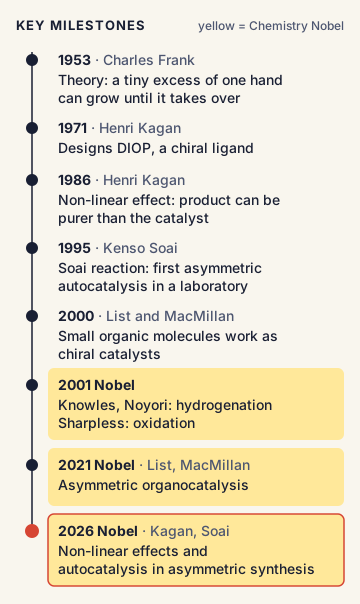
- Late 1960s–1970s: William Knowles at the US company Monsanto used a chiral rhodium catalyst for hydrogenation (adding hydrogen to a molecule). This led to the first industrial catalytic asymmetric synthesis, of L-DOPA, a drug for Parkinson's disease.
- 1971: Henri Kagan designed DIOP, a chiral ligand for rhodium, and got high enantiomeric excess in hydrogenation. Its two-fold symmetric (C2) design became a model for many later ligands.
- 1980s: Ryoji Noyori developed the BINAP family of catalysts for hydrogenation, and K. Barry Sharpless developed asymmetric oxidation methods, including the Sharpless epoxidation.
- 2001 Nobel Prize: Knowles and Noyori (for chirally catalysed hydrogenation) and Sharpless (for chirally catalysed oxidation).
- 2000: Benjamin List and David MacMillan, independently, showed that small organic molecules can act as chiral catalysts. They received the 2021 Nobel Prize for "asymmetric organocatalysis".
- 2026 Nobel Prize: Kagan and Kenso Soai, for non-linear effects and autocatalysis in asymmetric synthesis.
The linear assumption and Kagan's non-linear effect
Chemists long assumed a simple rule: the purity of the product follows the purity of the catalyst in a straight line. If the catalyst is 50% ee, the product should have half the ee it gets with a pure catalyst. In 1986, Kagan's group at Université Paris-Sud in Orsay showed this is not always true.
They studied three reactions: a titanium-catalysed oxidation of a sulfide, the Sharpless epoxidation of geraniol, and a proline-catalysed reaction (the Hajos-Parrish reaction). In some cases, a catalyst only partly one-handed gave a product far purer than expected; for example, a catalyst mix of 75:25 could give a product of about 90:10. This is a positive non-linear effect, also called asymmetric amplification. In other cases the product was less pure than expected (a negative non-linear effect).
Why does a non-linear effect happen?
Imagine each catalyst unit is built from two handed ligands joined to one metal atom. With a mixture of left (L) and right (R) ligands, three kinds of units can form: L+L, R+R and L+R (a "mixed" unit). If the mixed units are slow or inactive, they quietly lock away equal amounts of both hands.
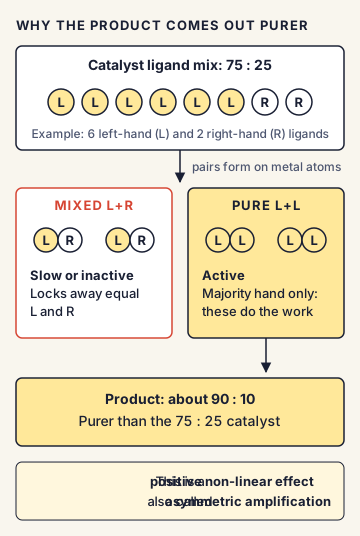
The leftover pure units are mostly of the majority hand, and they do most of the work. So the product comes out purer than the overall catalyst. Kagan also built simple mathematical models to describe this behaviour. His insight showed that the purity of the result depends on how catalyst molecules pair up, not just on the starting mix.
Soai's asymmetric autocatalysis
In an autocatalytic reaction, the product is itself the catalyst for making more of that product. Think of a rumour: each person who hears it tells more people, so it spreads faster and faster. In asymmetric autocatalysis, the chiral product speeds up the making of more molecules of its own hand.
- Around 1990, Soai's team at the Tokyo University of Science reported such a reaction with a pyridine-based alcohol, but the product purity dropped over time.
- In 1995, they reported the breakthrough: adding diisopropylzinc to pyrimidine-5-carbaldehyde gives a chiral alcohol (a pyrimidyl alkanol) that catalyses its own formation. Starting from a sample with only about 2% ee, repeated rounds pushed the product to far higher purity. This was the first asymmetric autocatalysis shown in a laboratory, now called the Soai reaction. The Nobel organisation has called it "one of the most spectacular chemical experiments ever conducted".
- Later versions amplified a tiny imbalance (around 0.00005% ee) to more than 99.5% ee. The reaction can also be "tipped" one way by chiral crystals, chiral surfaces or circularly polarised light.
The origin-of-life angle
In 1953, the physicist Charles Frank proposed a theoretical model: if a molecule catalyses its own formation and also blocks the formation of its mirror twin, a tiny random excess of one hand could grow until only that hand remains. For decades this was only an idea on paper. The Soai reaction was the first real chemical system to behave this way.
It shows that, in principle, a closed chemical system can turn a very small bias into near-total homochirality. This gives scientists a plausible route for how life's L-amino acids and D-sugars could have come to dominate. It does not prove what actually happened on early Earth.
Uses and India's interest
Asymmetric catalysis is central to modern drug making, since many top-selling medicines are single enantiomers. It is also used for flavours, fragrances and agrochemicals. Non-linear effects matter in factories too: a slightly impure, cheaper catalyst may still give a very pure product. For India, a large producer of generic drugs and active pharmaceutical ingredients, cheaper and cleaner routes to single-enantiomer drugs support both exports and affordable medicines. Indian research institutions such as CSIR laboratories and the IISERs also work on asymmetric synthesis.
Commonly confused concepts
- Catalysis vs autocatalysis: In ordinary catalysis, a separate substance speeds up the reaction. In autocatalysis, the product of the reaction is itself the catalyst.
- Asymmetric catalysis vs resolution: Asymmetric catalysis makes mainly one hand from the start. Resolution separates the two hands after a 50:50 mixture has already been made.
- Positive vs negative non-linear effect: Positive means the product is purer than the straight-line rule predicts (amplification). Negative means it is less pure than predicted.
- Organocatalysis vs metal catalysis vs enzyme catalysis: Organocatalysts are small metal-free organic molecules (2021 Nobel); metal catalysts use metal atoms with chiral ligands (2001 Nobel); enzymes are large biological proteins.
- 2001 vs 2021 vs 2026 Chemistry Nobels: 2001 was for chiral catalysts for hydrogenation and oxidation; 2021 was for asymmetric organocatalysis; 2026 is for non-linear effects and autocatalysis that amplify handedness.
Issues, criticism and the way forward
- Narrow use of the Soai reaction: The Soai reaction works for a small family of molecules under special lab conditions, using reactive zinc compounds. These would not have existed in an early-Earth setting, so it is a proof of principle, not a direct model of how life began.
- Mechanism still studied: The exact way the Soai reaction amplifies handedness took years of study by other chemists (for example Donna Blackmond, Scott Denmark and Oliver Trapp), and details are still discussed.
- Cost and metals: Many chiral catalysts use expensive or toxic metals like rhodium and ruthenium. The trend is towards cheaper metals, organocatalysts and enzymes, in line with green chemistry.
- Way forward: Using non-linear effects in industry could cut the cost of catalysts. Research on amplification continues to look for links with prebiotic chemistry and the search for life on other worlds.
Concepts to Know
- Catalyst: A substance that speeds up a reaction without being used up itself.
- Activation energy: The minimum energy molecules need to react. A catalyst lowers it, like digging a tunnel through a hill instead of climbing over it.
- Ligand: A molecule that attaches to a central metal atom in a catalyst. A chiral ligand gives the whole catalyst its handedness.
- Hydrogenation: A reaction that adds hydrogen atoms to a molecule, often used to make medicines and to harden vegetable oils.
- Epoxidation: A reaction that adds one oxygen atom across a carbon-carbon double bond, forming a three-sided ring (an epoxide).
- Enantiomeric excess (ee): A measure of purity: percentage of the major hand minus percentage of the minor hand.
- Prebiotic chemistry: The study of chemical reactions that could have happened on early Earth before life began.
- Green chemistry: Designing chemical processes that use less energy, produce less waste and avoid toxic substances.
- 2026 Nobel Prize in Chemistry: Henri B. Kagan (Université Paris-Sud, France) and Kenso Soai (Tokyo University of Science, Japan); citation: "for the discovery of non-linear effects and autocatalysis in asymmetric organic synthesis"; announced 7 October 2026; prize 12 million Swedish kronor, shared equally
- Kagan: DIOP ligand (1971); non-linear effects first reported in 1986 (Journal of the American Chemical Society)
- Soai: autocatalysis with a pyridyl alcohol (about 1990); the Soai reaction with a pyrimidyl alkanol (1995, journal Nature)
- Frank model of asymmetric autocatalysis: 1953
- 2001 Chemistry Nobel: Knowles, Noyori (hydrogenation) and Sharpless (oxidation)
- 2021 Chemistry Nobel: Benjamin List and David MacMillan (asymmetric organocatalysis)
- First industrial catalytic asymmetric synthesis: L-DOPA (Monsanto, Knowles)
● Tracked since October 11, 2026 · last seen October 11, 2026 · updates as the daily brief publishes