Child Labour (Prohibition and Regulation) Act, 1986
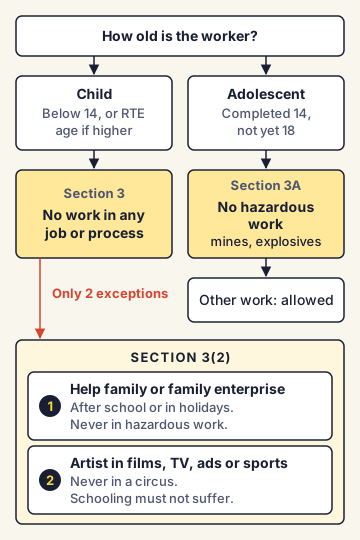
The Child Labour (Prohibition and Regulation) Act, 1986 is India's main law against child labour. Since its 2016 amendment, it is called the Child and Adolescent Labour (Prohibition and Regulation) Act, 1986. It says that no child below 14 years can be made to work in any job or process, and that adolescents aged 14 to 18 cannot work in hazardous (dangerous) jobs. It sets jail terms and fines for employers who break these rules.
Why does this law exist?
A child who works all day cannot go to school, play or grow up healthy. Work in mines, factories or with chemicals can injure a child's body for life. Poor families sometimes send children to work because they need the money, and employers like children because they are cheap and do not complain. A law with clear bans and punishments is needed to break this cycle.
Where did it come from?
The Constitution itself, through Article 24, bans children below 14 from working in factories, mines and other hazardous work. Older laws like the Employment of Children Act, 1938 also existed. In 1979 the government set up the Gurupadaswamy Committee to study child labour. It found that as long as poverty exists, child labour is hard to end fully, and suggested banning it in dangerous jobs while regulating it elsewhere. The 1986 Act followed this idea.
What did the original 1986 law do?
It did not ban all child work. It had two parts:
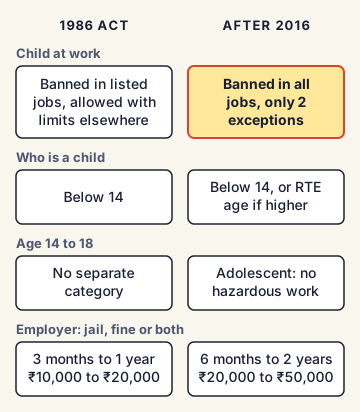
- Prohibition: children below 14 could not work in the occupations and processes listed in its Schedule. Part A listed occupations (like transport work on the railways and work in ports; domestic work and roadside eateries were added in 2006) and Part B listed processes (like beedi making, carpet weaving, and match and fireworks making). The list grew over the years to about 18 occupations and 65 processes.
- Regulation: in all other work, children could be employed, but with limits on working hours, rest and night work.
Critics said this "ban in some places, allow in others" approach left millions of children working legally in farms, homes, shops and family workshops.
What did the 2016 amendment change?
Parliament passed the Child Labour (Prohibition and Regulation) Amendment Act, 2016 (Act No. 35 of 2016). It got the President's assent on 29 July 2016 and came into force on 1 September 2016. The main changes are:
- Who is a child: a person below 14 years, or below the age set in the Right to Education (RTE) Act, 2009, whichever is more. This links the work ban with the age of free and compulsory schooling.
- New category "adolescent": a person who has completed 14 but not 18 years.
- Section 3: a child cannot be employed or allowed to work in any occupation or process. This is a complete ban.
- Section 3A: an adolescent cannot work in the hazardous occupations and processes listed in the Schedule.
- A shorter Schedule: the new Schedule listed only three heads: (1) mines, (2) inflammable substances or explosives, and (3) hazardous processes as defined in the Factories Act, 1948. In 2017, on the advice of a Technical Advisory Committee, the government expanded the Schedule into Part A (where adolescents cannot work and children cannot even help) and Part B (where children cannot help their family).
What are the two exceptions?
Section 3(2) allows a child to:
- Help the family or a family enterprise after school hours or during holidays, but only in work that is not hazardous. "Family" means the child's mother, father, brother, sister, and the brothers and sisters of the father and the mother.
- Work as an artist in the audio-visual entertainment industry (films, TV serials, advertisements) or in sports, but not in a circus, under prescribed safety conditions. This work must not affect the child's schooling.
What are the punishments?
Section 14 sets these:
- An employer who employs a child (or an adolescent in hazardous work) gets 6 months to 2 years in jail, or a fine of ₹20,000 to ₹50,000, or both.
- A repeat offence brings 1 to 3 years of jail.
- Parents or guardians are not punished for a first offence. For a repeat offence they can be fined up to ₹10,000. Parents are punished only if they let the child work for commercial purposes.
- Section 14A: offences by employers are cognizable, which means the police can register a case and arrest without a court's warrant.
- Section 14D: the District Magistrate can compound (settle on payment) a first offence or an offence by a parent.
How does rescue and rehabilitation work?
Under Section 14B, the government must create a Child and Adolescent Labour Rehabilitation Fund in every district or group of districts. The fine collected from the employer goes into it, and the government adds ₹15,000 for each child. The money, with interest, is paid to the rescued child. Section 14C says every rescued child must be rehabilitated under the laws in force. Section 17A lets the government give the District Magistrate powers to enforce the law, and Section 17B requires periodic inspection of workplaces.
India's position and Indian examples
- Census 2011 counted about 10.1 million working children aged 5 to 14 (about 3.9% of that age group), down by about 2.6 million from 2001. Uttar Pradesh had the most, followed by Bihar, Rajasthan and Maharashtra.
- The National Child Labour Project (NCLP), started in 1988, ran special schools to bring rescued children back to studies. It was later merged into the Samagra Shiksha school scheme (from 2021).
- The PENCIL portal (Platform for Effective Enforcement for No Child Labour), launched on 26 September 2017, lets anyone file a complaint and helps track rescue and rehabilitation.
- In June 2017, India ratified two core International Labour Organization (ILO) conventions: Convention 138 (minimum age for work) and Convention 182 (worst forms of child labour).
- In M.C. Mehta v. State of Tamil Nadu (1996), a case about children working in the match and fireworks units of Sivakasi, the Supreme Court ordered offending employers to pay ₹20,000 per child into a Child Labour Rehabilitation-cum-Welfare Fund, and asked the state to help the child's family, so that the child could go to school instead.
Commonly confused concepts
- Child vs adolescent: a child is below 14 (or the RTE age, if higher) and cannot work anywhere except the two exceptions. An adolescent is 14 to 18 and can work, but not in hazardous jobs.
- Child labour vs bonded labour: child labour is about the age of the worker. Bonded labour is about forced work to repay a debt, at any age, and is covered by the Bonded Labour System (Abolition) Act, 1976 and Article 23.
- Article 24 vs the 1986 Act: Article 24 bans children below 14 only in factories, mines and hazardous work. The Act goes further and bans child work in all occupations.
- Labour Ministry vs WCD Ministry: the Act is administered by the Ministry of Labour and Employment. In this case the Court asked the Ministry of Women and Child Development to run the monitoring cell.
Issues, criticism and the way forward
- The family enterprise loophole: critics such as child rights groups argue that "helping the family" is hard to check. A lot of child work happens inside homes and small units (like beedi rolling, carpet weaving, zari work), so the exception can hide real child labour.
- Shorter hazardous list: the 2016 law first cut the long list of hazardous jobs to three heads. Critics said this allowed adolescents into work that was earlier banned. The 2017 Schedule partly addressed this.
- Weak enforcement: inspections are few, conviction rates are low, and many rescued children are not properly rehabilitated.
- Old data: the last full count is from Census 2011, so the real present size of the problem is not known.
- The government's view is that the complete ban below 14, linked with free schooling under the RTE Act, and stronger punishments make the law much tighter than before.
- Way forward: suggested steps include regular inspections, district-level task forces, tracking each rescued child till they finish school, social security for poor families so they do not need the child's income, and new surveys to measure child labour.
Concepts to Know
- Hazardous process: a process in a factory where the raw materials, products or waste can seriously harm the health of workers or pollute the environment. The meaning is taken from the Factories Act, 1948.
- Cognizable offence: a serious offence where the police can register an FIR and arrest without a warrant from a court.
- Compounding: settling a case by paying an amount to the government, instead of going through a full trial.
- Public interest litigation (PIL): a case filed in court by a person or group for the public good, not just for their own benefit.
- Right to Education (RTE) Act, 2009: the law that gives every child aged 6 to 14 the right to free and compulsory education in a neighbourhood school.
- ILO (International Labour Organization): a United Nations agency, set up in 1919, that sets global standards for work and workers.
- Original Act: Child Labour (Prohibition and Regulation) Act, 1986 (Act No. 61 of 1986)
- Amendment Act: No. 35 of 2016; assent 29 July 2016; in force 1 September 2016; renamed the Child and Adolescent Labour (Prohibition and Regulation) Act, 1986
- Child: below 14 (or RTE age, whichever is more); adolescent: 14 to 18
- Section 3: total ban on child work, with 2 exceptions (family enterprise after school, non-hazardous; artist in entertainment or sports, not circus)
- Section 3A: adolescents banned in hazardous work listed in the Schedule (mines; inflammable substances or explosives; hazardous processes)
- Penalty: 6 months to 2 years and/or ₹20,000 to ₹50,000; repeat: 1 to 3 years; parents: no punishment for first offence, up to ₹10,000 fine for a repeat
- Section 14A: cognizable; Section 14B: Rehabilitation Fund with ₹15,000 per child added by government; Section 14D: compounding by District Magistrate
- India ratified ILO Conventions 138 and 182 in June 2017
- Census 2011: about 10.1 million working children aged 5 to 14
● Tracked since November 04, 2026 · last seen November 04, 2026 · updates as the daily brief publishes