Article 24
Prohibition of Employment of Children in Factories
Article 24 of the Indian Constitution says that no child below the age of 14 years shall be employed to work in any factory or mine or engaged in any other hazardous employment. It is a Fundamental Right in Part III of the Constitution. Together with Article 23, it forms the Right against Exploitation. Its aim is simple: to protect young children from dangerous work that harms their health and takes away their childhood.
Why does it exist?
In colonial India, children commonly worked long hours in mills, mines, tea gardens and workshops. The makers of the Constitution wanted to make sure that the new nation would not allow this. By placing the ban in the list of Fundamental Rights, they made it something a citizen can go to court to enforce, not just a government promise.
Where does it sit in the Constitution?
- Part III (Fundamental Rights): Articles 23 and 24 together are titled "Right against Exploitation". Article 23 bans human trafficking, begar (forced unpaid work) and other forced labour. Article 24 bans child labour in dangerous places.
- Part IV (Directive Principles): Article 39(e) asks the State to make sure that the "tender age of children" is not abused and that no one is forced by poverty to do work unsuited to their age or strength. Article 39(f) asks the State to give children opportunities to grow in a healthy way, with freedom and dignity, and to protect them from exploitation.
- The 86th Amendment Act, 2002: it added Article 21A (free and compulsory education for children aged 6 to 14 as a Fundamental Right), changed Article 45 (early childhood care and education for children below 6), and added Article 51A(k) (a Fundamental Duty of parents or guardians to give their child aged 6 to 14 the chance to study).
How does Article 24 work in practice?
Article 24 sets the basic rule, but it does not itself list punishments. Parliament makes laws to put it into action and to punish violators. The main laws are:
- The Child and Adolescent Labour (Prohibition and Regulation) Act, 1986 (amended in 2016), which goes beyond Article 24 and bans child work in all occupations.
- The Factories Act, 1948 (Section 67 barred children below 14 from working in factories) and the Mines Act, 1952 (which barred persons below 18 from working in mines). Both have now been merged into the Occupational Safety, Health and Working Conditions Code, 2020, which came into force on 21 November 2025.
- The Juvenile Justice (Care and Protection of Children) Act, 2015, which punishes keeping a child in bondage or using a child's earnings.
Who must follow it?
Many Fundamental Rights protect a person only against the State. Article 24 is different. It applies to everyone, including private factory owners, mine operators and contractors. Any person who employs a young child in hazardous work violates the Constitution.
What have the courts said?
- People's Union for Democratic Rights (PUDR) v. Union of India (1982), also called the Asiad Workers case: workers building stadiums for the 1982 Asian Games in Delhi were being paid less than minimum wages and children were working on the sites. The Supreme Court held that construction work is hazardous employment, so children below 14 cannot be employed in it under Article 24, even if the specific law had not listed it. It also held that the government agencies that hired the contractors were responsible for making sure labour laws were followed.
- M.C. Mehta v. State of Tamil Nadu (1996): in the Sivakasi match and fireworks case, the Court ordered employers to pay ₹20,000 per child into a welfare fund and asked the government to give an adult family member a job or support, so that children could go to school.
- Bandhua Mukti Morcha v. Union of India (1984 and 1997): the Court linked the rights of exploited workers, including children in carpet industries, with the right to life under Article 21 and asked the State to rescue and rehabilitate them.
Commonly confused concepts
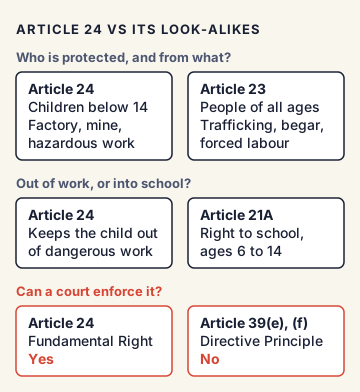
- Article 23 vs Article 24: Article 23 bans forced labour and trafficking for people of all ages. Article 24 is only about children below 14 in factories, mines and hazardous work.
- Article 24 vs Article 21A: Article 24 keeps the child out of dangerous work. Article 21A gives the child (6 to 14) the right to go to school. Both use similar age limits, and together they aim to move children from work to school.
- Article 24 vs Article 39(e) and (f): Article 24 is a Fundamental Right that courts can enforce. Articles 39(e) and (f) are Directive Principles, which guide the government but cannot be directly enforced in court.
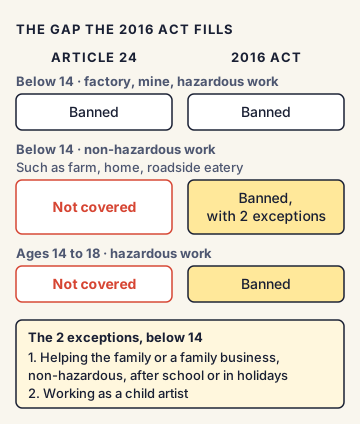
- Constitution vs the Act: the constitutional ban covers only hazardous places of work; the 2016 Act bans all child work below 14, with two narrow exceptions.
Issues, criticism and the way forward
- Narrow wording: Article 24 covers only factories, mines and "hazardous" work. Much child labour today is in farms, homes, roadside eateries and domestic work, which may not count as hazardous under the text. Parliament had to fill this gap through the 2016 law.
- Age gap: Article 24 protects children only up to 14, but the international standard (ILO Convention 138 and the UN Convention on the Rights of the Child) treats everyone below 18 as a child. The 2016 law partly closes this by protecting adolescents (14 to 18) from hazardous work.
- Enforcement: a right on paper means little without inspectors, prosecutions and rehabilitation. Courts have had to step in repeatedly, as in the present case.
- Way forward: experts suggest strong links between labour departments, schools and child protection units, so that every child out of school is traced; and support for poor families, because poverty is the main reason children work.
Concepts to Know
- Fundamental Right: a basic right listed in Part III of the Constitution. If it is violated, a person can go directly to the Supreme Court (Article 32) or a High Court (Article 226).
- Directive Principles of State Policy: guidelines in Part IV of the Constitution that the government should follow when making laws. They are important, but courts cannot force the government to follow them.
- Begar: forcing someone to work without paying them. It was common in the princely states and under landlords before independence.
- Hazardous employment: work that can harm a person's health or safety, such as work in mines, with explosives, with toxic chemicals or on construction sites.
- Asian Games (Asiad): a multi-sport event for Asian countries. Delhi hosted it in 1982, which is why the PUDR case is called the Asiad Workers case.
- Article 24: no child below 14 to be employed in any factory, mine or other hazardous employment
- Part III, "Right against Exploitation": Articles 23 and 24
- Applies against private persons too, not only the State
- Article 39(e) and (f): Directive Principles protecting children from abuse and exploitation
- 86th Amendment Act, 2002: added Article 21A (education for 6 to 14), changed Article 45 (care below 6), added Article 51A(k) (duty of parents)
- PUDR v. Union of India (1982), Asiad Workers case: construction work is hazardous employment under Article 24
- M.C. Mehta v. State of Tamil Nadu (1996): ₹20,000 per child into a rehabilitation-cum-welfare fund
- Factories Act, 1948 and Mines Act, 1952 now merged into the OSH Code, 2020 (in force from 21 November 2025)
● Tracked since November 04, 2026 · last seen November 04, 2026 · updates as the daily brief publishes