Central Staffing Scheme
How Officers Are Posted to the Centre
The Central Staffing Scheme (CSS) is the system the Union government uses to fill senior posts in its ministries and departments, such as Deputy Secretary, Director and Joint Secretary, by borrowing officers from the states and from central services. An IAS officer who has worked for years in a state comes to Delhi for a fixed term, works in a ministry, and then goes back.
This temporary posting is called central deputation. The scheme is run by the Department of Personnel and Training (DoPT), and the final approval comes from the Appointments Committee of the Cabinet (ACC).
Why does it exist?
The Union government makes national policy, but it does not have its own full set of senior generalist officers. If ministries were run only by officers who had never seen a district, policies could be cut off from ground reality. So the Centre borrows experienced officers from the states. The officer brings field experience to Delhi, and later takes national experience back to the state.
Think of it like a hospital sending its doctors for a few years to a national research institute: both sides gain. The scheme also gives the Centre a regular, fair and rule-based method of choosing officers, instead of picking them one by one.
Where did it come from?
Soon after Independence, the Centre tried a simple tenure system: officers came from the states for a fixed time and went back. Government reports of the early 1950s noted that this was breaking down, because officers who came on deputation stayed at the Centre almost indefinitely. In 1957, after consulting the states, the government set up a Central Administrative Pool as a reserve of officers for senior posts at Deputy Secretary level and above, especially for economic administration.
The present Central Staffing Scheme grew out of these arrangements. A 2003 government reply in Parliament described the scheme as having been in operation for over 40 years.
Who can come under the scheme?
- Officers of the three All India Services: the Indian Administrative Service (IAS), the Indian Police Service (IPS) and the Indian Forest Service (IFoS).
- Officers of participating Group A central services, for example the Indian Revenue Service.
- An officer needs at least 9 years of service, counted as on 1 July of that year, to be considered.
- For the Director level, an officer must have completed 14 years of service and received the Non-Functional Selection Grade.
- For the Joint Secretary level, an officer must first be empanelled, which means found suitable and placed on an approved list for that level.
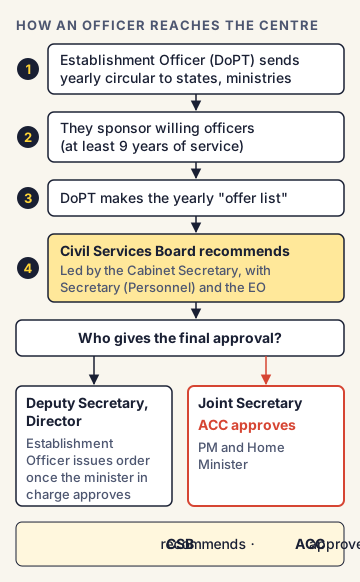
How does it work, step by step?
- Every year, the Establishment Officer (EO) of DoPT sends a circular to all state Chief Secretaries and to the ministries that control Group A services.
- They sponsor (nominate) officers who are suitable and willing to come to the Centre.
- From these names, DoPT prepares an "offer list" for that year. Vacancies are filled only from this list.
- The EO places panels of names before the Civil Services Board (CSB). The CSB includes the Cabinet Secretary, the Secretary (Personnel) and the Establishment Officer, among others. The Secretary of the ministry with the vacancy is also invited.
- The CSB recommends a name for each post.
- For Joint Secretary posts, the ACC gives the approval. For Deputy Secretary and Director posts, the ACC has handed this power to the Establishment Officer. He issues the order after the CSB recommends it and the minister in charge of that ministry approves.
How long does an officer stay, and what are the rules?
- Tenure: 4 years at Deputy Secretary level, and 5 years at Director and Joint Secretary levels.
- Cooling-off: After one central posting, an officer must spend 3 years back in the cadre before another one at these levels. For officers of the North-East and Jammu and Kashmir cadres, it is 2 years.
- Premature repatriation: An officer can be sent back early if promoted to the next grade, through a proposal from the ministry with the minister's approval. If an officer asks to go back early for personal reasons, the unfinished part of the tenure is added to the normal cooling-off period. This is called extended cooling-off.
- Debarment: If an appointed officer does not join, or the state refuses to relieve the officer, the officer is barred from central deputation for 5 years. The officer is also denied cadre clearance for foreign assignments.
What is the Central Deputation Reserve?
When the Centre fixes the size of each state's IAS cadre, it adds extra posts so that officers can go to the Centre without leaving state posts empty. This extra share is the Central Deputation Reserve (CDR). It can be up to 40% of the senior duty posts of a cadre. Senior duty posts are the important posts, like district collector or secretary to the state government, for which the cadre is mainly designed.
In simple words, the system expects up to 40% of a state's senior IAS officers to be available for work at the Centre.
What does the law say about deputation?
The legal base comes from Article 312 of the Constitution and the All India Services Act, 1951, under which the Centre makes rules after consulting the states. Rule 6(1) of the IAS (Cadre) Rules, 1954 says an officer may be sent to the Centre only with the concurrence (agreement) of the state government. A proviso adds that if the Centre and the state disagree, the Central Government decides, and the state must give effect to that decision. Similar rules apply to the IPS and IFoS.
Constitutional bodies also use the scheme
Constitutional bodies like the Election Commission of India need senior officers too. Under Article 324(6), the government must provide the ECI with the staff it asks for. Officers such as Deputy Election Commissioners are posted to the ECI on deputation through the same DoPT system.
India's position and practice
In practice, many states do not send enough officers. Ministry of Home Affairs data cited in 2022 showed large shortfalls against the CDR in many states, with more than 14 states short by over 80%. In December 2021, DoPT proposed changes to the IAS (Cadre) Rules. Under them, the Centre would fix the number of officers to be sent in consultation with the state.
A state would have to carry out the Centre's decision within a fixed time, and an officer could stand relieved if the state delayed. Several states objected that this would take away their say over their own officers. Separately, the Centre has also tried lateral entry, which means hiring outside experts directly at Joint Secretary, Director and Deputy Secretary level.
In August 2024, an advertisement for 45 such posts was cancelled at the government's request after a debate over reservation in these posts.
Commonly confused concepts
- Central Staffing Scheme vs Central Deputation Reserve: The CSS is the process of choosing and posting officers to the Centre. The CDR is the number of extra posts kept in a state cadre so that officers can be spared for the Centre.
- Civil Services Board (CSB) vs Appointments Committee of the Cabinet (ACC): The CSB is a committee of senior officers led by the Cabinet Secretary. It recommends names. The ACC is a committee of ministers chaired by the Prime Minister, with the Home Minister as the other member. It approves appointments, especially at Joint Secretary level and above.
- Deputation vs repatriation: Deputation is going to work for another government or body for a fixed time. Repatriation is going back to the parent cadre or department. Premature repatriation is going back before the term ends.
- All India Services vs Central Services: All India Services (IAS, IPS, IFoS) serve both the Centre and the states, and are allotted to state cadres. Central services, like the Indian Revenue Service, work only for the Union government.
- Empanelment vs appointment: Empanelment only means an officer is approved as suitable for a level. Appointment to an actual post comes later, when a vacancy is matched to the officer.
Issues, criticism and the way forward
- Shortage at the Centre: States often hold back officers because they need them for their own work. This leaves many Deputy Secretary and Director posts at the Centre empty or filled by other services.
- Unwilling officers: Some officers prefer state postings, where they hold more field power. Life in Delhi is also costly.
- Federal tension: States see the 2021 to 2022 proposals as weakening their control over officers who work for them. The Centre argues it needs enough officers to run national programmes. This touches the wider debate on cooperative federalism, the idea that the Centre and states should work together as partners.
- Transparency: Critics say empanelment for senior posts is not open enough. The government's position is that a multi-source assessment of officers makes selection fairer.
- Way forward: Experts suggest better planning of the reserve, more career incentives for central service, clear and published criteria for empanelment, and consultation with states before any change to the cadre rules. The Second Administrative Reforms Commission's tenth report on personnel administration (2008) also stressed merit-based and transparent postings.
Concepts to Know
- Cadre: The group of All India Service posts allotted to a state (or a joint group of states). An officer belongs to one cadre for the whole career.
- Deputation: Sending an officer to work for another government or organisation for a fixed period, while keeping the officer's link with the parent cadre.
- Department of Personnel and Training (DoPT): The Union ministry department that handles rules, postings, training and service matters for civil servants. It is the cadre controlling authority for the IAS.
- Pay matrix levels: The pay scales of central government employees, set by the Seventh Pay Commission. Level 14 is the Joint Secretary level and Level 15 is the Additional Secretary level.
- Concurrence: Formal agreement or consent.
- Group A services: The highest category of central government services, whose officers are usually recruited through the UPSC.
- CSS covers posts of Deputy Secretary, Director and above in Union ministries and departments.
- Run by DoPT through the Establishment Officer; approving authority: Appointments Committee of the Cabinet (ACC).
- ACC has delegated orders for Deputy Secretary and Director posts to the Establishment Officer, after CSB recommendation and approval of the minister in charge.
- Civil Services Board: Cabinet Secretary, Secretary (Personnel), Establishment Officer, among others.
- Minimum service to be considered: 9 years (as on 1 July); Director level: 14 years with Non-Functional Selection Grade.
- Tenure: Deputy Secretary 4 years; Director and Joint Secretary 5 years.
- Cooling-off: 3 years (2 years for North-East and J&K cadres); debarment for not joining: 5 years.
- Central Deputation Reserve: up to 40% of senior duty posts in a cadre.
- Rule 6(1), IAS (Cadre) Rules, 1954: deputation with state concurrence; in case of disagreement, the Centre decides.
- Central Administrative Pool: set up in 1957.
● Tracked since October 12, 2026 · last seen October 12, 2026 · updates as the daily brief publishes