All India Services (Article 312)
All India Services are a special kind of civil service that is common to the Centre and the states. Officers are recruited by the Union through the UPSC, but each officer is given to a state "cadre" and spends most of the career working for that state. They can also be sent to work for the Centre for some years. Today there are three All India Services: the Indian Administrative Service (IAS), the Indian Police Service (IPS) and the Indian Forest Service (IFoS).
Why do they exist?
India is a federation, so the Centre and the states each run their own governments. The makers of the Constitution wanted one thread that ties the whole system together. Officers trained to the same national standard, working in the states but answerable to the Union for discipline, help keep administration fair and uniform across the country.
They also bring field experience from districts to policy-making in Delhi when they serve at the Centre. Sardar Vallabhbhai Patel, the first Home Minister, strongly defended these services in the Constituent Assembly. The services are often called the "steel frame" of India.
Where did they come from?
The IAS and IPS replaced the British-era Indian Civil Service (ICS) and Indian (Imperial) Police after Independence. The IPS was formally set up in 1948. The Constitution recognised both in Article 312(2). Parliament then passed the All India Services Act, 1951, which lets the Centre make rules (after consulting the states) on recruitment and service conditions.
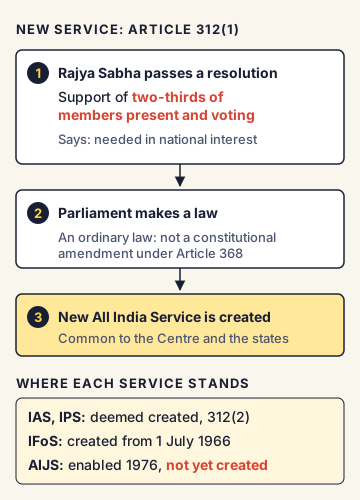
In 1961, the Rajya Sabha passed a resolution for three new All India Services, and the 1951 Act was amended in 1963. Only one of them, the Indian Forest Service, was actually created, from 1 July 1966. The proposed Indian Service of Engineers and Indian Medical and Health Service were never formed, because several states opposed them, and the idea was dropped in 1978.
What does Article 312 say?
- Article 312(1): Parliament can create a new All India Service only if the Rajya Sabha first passes a resolution, supported by at least two-thirds of the members present and voting, saying it is necessary in the national interest. The Rajya Sabha represents the states, so this gives states a say before a service common to them is created.
- Article 312(2): the IAS and IPS are deemed to be services created by Parliament under this Article.
- All India Judicial Service: the 42nd Amendment, 1976 allowed an All India Judicial Service to be created through the same route. It cannot include any post below that of a district judge (Article 236). It has not yet been created.
- Not a constitutional amendment: a law made under Article 312 is not treated as an amendment of the Constitution under Article 368, even if it changes Chapter VI of Part VI (subordinate courts).
How does the system work, step by step?
- The UPSC holds the Civil Services Examination (for IAS and IPS) and the Indian Forest Service Examination.
- The Centre appoints the selected candidates and allots each one to a state cadre (or a joint cadre).
- Officers train at national academies: the IAS at Mussoorie (LBSNAA), the IPS at Hyderabad (Sardar Vallabhbhai Patel National Police Academy) and the IFoS at Dehradun (Indira Gandhi National Forest Academy).
- They then serve the state: an IAS officer as a district collector, an IPS officer as a superintendent of police, an IFoS officer as a divisional forest officer.
- They may go on central deputation to the Union, for example IPS officers to the CBI, the Intelligence Bureau or the CAPFs, and then return to their state.
The cadre controlling authorities are the Department of Personnel and Training (DoPT) for the IAS, the Ministry of Home Affairs for the IPS, and the Ministry of Environment, Forest and Climate Change for the IFoS.
Who controls the officer: the Centre or the state?
This "dual control" is a favourite exam topic:
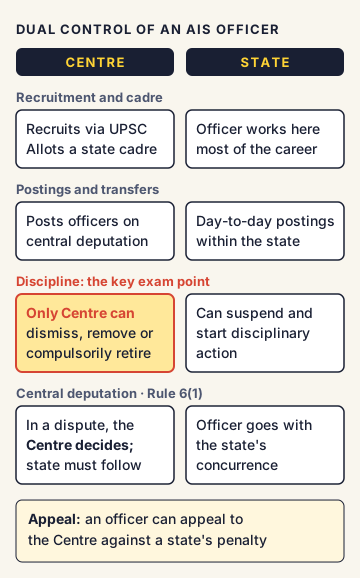
- The state decides day-to-day postings and transfers within the state, and can suspend an officer or start disciplinary action.
- Under the All India Services (Discipline and Appeal) Rules, 1969, major penalties such as dismissal, removal or compulsory retirement can be given only by the Central Government. An officer can appeal to the Centre against a state's penalty order.
- Article 311 protects all civil servants: no one can be dismissed by an authority lower than the one that appointed them, and there must normally be an inquiry with a fair chance to reply.
- Central deputation: under Rule 6(1) of the IAS (Cadre) Rules, 1954 (and the matching IPS and IFoS rules), an officer can be sent to the Centre with the state's concurrence. If the Centre and the state disagree, the matter is decided by the Central Government and the state must follow it.
- Each cadre keeps a Central Deputation Reserve, a share of senior posts (about 40%) set aside for officers who can go to the Centre.
Commonly confused concepts
- All India Services vs Central Services: All India Services (IAS, IPS, IFoS) serve both the Centre and the states. Central Services (like the Indian Revenue Service or Indian Foreign Service) serve only the Union. Both are recruited by the UPSC.
- All India Services vs State Services: state civil services (like a State Civil Service or State Police Service) are recruited by the State Public Service Commission and serve only that state. Some of their officers are later promoted into the IAS or IPS.
- Article 312 vs Article 309 vs Article 315: Article 312 is about All India Services. Article 309 lets Parliament and state legislatures regulate recruitment and service conditions of their own services. Article 315 sets up Public Service Commissions.
- Indian Forest Service (IFoS) vs Indian Foreign Service (IFS): the first is an All India Service under the MoEFCC; the second is a Central Service under the Ministry of External Affairs. Note the abbreviation "IFoS" for the forest service.
Issues, criticism and the way forward
- Centre-state tussle over deputation: states sometimes do not release enough officers for central posts, and the Centre has at times wanted officers whom the state did not wish to release. In December 2021, the DoPT proposed changing Rule 6(1) so that states must make a set number of officers available and an officer could be relieved even if the state delays. Several states objected that this would weaken federalism.
- Shortages at the Centre: reports have shown that far fewer IPS officers are on central deputation than the posts reserved for them.
- Deputation into other services: when All India Service officers fill senior posts in other organised services, such as the CAPFs, officers of those services complain of blocked promotions. The government's view is that All India Service officers bring wide field experience and help Centre-state coordination.
- Political pressure: frequent transfers and suspensions by state governments affect officers' independence. The Supreme Court in Prakash Singh v. Union of India (2006) asked for fixed tenures for senior police officers to reduce this.
- New services: the All India Judicial Service has been discussed for decades but not created, as many states and High Courts have concerns about local language, local laws and control over subordinate judges.
- Reform ideas: expert bodies such as the Second Administrative Reforms Commission have suggested domain specialisation, performance-based careers and fixed tenures to keep the "steel frame" strong.
Concepts to Know
- Cadre (state cadre): the state to which an All India Service officer is allotted for life, with its own list of posts.
- Concurrence: formal agreement or consent of a government to a decision.
- Steel frame: a description of the civil services as the strong structure that holds the whole administration together.
- Present and voting: only members who are in the House and actually vote are counted, not those absent or abstaining.
- Disciplinary action: steps taken against an officer for misconduct, from a warning or pay cut (minor penalty) to dismissal (major penalty).
- Article 312(1): new All India Service needs a Rajya Sabha resolution by two-thirds of members present and voting, then a law of Parliament
- Article 312(2): IAS and IPS deemed to be created by Parliament
- All India Services Act, 1951; amended 1963 to allow three new services; only the Indian Forest Service created, from 1 July 1966
- IPS formally replaced the Indian (Imperial) Police in 1948
- 42nd Amendment, 1976: enabled an All India Judicial Service (not below district judge, Article 236); not yet created
- Cadre controlling authorities: DoPT (IAS), MHA (IPS), MoEFCC (IFoS)
- AIS (Discipline and Appeal) Rules, 1969: dismissal, removal, compulsory retirement only by the Central Government
- Rule 6(1), IAS/IPS (Cadre) Rules, 1954: deputation with state concurrence; in disagreement, the Centre decides
- Central Deputation Reserve: about 40% of senior duty posts in a cadre
● Tracked since October 08, 2026 · last seen October 08, 2026 · updates as the daily brief publishes