Central Sector Scheme for Rehabilitation of Bonded Labourer, 2021
The Central Sector Scheme for Rehabilitation of Bonded Labourer is a Government of India scheme that gives money and other help to bonded labourers after they are freed. Its aim is to help them start a new life, so that they do not borrow again and fall back into bondage. It is run by the Ministry of Labour and Employment. The Centre pays the full cost of the cash help, so states do not have to add their own share.
Why does it exist?
A freed bonded labourer usually has no savings, no land, no house of his or her own, and often no documents. If nothing is given, the worker may have to borrow from the same kind of lender within weeks. The Supreme Court said in Neeraja Chaudhary (1984) that failing to rehabilitate freed workers violates Articles 21 and 23. The scheme is the government's main tool to meet this duty.
Where did it come from?
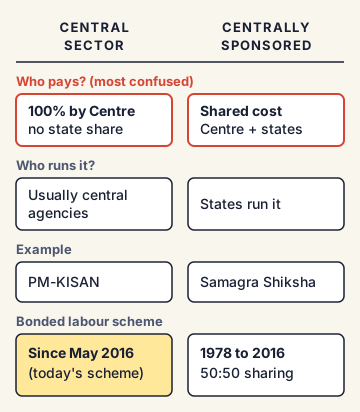
- 1978: The Centre started a Centrally Sponsored Scheme for rehabilitation. The cost was shared 50:50 between the Centre and the states. The aid amount was small and was raised over the years (it was ₹20,000 per person before 2016).
- 17 May 2016: The scheme was revamped and made a Central Sector Scheme. The Centre now paid 100% of the cash aid, and the amounts were raised sharply.
- 27 January 2022: It was revamped again and is now called the Central Sector Scheme for Rehabilitation of Bonded Labourer, 2021.
How much money does a freed worker get?
The cash aid depends on how vulnerable the person is:
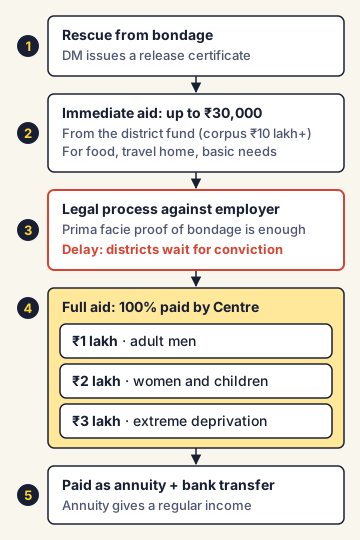
- ₹1 lakh: adult male bonded labourers.
- ₹2 lakh: special category beneficiaries, such as women and children (including orphans and children rescued from organised begging or forced child labour).
- ₹3 lakh: cases of extreme deprivation, such as transgender persons, women or children rescued from sexual exploitation or trafficking, persons with disabilities, or other cases the DM finds fit.
How is the money paid?
A part of the money is put into a long-term deposit (an annuity) in the worker's name, which pays a regular income. The rest goes directly into the worker's bank account through electronic transfer. In the 2016 version, at least ₹1.25 lakh of the ₹2 lakh, and at least ₹2 lakh of the ₹3 lakh, had to go into the annuity. Adult men could choose between the annuity and direct payment.
Immediate help on the day of rescue
Each state must keep a Bonded Labour Rehabilitation Fund in every district, with a permanent corpus (fixed starting amount) of at least ₹10 lakh, at the disposal of the DM. From the 2021 revision (effective 27 January 2022), the DM can give immediate financial assistance of up to ₹30,000 (raised from ₹20,000). This is meant for food, travel home and basic needs. It is adjusted later against the full amount.
The link to conviction
Full payment of the cash aid is linked to the legal process: proof of bondage and action against the employer. If the trial is not yet over, the DM can still process aid on the basis of a prima facie finding and proof of bondage. In practice, though, many districts wait for a conviction, and convictions are rare. This is the biggest reason for delays.
Non-cash help
Apart from cash, the scheme expects states to link freed workers with other benefits: a house site and farm land, land development, low-cost housing, animal husbandry, wage employment, skill training, ration cards and education for children. These come from other central and state schemes.
Money for surveys and awareness
The scheme pays ₹4.50 lakh per sensitive district for a survey of bonded labourers, once every three years. It also supports evaluation studies and awareness campaigns.
India's position and examples
Out of about 3.15 lakh people released between 1978 and January 2023, about 94% were reported as rehabilitated under this scheme and its earlier versions. But the NHRC and the Supreme Court have pointed out large gaps: in November 2024, the Court noted that over 4,100 released bonded labourers in Uttar Pradesh had not got financial aid.
Commonly confused concepts
- Central Sector Scheme vs Centrally Sponsored Scheme: A Central Sector Scheme is fully funded by the Centre and usually run by central agencies (example: PM-KISAN, this scheme after 2016). A Centrally Sponsored Scheme is shared between the Centre and states, and states run it (example: Samagra Shiksha, this scheme before 2016).
- Immediate assistance vs rehabilitation assistance: Immediate assistance (up to ₹30,000) is paid at once after rescue. Rehabilitation assistance (₹1, 2 or 3 lakh) is the full package, released through the legal process.
- Release certificate vs conviction: A release certificate is issued by the DM and proves the person was a bonded labourer. A conviction is a court finding that the employer is guilty. The certificate should come quickly; a conviction can take years.
Issues, criticism and the way forward
- Delay: Many freed workers wait months or years. Reports show some got even the ₹30,000 immediate aid only after two years.
- Conviction linkage: Linking full aid to the trial means the worker suffers for the slowness of the courts.
- Release certificates not issued: Without a certificate, the worker cannot claim anything, and many districts delay issuing it.
- Inter-state cases: When the worker is rescued in one state but belongs to another, both states may avoid responsibility.
- Way forward: Fixed time limits for release certificates and aid (as the Supreme Court has now ordered), delinking aid from conviction, direct transfer of money, and tracking each case online until the worker is settled.
Concepts to Know
- Rehabilitation: Helping a person rebuild a normal life with income, housing and dignity after a harmful situation.
- Annuity: A deposit that pays a fixed amount to a person at regular intervals, like a monthly pension.
- Corpus: A fixed fund kept ready so that money can be paid quickly when needed.
- Prima facie: A Latin phrase meaning "at first look". A prima facie finding means the evidence seems enough, even before a full trial.
- Ministry: Labour and Employment; type: Central Sector Scheme (100% central funding for cash aid)
- Original scheme: 1978 (Centrally Sponsored, 50:50 sharing)
- Revamped: 17 May 2016; revamped again with effect from 27 January 2022 as the 2021 scheme
- Cash aid: ₹1 lakh (adult male), ₹2 lakh (women and children), ₹3 lakh (extreme cases: transgender persons, trafficking or sexual exploitation victims, persons with disabilities)
- Immediate aid: up to ₹30,000 (from ₹20,000) from a district fund with a corpus of at least ₹10 lakh
- Survey grant: ₹4.50 lakh per sensitive district, once every 3 years
● Tracked since November 02, 2026 · last seen November 02, 2026 · updates as the daily brief publishes