Article 23
Prohibition of Traffic in Human Beings and Forced Labour
Article 23 of the Constitution bans trafficking in human beings, begar (work taken without pay) and all other forms of forced labour. It is a Fundamental Right in Part III of the Constitution. Together with Article 24 (ban on child labour in hazardous work), it forms the Right against Exploitation. Any breach of Article 23 is an offence that must be punished by law.
Why does it exist?
Before Independence, forced labour was common in India. Landlords and rulers made poor and lower-caste people work for free, a practice called begar. Debt bondage trapped families for generations. Women and children were bought and sold. The makers of the Constitution wanted to end these practices for good, so they made freedom from forced labour a Fundamental Right.
What does Article 23 say?
- Article 23(1): Traffic in human beings, begar and other similar forms of forced labour are prohibited. Any breach is an offence punishable by law.
- Article 23(2): The State may still impose compulsory service for public purposes, such as military service or social service. But while doing so, it must not discriminate on the grounds of religion, race, caste or class alone (or any of them).
Who must follow it?
Most Fundamental Rights protect people only against the State. Article 23 is different: it protects people against private persons too. A private landlord, factory owner or brick kiln owner who forces someone to work breaks Article 23.
Who makes the laws?
Article 35 gives Parliament (not state legislatures) the power to make laws to punish acts that are offences under Part III, including Article 23. Laws made to give effect to Article 23 include:
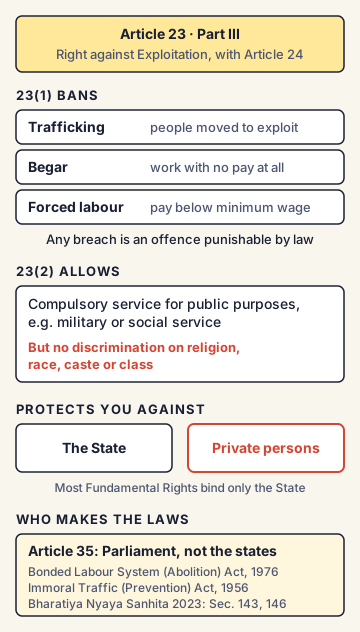
- the Bonded Labour System (Abolition) Act, 1976
- the Immoral Traffic (Prevention) Act, 1956 (on trafficking for sexual exploitation)
- Section 143 (trafficking of persons) and Section 146 (unlawful compulsory labour) of the Bharatiya Nyaya Sanhita, 2023
How have the courts widened it?
The Supreme Court has given "forced labour" a very wide meaning.
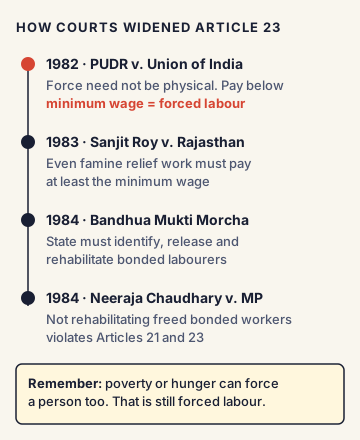
- PUDR v. Union of India (1982): Force does not have to be physical. If poverty or hunger makes a person accept work for less than the minimum wage, that is forced labour.
- Sanjit Roy v. State of Rajasthan (1983): Even in famine relief work, the State must pay at least the minimum wage. A Rajasthan law that exempted famine relief works from the minimum wage law was struck down to that extent.
- Bandhua Mukti Morcha v. Union of India (1984): The State must identify, release and rehabilitate bonded labourers.
- Neeraja Chaudhary v. State of Madhya Pradesh (1984): Failing to rehabilitate freed bonded workers violates Articles 21 and 23.
Commonly confused concepts
- Article 23 vs Article 24: Article 23 bans trafficking and forced labour for everyone. Article 24 bans employing children below 14 years in factories, mines or other hazardous work.
- Article 23 vs Article 21: Article 21 protects life and personal liberty, including the right to live with dignity. Courts often read both together in bonded labour cases.
- Begar vs bonded labour: Begar is work taken with no payment at all, often by custom. Bonded labour is work tied to a debt, usually with some very low payment.
- Article 23(2) exception vs forced labour: Compulsory military or social service for a public purpose is allowed, as long as there is no discrimination on religion, race, caste or class.
Issues, criticism and the way forward
- Bonded and forced labour still exist in brick kilns, farms, mills and domestic work, often hidden through migration.
- Many victims do not know their rights and fear the employer.
- Prosecution is weak, and the right is only as strong as its enforcement through laws and officers.
- Experts suggest better surveys, faster rehabilitation, stronger anti-trafficking laws and coordination between source and destination states.
Concepts to Know
- Fundamental Rights: Basic rights in Part III of the Constitution (Articles 12 to 35) that can be enforced in court.
- Trafficking in human beings: Recruiting, moving or holding people by force, fraud or threat in order to exploit them, for example for forced work or sexual exploitation.
- Begar: An old practice of forcing people to work without any payment.
- Minimum wage: The lowest daily or monthly pay that the government says an employer must pay a worker by law.
- Article 23: Part III; together with Article 24 forms the Right against Exploitation
- 23(1): bans traffic in human beings, begar and other forced labour; breach is a punishable offence
- 23(2): State may impose compulsory service for public purposes, without discrimination on religion, race, caste or class
- Applies against both the State and private persons
- Article 35: Parliament makes laws to punish such offences
- Key cases: PUDR (1982), Sanjit Roy (1983), Bandhua Mukti Morcha (1984), Neeraja Chaudhary (1984)
● Tracked since July 15, 2026 · last seen November 02, 2026 · updates as the daily brief publishes