Caste Enumeration in the Census
From 1931 to Census 2027
Caste enumeration means recording the caste of every person during the Census. Since Independence, India's Census has counted only Scheduled Castes (SCs) and Scheduled Tribes (STs), because the Constitution gives them reserved seats and special protection. All other castes, including the Other Backward Classes (OBCs), were not counted. Census 2027 changes this: for the first time since 1931, every person's caste is being recorded.
Why does it matter?
Many government decisions depend on knowing how many people belong to each group. For example, how many seats or jobs to reserve, which communities need more welfare support, and whether benefits are reaching the right people. Without a caste count, India has been making these decisions using estimates based on data that is almost 100 years old.
Think of it like a school trying to plan mid-day meals using a list of students made in its first year: the plan will be wrong for today's students.
Where did it come from?
The British-era Census began in 1872 (not all regions were counted at the same time) and became synchronous (everyone counted around the same date) from 1881. Caste was recorded in every Census from then until 1931. The 1941 Census also collected caste data, but it was not fully tabulated (counted and published), in part because of the Second World War.
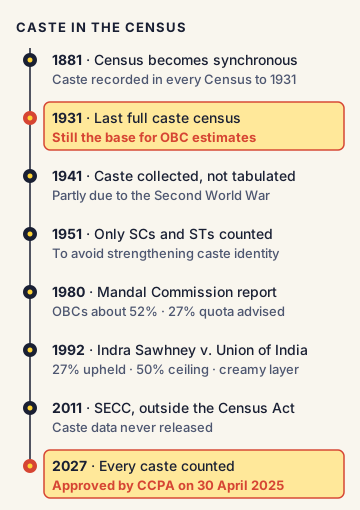
After Independence, the government decided in 1951 to stop counting caste, except for SCs and STs. The aim was to avoid strengthening caste identity in a new, democratic nation.
How have OBC numbers been estimated so far?
The Mandal Commission (the Second Backward Classes Commission, set up in 1979, report 1980, chaired by B.P. Mandal) used the 1931 Census data to estimate that OBCs were about 52% of India's population. On this basis, it recommended 27% reservation for OBCs in central government jobs. In Indra Sawhney v. Union of India (1992), the Supreme Court upheld this 27% quota but said that total reservation should normally not cross 50%. It also said the "creamy layer" (better-off people) among OBCs should be excluded from the benefit.
The Socio-Economic and Caste Census (SECC) 2011
In 2011, the central government ran a separate survey, the SECC, alongside the regular Census. It was not done under the Census Act. The Ministry of Rural Development handled rural areas and the Ministry of Housing and Urban Poverty Alleviation handled urban areas. The economic data was released and is used to select beneficiaries of schemes.
But the caste data was never released. It recorded about 46 lakh different caste, sub-caste, surname and clan names. The government also reported about 8.19 crore errors in the caste returns. An expert group under Arvind Panagariya (then NITI Aayog Vice-Chairman) was set up to classify the data, but the data was never published. The government later told Parliament and the Supreme Court that the data was unreliable.
State caste surveys
Since the Census is a Union subject, states cannot hold a "census". But some states held caste surveys of their own:
- Bihar (results released 2 October 2023): Extremely Backward Classes (EBCs) 36.01%, OBCs about 27.1%, SCs 19.65%, STs about 1.7%, and the unreserved (general) category 15.52%. EBCs and OBCs together came to about 63%. The Patna High Court upheld the survey in August 2023.
- Telangana (results released February 2025): Backward Classes (including Muslim BCs) 56.33%, SCs 17.43%, STs 10.45%, other castes 15.79%.
- Karnataka also held a survey in 2015 (often called the Kantharaj Commission survey), which was not formally adopted for years.
How is caste counted in Census 2027?
The Cabinet Committee on Political Affairs approved caste enumeration on 30 April 2025. In Census 2027, question 10 of the Household Schedule asks about SC / ST / Caste. The enumerator records the caste as the person declares it, in an open field, without a fixed list to pick from. Like all Census answers, it is protected by the confidentiality rules of the Census Act, 1948, so an individual's answer cannot be shared or used against them.
Commonly confused concepts
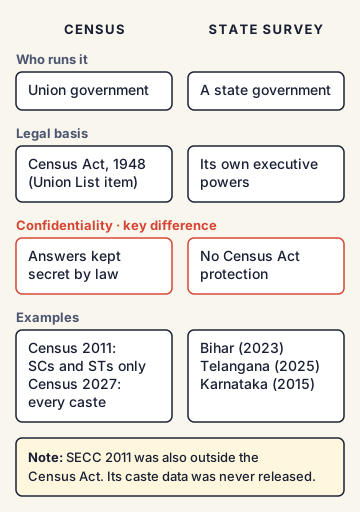
- Census vs caste survey: A Census is conducted by the Union under the Census Act, 1948 (Entry 69, Union List) and has legal confidentiality protection. A state caste survey is an administrative exercise by a state government, done under its own executive powers, without the Census Act's protection.
- Census 2011 vs SECC 2011: The Census 2011 was the regular count under the Census Act and counted only SCs and STs by caste. The SECC 2011 was a separate survey by two ministries, outside the Census Act, and its caste data was never released.
- SC/ST lists vs OBC lists: SCs and STs are listed by Presidential Orders under Articles 341 and 342, and only Parliament can change these lists. The Central OBC list follows Article 342A (added by the 102nd Amendment, 2018, which also gave the National Commission for Backward Classes constitutional status). The 105th Amendment (2021) restored the power of states to make their own OBC lists.
- Caste count vs reservation: Counting caste does not by itself change any reservation. Any change in quotas needs separate decisions by governments and must respect the limits set by the courts.
Issues, criticism and the way forward
- For the caste count: Supporters say good data is needed for fair reservation, targeted welfare and checking whether the benefits of reservation are reaching all sub-groups. Courts have also asked for "quantifiable data" before certain reservation decisions.
- Concerns: Critics worry it may harden caste identities and lead to demands to cross the 50% ceiling. There are also practical problems: thousands of caste names, spelling differences, the same caste known by different names in different states, and people giving surnames or clan names instead of caste. The SECC 2011 experience showed how hard it is to clean such data.
- Way forward suggested by experts: Use a clear coding system to map declared names to standard caste groups, train enumerators carefully on how to record caste, publish the data in a timely way, and keep individual answers strictly confidential.
Concepts to Know
- Enumeration: Counting people one by one and recording their details. An enumerator is the person who visits homes to do this.
- Reservation: Keeping a fixed share of seats in jobs, colleges or legislatures for groups that faced historical disadvantage.
- Other Backward Classes (OBCs): Groups that are socially and educationally backward but are not SCs or STs. They get 27% reservation in central government jobs and central educational institutions.
- Creamy layer: The better-off members of OBCs (for example, families with high income or senior government posts) who are kept out of OBC reservation benefits.
- Tabulation: Arranging the raw data from forms into tables of numbers, so the results can be published and used.
- Presidential Order: An official order issued by the President. The SC and ST lists for each state are notified this way.
- Last full caste census: 1931; 1941 caste data collected but not fully tabulated
- From 1951, only SCs and STs counted by caste
- Mandal Commission: set up 1979, report 1980; estimated OBCs at 52% (1931 data); recommended 27% OBC reservation
- Indra Sawhney v. Union of India (1992): 27% OBC quota upheld; 50% ceiling; creamy layer excluded
- SECC 2011: run by Rural Development and Housing and Urban Poverty Alleviation ministries; about 46 lakh caste names; about 8.19 crore errors reported; caste data never released
- Bihar caste survey (Oct 2023): EBC 36.01%, OBC about 27.1%, SC 19.65%; Telangana (Feb 2025): BCs 56.33%
- Caste enumeration approved by the Cabinet Committee on Political Affairs on 30 April 2025
- Census 2027: question 10 of the 40-question Household Schedule; caste recorded as declared
- Articles 341/342 (SC/ST lists), 342A (Central OBC list; 102nd Amendment 2018; amended by 105th Amendment 2021)
● Tracked since August 14, 2026 · last seen October 31, 2026 · updates as the daily brief publishes