Blended Finance
Using Public Money to Attract Private Investment
Blended finance means using a small amount of public or charity money to make a project safe and attractive enough for private investors to put in much larger amounts. The public money takes on the extra risk, or accepts a lower return, so that banks, pension funds and companies feel comfortable joining. In simple words, public money is the "bait" or the "safety net" that pulls private money into places it would normally avoid. It is used mostly in developing countries, for things like clean energy, roads, water, health and small businesses.
Why does it exist?
The world needs trillions of dollars every year for development and climate action. Governments and aid agencies have only billions. Private investors, like pension funds and insurance companies, hold huge amounts of money, but they avoid many developing countries. They see risks: the currency may fall, rules may change, the buyer of the power (often a state electricity company) may not pay on time, or the technology may be new.
So good projects stay unbuilt. Blended finance tries to close this gap by using scarce public money to unlock much bigger private money, instead of paying for whole projects itself.
A simple example
Imagine five friends want to lend money to a new solar farm in a poor district. They are worried that it might fail. Now a rich uncle says: "If the project loses money, I will take the first ₹10 of every ₹100 of loss." Suddenly the friends feel safe and lend. The uncle's promise is a first-loss guarantee. He did not pay for the whole farm. He only took the riskiest part, and that was enough to bring in everyone else.
Where did it come from?
- Development banks have mixed public and private money for decades. The International Finance Corporation (IFC), the private-sector arm of the World Bank Group, has long invested alongside private companies.
- The idea became a global strategy in 2015. That year, the Addis Ababa Action Agenda (from the Third International Conference on Financing for Development, held in Addis Ababa, Ethiopia) and the Sustainable Development Goals (SDGs) were adopted. The big development banks and the International Monetary Fund (IMF) promised to move "From Billions to Trillions": to use their billions to attract trillions of private money.
- In 2017, the OECD Development Assistance Committee (DAC), the club of major aid-giving countries, adopted the OECD DAC Blended Finance Principles to guide how donors should use it.
- In climate talks, the New Collective Quantified Goal (NCQG) agreed at COP29 in Baku (2024) asks developed countries to take the lead in mobilising at least US$300 billion a year by 2035 for developing countries. It also calls on all actors to scale up finance from all public and private sources to at least US$1.3 trillion a year by 2035. Reaching the larger number depends heavily on drawing in private money, which is exactly what blended finance is designed to do.
How does it work? The main tools
The public or charity partner can play one or more of these roles:
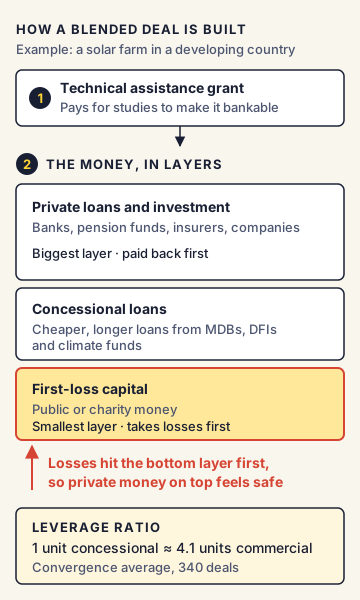
- Concessional loans: loans at a lower interest rate or with a longer repayment period than the market gives.
- First-loss capital (junior capital): the public partner agrees to absorb the first losses, so private investors are protected.
- Guarantees: a promise to repay lenders if the borrower fails to pay. This lowers the risk for banks.
- Technical assistance grants: free money to prepare a project properly (studies, designs, legal work), so it becomes "bankable", meaning a bank is willing to lend to it.
- Risk insurance: protection against political events or currency crashes.
Each tool changes the risk-and-return balance just enough for private investors to say yes.
The key definitions and numbers
- OECD definition: blended finance is "the strategic use of development finance for the mobilisation of additional finance towards sustainable development in developing countries".
- The five OECD DAC principles (2017): anchor it to a development reason; design it to bring in more commercial money; fit it to the local context; focus on good partnerships; and monitor it for transparency and results.
- Market size: According to Convergence, a global network that tracks such deals, there were 123 blended finance deals worth about US$18.3 billion in 2024, down from US$23.1 billion in 2023. Climate-related deals made up about 62% of the money.
- Leverage ratio: the amount of private or commercial money brought in for every unit of public or concessional money. Convergence data across 340 deals show an average of about 4.1 units of commercial money per unit of concessional money. Only about half of that came from truly private sources; the rest came from development banks and charities.
Who are the main players?
- Multilateral development banks (MDBs): banks owned by many countries, such as the World Bank Group, the Asian Development Bank (ADB), the African Development Bank and the European Investment Bank.
- Climate funds: such as the Climate Investment Funds (CIF), set up in 2008, which works through two funds, the Clean Technology Fund (CTF) and the Strategic Climate Fund (SCF), in over 70 low- and middle-income countries.
- Development finance institutions (DFIs): national bodies that invest in private businesses abroad.
- Philanthropies: large charitable foundations.
- Private investors: commercial banks, pension funds, insurance companies and companies.
India's position and Indian examples
India uses the logic of blended finance in many home-grown schemes:
- Viability Gap Funding (VGF): started by the Department of Economic Affairs, Ministry of Finance, in 2006 for infrastructure built under public-private partnerships (PPPs). Many useful projects, like a road in a remote area, cannot earn enough to attract private builders. Under the original scheme, the Centre could give up to 20% of project cost as a one-time grant, and the sponsoring ministry or state could add another 20%. This grant fills the "viability gap" so the private partner can earn a fair return. The scheme was later revamped. The same idea is used today to support battery energy storage and offshore wind projects.
- National Investment and Infrastructure Fund (NIIF): announced in the Union Budget 2015-16. The government holds 49% in each of its funds, and the rest comes from domestic and foreign investors. The government's stake gives comfort to big global investors to join.
- India also receives concessional climate money through development banks and climate funds. As a large developing country, India argues that rich countries should give more public, grant-based climate finance, not only loans and private money.
Commonly confused concepts
- Blended finance vs climate finance: Climate finance is any money spent on cutting emissions or adapting to climate change, whatever its source. Blended finance is a method of structuring money (public plus private). A blended deal may or may not be about climate.
- Blended finance vs Public-Private Partnership (PPP): A PPP is a long-term contract between a government and a private company to build or run a public asset, like a highway. Blended finance is about mixing types of money to lower risk. A PPP can use blended finance (VGF is an example), but they are not the same thing.
- Concessional loan vs grant: A concessional loan must be repaid, only on easier terms. A grant never has to be repaid.
- Mobilise vs leverage: "Mobilise" means the total extra private money brought in. "Leverage ratio" is the comparison: how many units of private money came in for each unit of public money.
- Catalytic finance: Another name for the public money in a blended deal. Like a catalyst in chemistry, it starts the reaction (private investment) without being the main ingredient.
Issues, criticism and the way forward
- Too little private money: In 2015, the slogan was "billions to trillions". Later studies show far lower results. Some experts estimate MDBs bring in only about 0.7 units of private money per unit of their own, against early hopes of far higher ratios.
- Using aid to boost private profits: Critics say public money may end up making private investors' returns safer and higher, while the poor see little benefit.
- Uneven spread: Most deals go to middle-income countries with some market stability. The poorest countries, which need help most, often get very little.
- Currency risk: Loans in dollars become harder to repay if the local currency falls. Few blended tools fully solve this.
- Loans instead of grants: Developing countries worry that blended finance shifts climate finance towards loans and private money, adding to their debt, instead of the grants rich countries promised.
- Transparency: Deal terms are often secret, so it is hard to judge whether public money was really needed.
- Way forward: Experts suggest standardising deals so they can be repeated at scale, offering local-currency lending and currency hedging, building strong project pipelines with technical help, publishing deal data, and following the OECD DAC principles.
Concepts to Know
- Development finance: Money from governments, aid agencies and development banks whose main purpose is to help poorer countries grow, not to make a profit.
- Bankable project: A project with clear plans, approvals and expected income, so that a bank is willing to lend to it.
- Pension fund: A big pool of savings collected from workers that is invested to pay their pensions after retirement. Such funds want safe, steady returns.
- Multilateral development bank (MDB): A bank owned by many countries together that lends to developing countries for development projects, like the World Bank or ADB.
- OECD (Organisation for Economic Co-operation and Development): A group of mostly rich countries that studies economic policy and sets common standards. Its Development Assistance Committee (DAC) is the forum of major aid donors.
- Currency risk: The danger that the value of a country's money falls against the dollar, making dollar loans more costly to repay.
- OECD DAC Blended Finance Principles adopted in 2017 (five principles)
- 2015: Addis Ababa Action Agenda and the MDBs' "From Billions to Trillions" agenda
- Convergence data: 123 deals worth US$18.3 billion in 2024; US$23.1 billion in 2023; about 62% of 2024 money climate-related
- Average leverage: about 4.1 units of commercial money per unit of concessional money (Convergence, 340 deals)
- Climate Investment Funds set up in 2008; two funds: Clean Technology Fund and Strategic Climate Fund
- NCQG (COP29, Baku, 2024): at least US$300 billion a year by 2035 led by developed countries; at least US$1.3 trillion a year by 2035 from all sources
- India: VGF scheme 2006 (original 20% Centre + 20% sponsoring authority); NIIF announced in Budget 2015-16 with 49% government stake
● Tracked since November 11, 2026 · last seen November 11, 2026 · updates as the daily brief publishes