ASEAN Defence Ministers' Meeting-Plus (ADMM-Plus)
Asia's Defence Diplomacy Platform
The ASEAN Defence Ministers' Meeting-Plus, or ADMM-Plus, is a meeting where the defence ministers of the Southeast Asian countries sit down with the defence ministers of eight major partner countries. India is one of these eight partners. The forum lets these countries talk about security problems and run joint military training together. It is the main official meeting place for defence ministers in the Asia-Pacific region.
Why does it exist?
Southeast Asia sits on some of the busiest sea routes in the world. The region faces many shared dangers: terrorism, piracy, cyclones and earthquakes, and disputes at sea. No single country can handle all of these alone. Big powers like the US, China, India and Japan also have strong interests in the region. ADMM-Plus gives all of them one table where they can talk, build trust and practise working together, so that small problems do not grow into conflicts.
What is ASEAN?
ASEAN (the Association of Southeast Asian Nations) is a regional group formed in 1967. As of October 2026, it has 11 members: Brunei, Cambodia, Indonesia, Laos, Malaysia, Myanmar, the Philippines, Singapore, Thailand, Vietnam and Timor-Leste. Timor-Leste became the 11th member on 26 October 2025, at the 47th ASEAN Summit in Kuala Lumpur. It was the first new member since Cambodia joined in 1999.
Where did it come from?
The story has three steps:
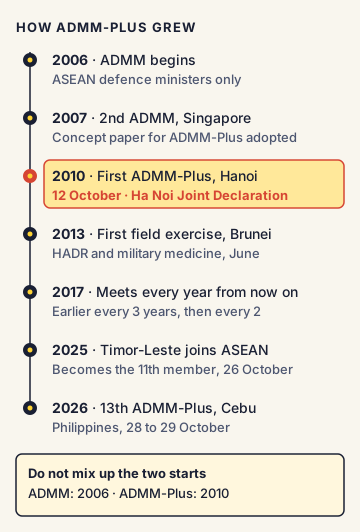
- In 2006, ASEAN defence ministers began meeting formally as the ASEAN Defence Ministers' Meeting (ADMM). This was for ASEAN members only.
- In 2007, at the second ADMM in Singapore, the ministers adopted a concept paper to set up a wider meeting with outside partners. This became the ADMM-Plus.
- The first ADMM-Plus was held in Hanoi, Vietnam, on 12 October 2010. The ministers adopted the Ha Noi Joint Declaration there.
How often does it meet?
At first, the ADMM-Plus was planned to meet once every three years. Ministers later shortened this to once every two years (the decision was taken around 2012-2013). From 2017, it has met every year. The meeting is always hosted by the country that holds the ASEAN chair that year. The 13th ADMM-Plus was held in Cebu, Philippines, on 28 and 29 October 2026, along with the 20th ADMM.
Who are the eight "Plus" countries?
- Australia
- China
- India
- Japan
- New Zealand
- Russia
- South Korea
- United States
So the forum brings ASEAN's members together with the most powerful countries that have interests in the region. Rival powers, such as the US and China, or India and China, sit in the same room.
How does it work in practice? The Experts' Working Groups
Talking is not enough, so the ADMM-Plus also runs practical cooperation through Experts' Working Groups (EWGs). Each group focuses on one area. Each is co-chaired by one ASEAN country and one Plus country, and works on a three-year cycle. The groups hold meetings and also organise joint field exercises.
In 2010, five areas were chosen. Two more were added later, so there are now seven areas:
- Maritime security
- Counter-terrorism
- Humanitarian assistance and disaster relief (HADR)
- Peacekeeping operations
- Military medicine
- Humanitarian mine action (clearing landmines left after wars)
- Cyber security
The first field exercise under ADMM-Plus was a combined HADR and military medicine exercise in Brunei in June 2013. In it, troops, ships and helicopters from 18 countries practised rescue and relief after an imagined typhoon.
India's role
India has been a Plus member from the start in 2010. For the 2024-2027 cycle, India and Malaysia co-chair the Experts' Working Group on Counter-Terrorism. India hosted its 14th meeting in New Delhi in March 2025, the first time India co-chaired this group. The forum fits India's Act East Policy, which aims to build closer economic and security ties with Southeast Asia.
India also uses these meetings to hold one-on-one talks with many defence ministers at once. For example, the India-US 10-year defence framework was signed on the sidelines of the 12th ADMM-Plus in Kuala Lumpur in October 2025. Separately from ADMM-Plus, India and ASEAN navies held their first joint exercise, the ASEAN-India Maritime Exercise (AIME), in May 2023, co-hosted by India and Singapore.
Commonly confused concepts
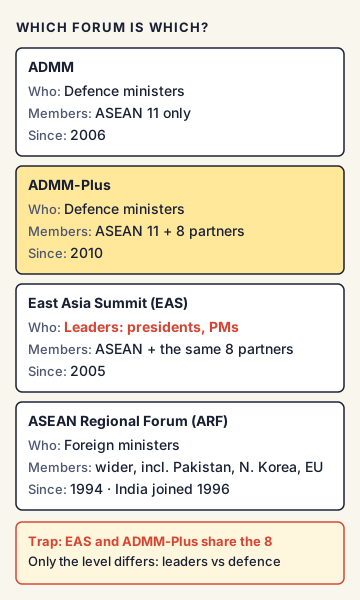
- ADMM vs ADMM-Plus: The ADMM is only for ASEAN defence ministers (since 2006). The ADMM-Plus adds the eight partner countries (since 2010).
- ADMM-Plus vs ASEAN Regional Forum (ARF): The ARF began in 1994 (first meeting in Bangkok) and India joined in 1996. It is mainly a meeting of foreign ministers, with a much larger membership, including countries like Pakistan, North Korea and the European Union. The ADMM-Plus is for defence ministers and has a smaller, fixed group.
- ADMM-Plus vs East Asia Summit (EAS): The EAS (from 2005) is a meeting of heads of state and government (leaders). Its 8 non-ASEAN members are the same eight countries as the ADMM-Plus partners, but it works at the leaders' level.
- ADMM-Plus vs Shangri-La Dialogue: The Shangri-La Dialogue is held every year in Singapore, but it is organised by a private think tank (the International Institute for Strategic Studies), not by governments. It is an open conference, not an official decision-making meeting.
Issues, criticism and the way forward
- Talk more than action: ASEAN works by consensus, meaning every member must agree. This keeps everyone comfortable but means sensitive issues, like the South China Sea disputes, are rarely settled.
- Great-power rivalry: Tensions between the US and China, and between India and China, can make joint statements hard to agree on. In some years, ministers could not agree on a joint declaration at all.
- Limited depth: Exercises are mostly in "soft" areas like disaster relief and medicine, which are easy to agree on. They build trust but do not solve hard security problems.
- ASEAN centrality: ASEAN wants to stay in the "driver's seat" of regional security. Some experts feel big-power groups like the Quad could reduce ASEAN's importance. Others argue the two can work side by side.
- Way forward: Experts suggest more practical exercises, faster sharing of information during disasters, stronger cooperation on cyber and maritime security, and keeping the forum open to all, so that it stays a bridge between rival powers.
Concepts to Know
- Consensus: A decision that everyone agrees to, or at least does not oppose. No vote is taken; if even one member objects, the decision does not go through.
- Humanitarian Assistance and Disaster Relief (HADR): Help given by armed forces after disasters like floods, cyclones and earthquakes: rescue, food, medicines and temporary shelter.
- Act East Policy: India's policy, launched in 2014 as an upgrade of the 1990s "Look East Policy", to build close economic, strategic and cultural ties with Southeast and East Asia.
- Sidelines of a meeting: Small side meetings between two countries that happen while a larger meeting is going on. Ministers use them because many counterparts are in one place.
- ASEAN centrality: The idea that ASEAN should be at the centre of all regional cooperation in Southeast Asia, setting the agenda and hosting the main forums.
- ADMM began in 2006; ADMM-Plus concept adopted in 2007 (2nd ADMM, Singapore)
- First ADMM-Plus: Hanoi, 12 October 2010 (Ha Noi Joint Declaration)
- Meeting frequency: every 3 years at first, then every 2 years, annual since 2017
- 8 Plus countries: Australia, China, India, Japan, New Zealand, Russia, South Korea, US
- ASEAN has 11 members since Timor-Leste joined on 26 October 2025
- 7 areas of Experts' Working Groups; each co-chaired by one ASEAN and one Plus country; 3-year cycle
- India and Malaysia co-chair the EWG on Counter-Terrorism for 2024-2027
- First ADMM-Plus field exercise: HADR and military medicine, Brunei, June 2013
- 13th ADMM-Plus: Cebu, Philippines, 28-29 October 2026
● Tracked since October 28, 2026 · last seen October 29, 2026 · updates as the daily brief publishes