India-US Major Defence Partnership (MDP)
Foundational Agreements and the 2025 Framework
The India-US Major Defence Partnership is the special defence relationship between India and the United States. In 2016, the US gave India the title of "Major Defence Partner". This status is unique to India. It means the US treats India almost like its closest allies when it comes to selling weapons and sharing defence technology, even though India is not in any military alliance with the US.
Why does this partnership matter?
India needs modern weapons, aircraft and technology to protect its long land borders and its huge sea area in the Indian Ocean. For decades, most of India's weapons came from the Soviet Union and later Russia. Depending on one supplier is risky, like a family that buys everything from one shop: if that shop closes, the family is stuck.
The US, on its part, sees a strong India as a balance against China's growing power in the Indo-Pacific. So both countries gain from closer defence ties.
Where did it come from?
During the Cold War (about 1947 to 1991), India and the US were distant. The US was close to Pakistan, and India was close to the Soviet Union. After the Soviet Union broke up in 1991, things slowly changed. The key steps were:
- 2005: The two countries signed the first 10-year New Framework for the India-US Defence Relationship.
- 2008: The India-US Civil Nuclear Agreement ended India's isolation in nuclear trade and built trust.
- 2012: The Defence Technology and Trade Initiative (DTTI) was started to move from simple buying and selling to making and developing weapons together.
- 2015: The defence framework was renewed for another 10 years.
- June 2016: The US named India a Major Defence Partner. The US Congress backed this in law through Section 1292 of the National Defense Authorization Act (NDAA) for Fiscal Year 2017, passed in December 2016.
- August 2018: The US moved India to Strategic Trade Authorization Tier 1 (STA-1). This lets American companies export many sensitive high-technology items to India without a separate licence each time.
- 31 October 2025: The two defence ministers signed a new 10-year Framework for the US-India Major Defence Partnership in Kuala Lumpur, Malaysia, on the sidelines of the ASEAN Defence Ministers' Meeting-Plus. It is the third such framework (after 2005 and 2015). It covers maritime security, defence technology, space and cyber cooperation.
What are the four foundational agreements?
The US signs a set of basic agreements with close defence partners. They are called "foundational" because deep military cooperation is built on top of them, like the foundation of a house. India has signed all four:
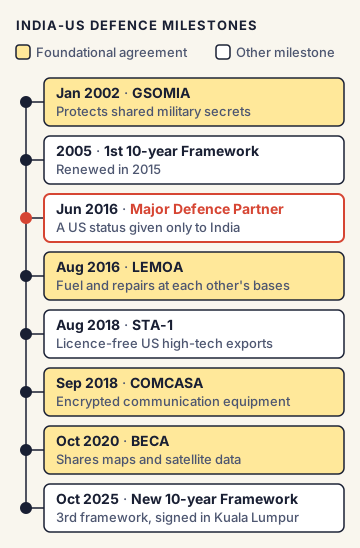
- GSOMIA (General Security of Military Information Agreement), January 2002: Both sides promise to protect secret military information they share with each other. An Industrial Security Annex (ISA) was added in 2019, so that private defence companies can also share classified information safely.
- LEMOA (Logistics Exchange Memorandum of Agreement), 29 August 2016: Each country's military can use the other's chosen bases for fuel, food, spare parts and repairs, and pay for it later. It is like a running account at a petrol pump. It does not allow either side to station troops permanently on the other's soil.
- COMCASA (Communications Compatibility and Security Agreement), September 2018: It lets the US supply encrypted (secret-coded) communication equipment to India. This means Indian and US ships and aircraft can talk to each other safely during joint operations. It was signed at the first 2+2 Ministerial Dialogue in New Delhi on 6 September 2018.
- BECA (Basic Exchange and Cooperation Agreement), October 2020: It allows the two sides to share geospatial data, meaning maps, satellite images and location information. Such data helps with navigation and with hitting targets accurately with missiles and drones. It was signed at the third 2+2 dialogue in New Delhi.
How does the partnership work?
Cooperation happens at several levels:
- Dialogues: The 2+2 Ministerial Dialogue brings together the foreign and defence ministers of both countries. India holds this format with only a few close partners.
- Military exercises: Examples are Yudh Abhyas (armies), Malabar (navies, started in 1992 as an India-US exercise, now also with Japan and Australia), Cope India (air forces) and Tiger Triumph (all three services together, first held in 2019).
- Supply and people: In August 2024, the two sides signed a Security of Supply Arrangement (SOSA). It is a non-binding promise that each side will give priority to the other's urgent defence orders during a crisis. India became the 18th country to sign a SOSA with the US. A separate agreement allows each side to post military liaison officers (contact officers) with the other's commands.
- Industry and start-ups: INDUS-X (India-US Defence Acceleration Ecosystem), launched in June 2023, connects defence start-ups and investors of both countries. In February 2025, the two sides announced the Autonomous Systems Industry Alliance (ASIA) for underwater and aerial drones.
How does India buy weapons from the US?
There are two routes. In Foreign Military Sales (FMS), India buys directly from the US government, which then buys from the company. In Direct Commercial Sales (DCS), India signs a contract directly with the US company, with US government export approval. Inside India, a big purchase passes through the Defence Acquisition Council (DAC), chaired by the Defence Minister, and then the Cabinet Committee on Security (CCS), chaired by the Prime Minister.
India's position and Indian examples
India has bought many major US platforms since the late 2000s. These include C-17 Globemaster and C-130J Super Hercules transport aircraft, P-8I maritime patrol aircraft, Apache attack helicopters, Chinook heavy-lift helicopters and MH-60R naval helicopters. In October 2024, India signed a deal of about US$ 3.8 to 4 billion for 31 MQ-9B drones (15 SeaGuardians for the Navy, and 8 SkyGuardians each for the Army and Air Force).
In June 2023, GE Aerospace and Hindustan Aeronautics Limited (HAL) signed an agreement to co-produce F414 jet engines in India for the Tejas Mk2 fighter. As of early 2026, talks on co-producing Javelin anti-tank missiles and Stryker armoured vehicles were still going on. Through all this, India follows strategic autonomy: it keeps close ties with the US but also continues defence ties with Russia, France and others.
Commonly confused concepts
- Major Defence Partner vs Major Non-NATO Ally (MNNA): MNNA is a legal status the US gives to allies like Japan, Australia and Pakistan. India is not an MNNA. "Major Defence Partner" is a separate status created only for India.
- Ally vs partner: An ally (like NATO members) has a treaty promise to defend each other in war. India has no such treaty with the US. It is a partner, not an ally.
- LEMOA vs a military base: LEMOA only allows refuelling and repairs at chosen facilities. It does not give the US a base in India.
- Defence Framework vs foundational agreements: The 10-year framework is a broad roadmap for cooperation. The four foundational agreements are specific, technical agreements on information, logistics, communication and maps.
- STA-1 vs MDP: STA-1 is an export-control category of the US Commerce Department. MDP is a political and defence status. STA-1 makes the MDP promise of technology sharing work in practice.
Issues, criticism and the way forward
- Technology transfer gaps: India wants deep technology transfer, but US companies often protect their key know-how. For example, the F414 deal faced long talks on how much core technology would be shared.
- Delays: Deliveries and co-production plans have often been slow. The DTTI produced few big joint projects in its first decade.
- Trust and wider ties: Disputes over trade, tariffs and India's purchase of Russian oil have strained ties at times. Critics say defence ties cannot be fully insulated from such disputes.
- US laws on Russia deals: The US law CAATSA (Countering America's Adversaries Through Sanctions Act, 2017) allows sanctions on countries that buy major Russian weapons. India's S-400 air defence purchase from Russia raised this concern.
- Strategic autonomy concerns: Some experts worry that too much dependence on US systems could limit India's freedom of choice. Others argue that India gains more by having many suppliers.
- Way forward: Experts suggest moving from "buyer-seller" to "co-developer and co-producer", using the 2025 framework to speed up joint production in India, and linking US firms with India's private defence industry under Aatmanirbhar Bharat (self-reliant India).
Concepts to Know
- Indo-Pacific: The large sea region from the eastern coast of Africa across the Indian Ocean to the western Pacific Ocean. Much of the world's trade passes through it.
- Encrypted communication: Messages turned into a secret code so that only the intended receiver can read them.
- Geospatial data: Information linked to a place on Earth, such as maps, satellite photos and GPS coordinates.
- Co-production: Two countries or companies making a product together, often with part of the manufacturing done in the buyer's country.
- Export control: Rules by which a country decides which sensitive goods and technologies its companies may sell abroad, and to whom.
- Strategic autonomy: India's policy of making its own foreign policy choices without joining any military bloc.
- Major Defence Partner status: June 2016; backed by Section 1292 of the US NDAA for FY2017
- STA-1 status for India: August 2018
- Defence frameworks: 2005, 2015, and the 10-year framework signed on 31 October 2025 in Kuala Lumpur
- Foundational agreements: GSOMIA (2002), LEMOA (August 2016), COMCASA (September 2018), BECA (October 2020)
- First 2+2 Ministerial Dialogue: 6 September 2018, New Delhi
- SOSA signed: August 2024 (India the 18th SOSA partner of the US)
- INDUS-X: launched June 2023; ASIA (Autonomous Systems Industry Alliance): announced February 2025
- MQ-9B deal: 31 drones, October 2024; GE-HAL F414 engine agreement: June 2023
● Tracked since October 20, 2026 · last seen October 20, 2026 · updates as the daily brief publishes