Article 361
Immunity of the President and Governors
Article 361 of the Constitution protects the President of India and the Governors of states from court cases while they hold office. It says they cannot be dragged into court over how they use the powers of their office. It also says no criminal case can be started against them, and no court can order their arrest, while their term lasts. This protection is called immunity: a legal shield that keeps a person safe from certain kinds of court action.
Why does it exist?
The President and the Governors are the formal heads of the Union and the states. If any person could file a case against them for every official decision, they would spend their time in courtrooms instead of doing their job. Their office would also lose dignity. So the Constitution makers gave them a shield, but only for the time they hold office and mainly for official acts.
Think of it like a match referee: players cannot sue the referee for each decision during the game, but the rules of the game still apply.
Where did it come from?
The idea comes from the old British principle that "the King can do no wrong", which meant the monarch could not be sued in the King's own courts. India did not copy this fully, because India has no king and its heads of state are elected or appointed for a fixed term. In the Draft Constitution, this provision was Draft Article 302.
The Constituent Assembly discussed and adopted it on 8 September 1949, with changes to make clear that ordinary people keep their right to sue the government itself. One member asked whether the shield meant a President or Governor could never be charged while in office, but this question was not answered in the debate.
What does Article 361 say, clause by clause?
- Clause (1): The President or a Governor is not answerable to any court for using the powers and doing the duties of the office, or for any act done (or meant to be done) while using those powers.
- First proviso to clause (1): The President's conduct can still be reviewed by the court, tribunal or body that Parliament appoints to investigate an impeachment charge under Article 61.
- Second proviso to clause (1): Nothing in this clause stops any person from bringing proper cases against the Government of India or a state government.
- Clause (2): No criminal case can be started or continued against the President or a Governor in any court during the term of office.
- Clause (3): No court can issue an order for the arrest or imprisonment of the President or a Governor during the term of office.
- Clause (4): A civil case (a case for money, property or other personal relief) about their personal acts, done before or during office, can be filed during the term only after two months' written notice. The notice must state what the case is about, the cause of action, the name and address of the person filing it, and the relief claimed.
What is not protected?
The shield is wide, but it has clear limits. Learn these, because exam questions often test them:
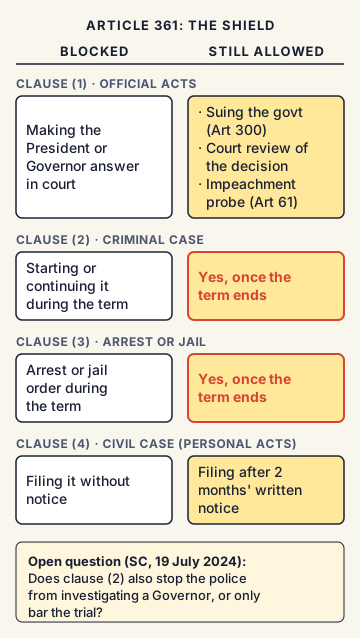
- The government can still be sued. If a Governor's order harms you, you can challenge the order by suing the state government. Under Article 300, the Government of India and state governments can sue and be sued.
- Courts can still review official decisions. The Governor personally cannot be made to answer in court, but the decision itself can be examined to see if it was based on relevant material or was made in bad faith (mala fide).
- The shield ends with the term. Clauses (2) and (3) apply only "during his term of office". After leaving office, a former President or Governor can face a criminal case.
- Personal civil cases are allowed after the two-month notice.
- Impeachment is separate. The President can be removed by impeachment under Article 61 for "violation of the Constitution", and immunity does not block that process.
What have the courts said?
- Rameshwar Prasad v. Union of India (2006): This case came from the dissolution of the Bihar Legislative Assembly in 2005 on the Governor's report. A five-judge Constitution Bench held that the Governor enjoys complete personal immunity under Article 361(1) and cannot be asked to answer allegations in court. But it also held that this immunity does not stop courts from examining whether the Governor's action was valid, including whether it was mala fide. The court found the dissolution unconstitutional.
- The 2024 challenge on criminal immunity: On 19 July 2024, a bench led by Chief Justice D.Y. Chandrachud, with Justices J.B. Pardiwala and Manoj Misra, agreed to examine how far Article 361(2) protects a Governor. The petition came from a contractual woman employee of the West Bengal Raj Bhavan who had accused the Governor of molestation. It argues that Article 361 may bar a criminal trial but should not stop the police from investigating and collecting evidence. The court sought the Attorney General's help on this question.
Related protections in the same part of the Constitution
Article 361 sits in Part XIX (Miscellaneous). Next to it are two other articles students often see together:
- Article 361A: Protects newspapers, radio and TV from court cases for publishing a substantially true report of the proceedings of Parliament or a state legislature, unless the report is made with malice. It was added by the 44th Amendment Act, 1978.
- Article 361B: Says a member disqualified for defection under the Tenth Schedule cannot hold any paid political post until the end of their term or until they are elected again. It was added by the 91st Amendment Act, 2003. This is about defection, not immunity.
Commonly confused concepts
- Article 361 vs Parliamentary Privileges (Articles 105 and 194): Article 361 protects the President and Governors in their office. Articles 105 and 194 protect MPs and MLAs only for what they say and vote inside the House and its committees. Neither gives MPs or MLAs a shield from ordinary criminal law outside the House.
- Article 361 vs the Judges (Protection) Act, 1985: Article 361 is in the Constitution. The Judges (Protection) Act is an ordinary law. Section 3(1) of that Act bars civil and criminal cases against a sitting or former judge for acts done in judicial or official duty. But Section 3(2) keeps the power of the government, the Supreme Court and the High Courts to take action against a judge. This built-in exception is a key point of comparison.
- Article 361 vs prior sanction for public servants: Ordinary government officers do not get immunity. Instead, under Section 218 of the Bharatiya Nagarik Suraksha Sanhita (BNSS), 2023 (earlier Section 197 of the CrPC), a court needs the government's prior permission (sanction) before it can take up a case against certain public servants for acts done in official duty. Sanction is a filter, not a full shield: once sanction is given, the case can go on.
- Article 361 vs Section 16 of the CEC Act, 2023: Article 361 is constitutional and, for criminal cases, ends with the term. Section 16 is a statute (a law made by Parliament), covers both serving and former CECs and ECs, and lasts for life for acts done in official duty.
Issues, criticism and the way forward
- Investigation vs trial: Critics argue that if police cannot even record a complaint or collect evidence while a Governor is in office, the evidence may be lost by the time the term ends. Others argue that any investigation would itself harm the dignity and working of the office.
- Long terms: A Governor has no fixed limit on how many terms they serve and holds office "during the pleasure of the President" (Article 156). A long tenure can delay justice for a victim for many years.
- Equality before law: Article 14 promises that everyone is equal before the law. Critics say a wide immunity sits uneasily with this. Supporters reply that the shield is limited in time and scope, and that the government remains answerable.
- Way forward: Suggestions include allowing a limited investigation to preserve evidence while barring trial until the term ends, and clear guidance from the Supreme Court on where the line lies.
Concepts to Know
- Immunity: A legal protection that stops certain court cases against a person. It does not mean the act was right; it only means the court cannot hear the case, at least for a time.
- Civil vs criminal proceedings: A civil case is between private parties over money, property or rights (for example, a dispute over a house). A criminal case is about a crime and can lead to jail or a fine.
- Mala fide: A Latin phrase meaning "in bad faith", that is, done with a dishonest or improper motive.
- Impeachment: The special process under Article 61 by which Parliament can remove the President for violation of the Constitution. It needs a two-thirds majority of the total membership of each House.
- Proviso: A sentence added to a legal rule that creates an exception or a condition to it.
- Basic structure: The core features of the Constitution (such as rule of law, judicial review and free and fair elections) that Parliament cannot destroy even by amendment. The Supreme Court laid this down in the Kesavananda Bharati case (1973).
- Article 361 is in Part XIX of the Constitution; it was Draft Article 302, adopted on 8 September 1949
- Clause (1): not answerable to any court for official acts; impeachment review (Art 61) and suits against the government are saved
- Clause (2): no criminal case during the term; Clause (3): no arrest or imprisonment order during the term
- Clause (4): civil case for personal acts only after 2 months' written notice
- Rameshwar Prasad v. Union of India (2006): Governor has personal immunity, but the action can be judicially reviewed for mala fides
- 19 July 2024: Supreme Court agreed to examine the scope of Article 361(2) for a Governor
- Article 361A added by the 44th Amendment (1978); Article 361B added by the 91st Amendment (2003)
- Judges (Protection) Act, 1985: Section 3(1) bars cases; Section 3(2) keeps the power of government and courts to act
● Tracked since October 17, 2026 · last seen October 17, 2026 · updates as the daily brief publishes