Appellate Jurisdiction of the Supreme Court
Articles 132 to 134A
The Supreme Court is India's highest court of appeal. "Appellate jurisdiction" means its power to hear appeals: cases where a party unhappy with a High Court's decision asks a higher court to look again. The Constitution gives four routes for this: Articles 132, 133, 134 and 136. Articles 132, 133 and 134 cover appeals in constitutional, civil and criminal cases, usually on a certificate from the High Court.
Article 134A sets out how that certificate is given (it is a rule about the certificate, not a fifth route). Separately, Article 136 lets the Supreme Court itself allow an appeal from almost any court, by special leave.
Why does it exist?
High Courts can make mistakes, and different High Courts can read the same law in different ways. If there were no appeal, a citizen in one state could have different rights from a citizen in another. Appeals to one top court keep the law uniform across India and let serious errors be corrected. At the same time, the Supreme Court cannot hear every case.
So the Constitution uses filters, like the High Court's certificate, to send up mainly the cases that raise important questions of law.
Where did it come from?
Until 1949, appeals from Indian courts went to the Privy Council in London, and the Federal Court of India (set up in 1937 under the Government of India Act, 1935) heard some constitutional cases. A 1949 law, the Abolition of Privy Council Jurisdiction Act, stopped appeals to London from 10 October 1949 and gave that work to the Federal Court.
The Constitution, in force from 26 January 1950, then made the Supreme Court the final court. Article 135 gave the Supreme Court the powers the Federal Court had. Later amendments changed the routes:
- 30th Amendment Act, 1972: Removed the old rule in Article 133 that allowed civil appeals based on the money value of the dispute (not less than ₹20,000). Since then, a civil appeal under Article 133 needs a substantial question of law of general importance that, in the High Court's opinion, needs to be decided by the Supreme Court.
- 44th Amendment Act, 1978: Inserted Article 134A, which sets out how and when the High Court decides on a certificate. It came into force on 1 August 1979. The same amendment removed an older clause in Article 132 that let the Supreme Court grant special leave in constitutional cases when a High Court refused a certificate (Article 136 already covers that).
How does an appeal by certificate work? (step by step)
- The High Court gives its final judgment, decree, final order or sentence.
- Under Article 134A, the High Court may decide on its own whether to give a certificate. Or the losing party can make an oral application immediately after the judgment is delivered. If the party applies, the High Court must decide the question.
- The High Court decides "as soon as may be" whether the case deserves a certificate under Article 132(1), 133(1) or 134(1)(c).
- If the certificate is granted, the party can file the appeal in the Supreme Court as a matter of right.
- If the certificate is refused, the party can still ask the Supreme Court for special leave to appeal under Article 136.
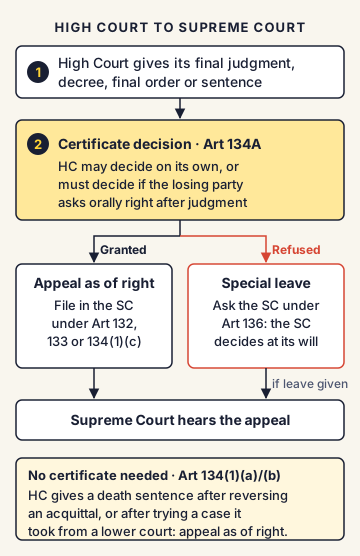
Think of the certificate like a school teacher's recommendation letter. If your teacher writes it, the top college must look at your application. If the teacher refuses, you can still apply directly, but the college decides whether to even look at it.
The four routes, one by one
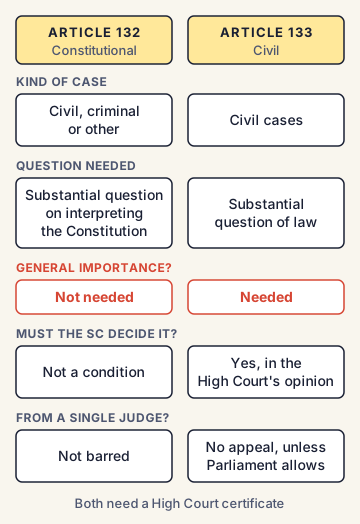
- Article 132 (constitutional cases): An appeal lies from any civil, criminal or other High Court decision if the High Court certifies that the case involves a substantial question of law as to the interpretation of the Constitution. The question need not be of "general importance".
- Article 133 (civil cases): An appeal lies if the High Court certifies that (a) the case involves a substantial question of law of general importance, and (b) in its opinion, that question needs to be decided by the Supreme Court. Both conditions are needed. Article 133(3) says no appeal under Article 133 lies from a judgment of a single judge of a High Court, unless Parliament provides otherwise by law.
- Article 134 (criminal cases): An appeal lies as of right, without needing a certificate, in two situations:
- 134(1)(a): The High Court, on appeal, reversed an acquittal (a "not guilty" decision) and sentenced the accused to death.
- 134(1)(b): The High Court took a case from a lower court, tried it itself, convicted the accused and sentenced them to death.
- In other cases, an appeal lies if the High Court certifies under Article 134A that the case is fit for appeal (134(1)(c)).
- Article 134(2): Parliament may give the Supreme Court wider criminal appellate powers by law. It did so through the Supreme Court (Enlargement of Criminal Appellate Jurisdiction) Act, 1970. Under it, an appeal also lies as of right in the same two situations as 134(1)(a) and (b) when the sentence is imprisonment for life or for not less than ten years (that is, 10 years or more). The two situations are: the High Court reverses an acquittal, or it tries a case it took from a lower court.
- Article 136 (special leave): The Supreme Court may, at its discretion, grant special leave to appeal from any judgment, decree, determination, sentence or order of any court or tribunal in India, except courts or tribunals of the armed forces. This is the most widely used route today.
India's position and Indian examples
In practice, very few cases reach the Supreme Court by certificate; most come through Special Leave Petitions (SLPs) under Article 136. Certificates still matter in landmark cases where a High Court bench itself feels the Supreme Court must settle the question. The marital rape appeal is one such case: in May 2022, the two judges of the Delhi High Court disagreed on the main question but both agreed to certify that the case involved substantial questions of law fit for the Supreme Court.
Commonly confused concepts
- Appeal by certificate (Articles 132-134A) vs Special Leave (Article 136): A certificate is granted by the High Court; once granted, the appeal is a right. Special leave is granted by the Supreme Court itself, at its discretion. A certificate refused is not the end of the road: Article 136 is still open.
- Article 132 vs Article 133: Article 132 needs a substantial question about interpreting the Constitution, but not of "general importance". Article 133 needs a substantial question of law of general importance that needs a Supreme Court decision. Trap: "general importance" is required under 133, not under 132.
- Appeal as of right (134(1)(a)/(b)) vs appeal by certificate (134(1)(c)): Only a death sentence after reversing an acquittal, or after the High Court tried a case it withdrew from a lower court, gives an automatic appeal under the Constitution itself. Life imprisonment or imprisonment for 10 years or more, in either of these same two situations, gives an automatic appeal under the 1970 Act, not the Constitution directly.
- Appellate vs original vs advisory jurisdiction: Appellate (Articles 132-136) means hearing appeals. Original jurisdiction (Article 131) means hearing disputes between the Centre and states, or between states, first-hand. Advisory jurisdiction (Article 143) means giving an opinion when the President asks.
- Appeal vs Review (Article 137) vs Curative petition: An appeal goes to a higher court. A review asks the same Supreme Court to re-look at its own judgment for clear errors. A curative petition (from Rupa Ashok Hurra, 2002) is a last remedy after a review fails.
- 30th vs 44th Amendment: The 30th (1972) removed the money-value test for civil appeals. The 44th (1978) added Article 134A.
Issues, criticism and the way forward
- Overload: Article 136 was meant to be used sparingly, but SLPs now make up most of the Supreme Court's work. This leaves less time for big constitutional questions and creates long delays.
- Rarely used certificates: High Courts seldom grant certificates, so the filter in Articles 132-134 does little. Parties go straight to Article 136.
- Access and cost: Appeals in Delhi are costly for people from distant states. The Law Commission, in its 229th Report (2009), suggested four regional benches of the Supreme Court to hear appeals (at Delhi, Chennai or Hyderabad, Kolkata and Mumbai). It also suggested a Constitution Bench at Delhi for constitutional questions. (A Constitution Bench is a bench of at least five Supreme Court judges.) Others have proposed regional Courts of Appeal or a separate Constitution Court for constitutional questions.
- Delay in criminal appeals: Long waits in criminal appeals mean many prisoners stay in jail for years while their appeals are pending.
- Way forward: Suggestions include clearer rules for admitting SLPs, more use of Constitution Benches for big questions, filling judicial vacancies, and better case management through technology.
Concepts to Know
- Jurisdiction: The power of a court to hear and decide a certain kind of case.
- Certificate (of fitness for appeal): A formal statement by a High Court that a case is fit to go to the Supreme Court on appeal.
- Decree: The formal final decision of a court in a civil case, stating the rights of the parties.
- Acquittal: A court's decision that an accused person is not guilty.
- Substantial question of law: A serious, debatable question about what the law means, not a simple question of facts, and not one already clearly settled by the Supreme Court.
- Division Bench: A bench of two (or more) judges of a High Court. A split verdict means the judges disagree.
- Privy Council: A British body in London that served as the final court of appeal for British colonies, including India until 1949.
- Article 132: appeal in constitutional cases on High Court certificate (substantial question on interpretation of the Constitution)
- Article 133: appeal in civil cases on High Court certificate (substantial question of law of general importance that needs Supreme Court decision); 133(3): no appeal under Article 133 from a single judge unless Parliament provides
- Article 134(1)(a)/(b): criminal appeal as of right when the High Court imposes death after reversing an acquittal, or after withdrawing a case from a lower court and trying it
- Article 134(1)(c): criminal appeal on certificate; 134(2): Parliament can widen powers
- Supreme Court (Enlargement of Criminal Appellate Jurisdiction) Act, 1970: appeal as of right on life imprisonment or not less than 10 years, after reversal of acquittal or after withdrawing a case from a lower court and trying it
- Article 134A: inserted by the 44th Amendment Act, 1978 (in force 1 August 1979); certificate decided on the High Court's own motion (it may) or on oral application immediately after judgment (it must)
- 30th Amendment Act, 1972: removed the ₹20,000 value test for civil appeals
- Article 135: Federal Court's powers; Article 136: special leave (not for armed forces courts and tribunals); Article 137: review
- Privy Council appeals ended: from 10 October 1949, by the Abolition of Privy Council Jurisdiction Act, 1949
● Tracked since November 19, 2026 · last seen November 19, 2026 · updates as the daily brief publishes