Anti-Submarine Warfare Shallow Water Craft (ASW-SWC) Programme
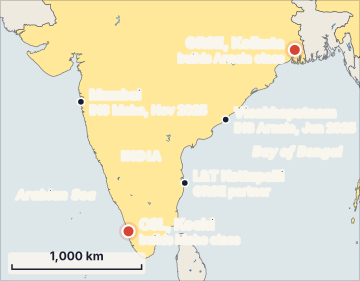
The Anti-Submarine Warfare Shallow Water Craft (ASW-SWC) programme is the Indian Navy's project to build 16 small warships that hunt submarines close to the coast. Eight are built by Garden Reach Shipbuilders and Engineers (GRSE), Kolkata (the Arnala class) and eight by Cochin Shipyard Limited (CSL), Kochi (the Mahe class). Both shipyards are public sector companies. The ships replace the old Abhay-class corvettes and are among the biggest home-built shipbuilding orders the Navy has given.
Why does India need these ships?
Big frigates and destroyers are built for the deep ocean. Close to the shore, the water is shallow, busy and noisy, and large ships with deep hulls cannot operate well there. Yet this is exactly where an enemy submarine might wait outside a port or lay mines. India needed small, quiet, fast ships with special shallow-water sonars to guard harbours and coastal sea lanes. The Abhay-class corvettes that did this job were commissioned around 1989 to 1991 and had become old.
Where did it come from?
- December 2013: The Defence Acquisition Council (DAC), the top defence buying body chaired by the Defence Minister, approved buying 16 shallow-water ASW craft at about ₹13,440 crore.
- June 2014: The Ministry of Defence (MoD) invited bids from Indian shipyards under the "Buy and Make (Indian)" route of the then procurement rules.
- October 2017: CSL and GRSE emerged as the lowest bidders.
- 29 April 2019: MoD signed a ₹6,311 crore contract with GRSE for eight ships.
- 30 April 2019: MoD signed a ₹6,311 crore contract with CSL for eight ships.
- GRSE builds some of its ships with private-sector partner Larsen & Toubro (L&T) at its Kattupalli shipyard near Chennai.
How does a new warship reach the Navy?
A warship goes through clear steps:
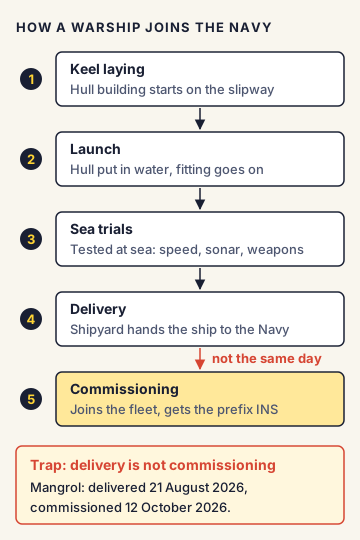
- Keel laying: the formal start of building the hull on the slipway.
- Launch: the hull is put into water for the first time; fitting of machinery and weapons continues afloat.
- Sea trials: the ship is tested at sea for speed, engines, sonars and weapons.
- Delivery: the shipyard hands over the ship to the Navy by signing a delivery document.
- Commissioning: the formal ceremony where the ship joins the fleet and gets the prefix "INS".
The key parts and facts
- Size: about 77 to 78 metres long, around 900 tonnes displacement (the weight of water the ship pushes aside, which equals the ship's weight).
- Speed and range: up to about 25 knots (about 46 km per hour); range about 1,800 nautical miles at 14 knots.
- Propulsion: three diesel engines driving waterjets. A waterjet sucks in water and pushes it out at the back at high speed, like a powerful water pump. Waterjets let a ship work in shallow water, turn sharply and make less underwater noise. These are reported to be the largest Indian Navy warships driven by waterjets.
- Sensors: the Abhay hull-mounted sonar (designed by DRDO's NPOL and built by BEL) and a low frequency variable depth sonar that is lowered under the water.
- Weapons: the RBU-6000 anti-submarine rocket launcher, lightweight torpedoes (324 mm), rails for laying anti-submarine mines, a 30 mm gun and remote-controlled machine guns.
- Roles: coastal ASW, underwater surveillance, mine laying, search and rescue, and low intensity maritime operations.
- Indigenous content: around 80% on CSL's ships.
The ships and their names
The ships carry the names of earlier ships and coastal places of India.
- Arnala class (GRSE): Arnala, Androth, Anjadip, Amini, Agray, Akshay, Ajay, Abhay. INS Arnala was the first of the whole programme to be commissioned, on 18 June 2025 at Visakhapatnam.
- Mahe class (CSL): Mahe, Malvan, Mangrol, Malpe, Mulki, Magdala, Machilipatnam and one more. INS Mahe was commissioned on 24 November 2025 in Mumbai.
India's position
The programme is a showcase of Aatmanirbhar Bharat (self-reliant India) in defence. Both shipyards are Indian public sector companies, the main sonar is Indian, and many systems are made by Indian firms, including small and medium enterprises. Together with P-8I aircraft, MH-60R helicopters and Kamorta-class corvettes, these 16 craft close the shallow, coastal layer of India's anti-submarine shield.
Commonly confused concepts
- Arnala class vs Mahe class: Both are ASW-SWC designs of nearly the same size and role. Arnala class = GRSE, Kolkata. Mahe class = CSL, Kochi.
- ASW-SWC vs Kamorta class: Kamorta-class (Project 28) are bigger ASW corvettes (about 3,300 tonnes) for wider sea areas. ASW-SWCs are smaller (about 900 tonnes) and built for shallow coastal waters.
- Delivery vs commissioning: Delivery is the shipyard handing the ship over. Commissioning is the Navy formally taking it into service. Mangrol was delivered on 21 August 2026 and is being commissioned on 12 October 2026.
- Abhay class (old corvettes) vs Abhay sonar vs INS Abhay (new ASW-SWC): The same name appears three times. The old Abhay-class corvettes are being replaced; "Abhay" is also the hull-mounted sonar on the new ships, and one new GRSE ship is also named Abhay.
Issues, criticism and the way forward
- Delays: The project was approved in 2013, but the first ship came only in 2025. The first GRSE ship was due within 42 months of the 2019 contract, but arrived years later.
- Imported parts: Some systems, such as engines and the variable depth sonar's foreign technology partner, still come from abroad.
- Way forward: Faster trials, a steady flow of orders so shipyards keep skilled workers, more indigenous engines and sonars, and adding unmanned underwater systems to support these craft.
Concepts to Know
- Defence Acquisition Council (DAC): The top body in the Ministry of Defence that approves big defence purchases. It is chaired by the Defence Minister.
- Knot and nautical mile: A nautical mile is about 1.852 km. A knot is a speed of one nautical mile per hour.
- Displacement: The weight of the water a ship pushes aside when floating. It equals the ship's own weight, so it is used to describe a warship's size.
- Public sector shipyard: A shipyard owned mainly by the government, like CSL, GRSE or Mazagon Dock.
- 16 ASW-SWCs approved by the DAC in December 2013 (about ₹13,440 crore)
- Contracts: GRSE on 29 April 2019 and CSL on 30 April 2019, about ₹6,311 crore each, 8 ships each
- GRSE: Arnala class (first commissioned: INS Arnala, 18 June 2025, Visakhapatnam)
- CSL: Mahe class (first commissioned: INS Mahe, 24 November 2025, Mumbai)
- Length about 77 to 78 m; about 900 tonnes; up to 25 knots; diesel-waterjet propulsion
- Sonars: Abhay hull-mounted sonar (DRDO-NPOL, built by BEL) + low frequency variable depth sonar
- Replace the Abhay-class corvettes
● Tracked since October 09, 2026 · last seen October 09, 2026 · updates as the daily brief publishes