Anti-Submarine Warfare (ASW)
How Navies Hunt Submarines
Updated 13 Oct 2026: Named the Abhay hull-mounted sonar and low-frequency variable depth sonar carried by India's ASW shallow water craft.
Anti-submarine warfare, or ASW, is the set of methods, ships, aircraft and weapons a navy uses to find, track and destroy enemy submarines. A submarine is dangerous because it hides under water, where radar and eyesight do not work. So ASW is mainly a contest of sound: the hunter tries to hear or "echo-locate" the submarine before the submarine can attack. Every major navy, including India's, treats ASW as one of its most important jobs.
Why is a submarine so hard to find?
Radar and light do not travel far under sea water. Radio waves die out within a few metres. So a submarine under water is almost invisible to normal sensors. Modern submarines are also built to be very quiet. They use special hull coatings, careful engine mounting and slow-turning propellers to make less noise. A quiet submarine can sit near a port or a sea route and wait, like a hidden sniper.
What can a submarine do?
It can sink warships and cargo ships with torpedoes. It can lay mines (hidden explosive devices) at the mouth of a harbour. It can fire missiles at targets on land. It can also quietly watch an enemy's ships and collect information. For a country like India, which brings in most of its trade and oil by sea, an enemy submarine near its ports is a serious threat.
Where did ASW come from?
ASW became a serious subject in World War I (1914 to 1918), when German submarines, called U-boats, sank a very large number of Allied cargo ships. Navies answered with convoys (ships travelling together under escort) and depth charges (bombs that explode under water). In World War II, sonar and aircraft patrols became the main ASW tools.
During the Cold War, the United States and the Soviet Union built large fleets of nuclear submarines. This led to modern ASW: long-range sonars, maritime patrol aircraft, helicopters and homing torpedoes.
How does sonar work?
Sonar stands for SOund Navigation And Ranging. It is the main tool of ASW. There are two kinds:
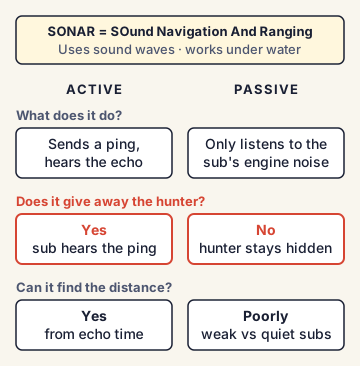
- Active sonar: The ship sends out a loud "ping" of sound. If the sound hits a submarine, an echo comes back. From the time the echo takes, the ship can work out the distance. This is like shouting in a valley and hearing the echo. But the ping also tells the submarine that a hunter is nearby.
- Passive sonar: The ship only listens. It tries to hear the noise of the submarine's engines and propellers. It does not reveal itself, but it cannot easily measure distance, and it struggles against very quiet submarines.
Sonars can be fitted in different ways. A hull-mounted sonar sits in the bottom of the ship. A variable depth sonar (VDS) is lowered on a cable to a chosen depth below the ship. A towed array is a long line of listening devices pulled far behind a ship, away from the ship's own noise. Sonobuoys are small floating sonars dropped into the sea by aircraft. They send what they hear back to the aircraft by radio.
The layers of ASW (who does what)
Navies hunt submarines with several layers working together:
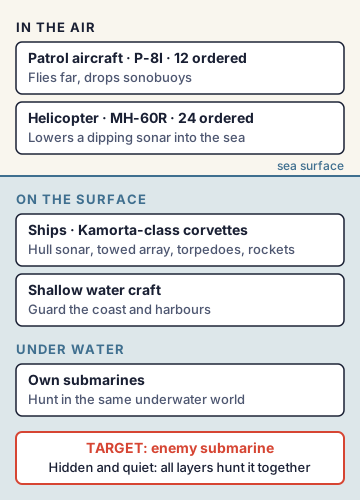
- Maritime patrol aircraft fly long distances over the sea and drop sonobuoys. India uses the Boeing P-8I. India ordered 8 in 2009 and 4 more in 2016, for 12 in total.
- Helicopters fly from ships and lower a "dipping sonar" into the water. India ordered 24 MH-60R Seahawk helicopters from the United States in 2020. Its first MH-60R squadron, INAS 334, was commissioned at Kochi in March 2024.
- Surface ships such as frigates and corvettes carry hull and towed sonars, torpedoes and rockets. India's Kamorta-class corvettes (Project 28), built by GRSE, Kolkata, were India's first home-built stealth ASW corvettes (four ships, commissioned between 2014 and 2020).
- Shallow water craft guard the coast and harbours, where big ships cannot work well. In 2019 India ordered 16 Anti-Submarine Warfare Shallow Water Craft (ASW-SWC): 8 from GRSE, Kolkata (the Arnala class) and 8 from Cochin Shipyard Limited (the Mahe class). They replace the old Abhay-class corvettes. The first, INS Arnala, was commissioned at Visakhapatnam in June 2025. The first Mahe-class ship, INS Mahe, followed in November 2025. As of October 2026, INS Mangrol is the third Mahe-class ship in service. These small ships run on waterjets (engines that push the ship by shooting out a jet of water), which lets them turn quickly in shallow water. They carry the home-built Abhay compact hull-mounted sonar, designed by DRDO's NPOL, Kochi. They also carry a low-frequency variable depth sonar, which is lowered below the ship to listen under the water layers that hide submarines. Their weapons are lightweight torpedoes, ASW rockets and torpedo decoys, and they can also lay mines.
- Submarines themselves are also excellent submarine hunters, because they share the same underwater world.
The weapons of ASW
- Torpedoes are self-propelled underwater missiles. A lightweight torpedo (324 mm wide) is dropped from aircraft, helicopters or small ships. A heavyweight torpedo (533 mm wide) is fired from submarines and larger ships. India's Varunastra is a home-built heavyweight anti-submarine torpedo designed by DRDO's Naval Science and Technological Laboratory (NSTL), Visakhapatnam, and inducted in 2016.
- ASW rockets are fired in a pattern over the place where a submarine is thought to be, like throwing a net. The Russian-origin RBU-6000 launcher is a well-known example.
- Sea mines can be laid to block the path of submarines.
- Torpedo decoys protect the hunter itself. A decoy is a device that copies the sound of a ship, so an enemy torpedo that homes in on sound chases the decoy instead. India's Maareech advanced torpedo decoy system was designed by DRDO's NPOL, Kochi and NSTL, Visakhapatnam, and is built by Bharat Electronics Limited (BEL). The Navy signed the contract for it in June 2020.
Why are shallow waters harder?
Hunting a submarine close to the coast is harder than in the open ocean. There is a lot of noise from fishing boats, cargo ships and waves breaking on the shore. Sound bounces off the sea floor and the surface, creating confusing echoes (called reverberation or clutter). River water mixing with sea water changes the temperature and saltiness, and this bends sound.
The thermocline, a layer where water temperature drops sharply with depth, can bend sound so much that a submarine sitting below it stays hidden. This is why special shallow-water sonars and variable depth sonars are needed.
India's position
India's coastline was officially re-measured in 2025 at about 11,098 km (earlier about 7,516 km), using a new method. Most of its trade and energy also comes by sea. Submarines of other navies are reported in the Indian Ocean more often. So India is building ASW strength at every layer: P-8I aircraft, MH-60R helicopters, Kamorta-class corvettes, new frigates and destroyers with towed arrays, and 16 ASW shallow water craft for the coast.
Indian research bodies like DRDO's Naval Physical and Oceanographic Laboratory (NPOL), Kochi design sonars, and Bharat Electronics Limited (BEL) builds them.
Commonly confused concepts
- Sonar vs radar: Radar uses radio waves and works in air. Sonar uses sound waves and works under water.
- Active vs passive sonar: Active sends a ping and listens for the echo (finds range but gives away the hunter). Passive only listens (stays hidden but finds range poorly).
- SSK vs SSN vs SSBN: An SSK is a diesel-electric attack submarine (India's Kalvari class). An SSN is a nuclear-powered attack submarine. An SSBN is a nuclear-powered submarine carrying nuclear ballistic missiles (India's Arihant class). All three are ASW targets, but SSKs are quieter and hardest to catch near coasts.
- Lightweight vs heavyweight torpedo: 324 mm, short range, from aircraft and small ships; versus 533 mm, long range, mainly from submarines and big ships.
- ASW vs mine countermeasures (MCM): ASW hunts submarines. MCM finds and clears sea mines. Some ships do a bit of both, but they are separate jobs.
Issues, criticism and the way forward
- Quieter submarines: Air-independent propulsion (AIP) lets diesel submarines stay under water for weeks without surfacing, making them harder to find.
- Gaps in numbers: India's ASW fleet has grown slowly. For years, older ships retired before new ones arrived, leaving gaps in coastal ASW cover.
- Import dependence: Key items like aircraft, helicopters and some sonars and torpedoes are still imported.
- Way forward: Experts suggest more home-built sonars and torpedoes, unmanned underwater vehicles to watch key routes, underwater sensor networks near ports, and better sharing of data among the Navy, Coast Guard and friendly navies.
Concepts to Know
- Commissioning: The formal ceremony at which a new ship becomes part of the Navy. Its flag is raised and it becomes "INS" (Indian Naval Ship).
- Corvette and frigate: Types of warships. A corvette is small and suits coastal work. A frigate is larger and often focuses on escort and ASW in open seas.
- Depth charge: An old ASW weapon: a barrel of explosives dropped into the sea that blows up at a set depth.
- Air-independent propulsion (AIP): A system that lets a non-nuclear submarine make power under water without needing air from the surface, so it can stay submerged for much longer.
- Littoral waters: The sea areas close to the coast.
- SONAR = SOund Navigation And Ranging; active (ping and echo) vs passive (listen only)
- Lightweight torpedo: 324 mm; heavyweight torpedo: 533 mm
- P-8I: 8 ordered in 2009 + 4 in 2016 = 12 aircraft
- MH-60R: 24 ordered from the US in 2020; first squadron INAS 334 commissioned at Kochi, March 2024
- Kamorta class (Project 28): 4 ASW corvettes by GRSE, commissioned 2014 to 2020
- Varunastra: DRDO-NSTL heavyweight ASW torpedo, inducted 2016
- NPOL, Kochi (DRDO) designs naval sonars
- ASW-SWC: 16 ordered in 2019 (8 Arnala class by GRSE, 8 Mahe class by Cochin Shipyard); INS Arnala first commissioned, June 2025; INS Mangrol third Mahe-class ship, October 2026; sensors: Abhay hull-mounted sonar (NPOL) + low-frequency variable depth sonar
- Maareech: DRDO (NPOL + NSTL) torpedo decoy system built by BEL; Navy contract June 2020
- 13 Oct 2026Named the Abhay hull-mounted sonar and low-frequency variable depth sonar carried by India's ASW shallow water craft.
- 12 Oct 2026Added India's 16 ASW shallow water craft (Arnala and Mahe classes, including INS Mangrol, October 2026) and the Maareech torpedo decoy.
● Tracked since March 17, 2026 · last seen October 12, 2026 · updates as the daily brief publishes