Animating the Carbon Cycle
How Wild Animals Help Store Carbon
"Animating the carbon cycle" is the idea that wild animals are not just passengers in nature's carbon cycle; they help drive it. By eating, hunting, moving, spreading seeds and leaving dung, animals change how much carbon plants, soils and oceans can hold. When healthy animal populations are protected or brought back, ecosystems can often store more carbon. When animals disappear, some of that storage is lost, even if the forest or sea itself is not cut down.
Why does this idea matter?
Most climate policy counts carbon in trees, soil and the ocean, but treats animals as if they do not matter for carbon. Scientists say this leaves a blind spot. A forest can look green from a satellite and still be losing carbon slowly because the animals that plant its big trees have been hunted out.
This "empty forest" problem is called defaunation (the loss of animals from an ecosystem). So the idea asks a simple question: if animals affect carbon, should protecting them be part of climate action?
First, a quick reminder: what is the carbon cycle?
Carbon keeps moving between the air, living things, soil, rocks and the ocean.
- Plants take in carbon dioxide (CO2) from the air through photosynthesis and store the carbon in their leaves, wood and roots.
- When plants and animals breathe, decay or burn, carbon goes back into the air as CO2.
- In the ocean, tiny floating plants called phytoplankton take in CO2. Some of this carbon sinks to the deep sea when they die or are eaten.
A place that takes in more carbon than it releases is called a carbon sink. A place that releases more than it takes in is a carbon source. Animals can push an ecosystem towards being a sink or a source.
Where did the idea come from?
It grew out of decades of ecology research.
- 1969: American ecologist Robert Paine named the idea of a keystone species, based on his experiments removing a starfish (Pisaster ochraceus) from rocky shores. Mussels, which the starfish ate, spread and pushed out many other species. A keystone species is one whose effect on its ecosystem is very large compared with its numbers. It is named after the keystone at the top of an arch, which holds the whole arch together.
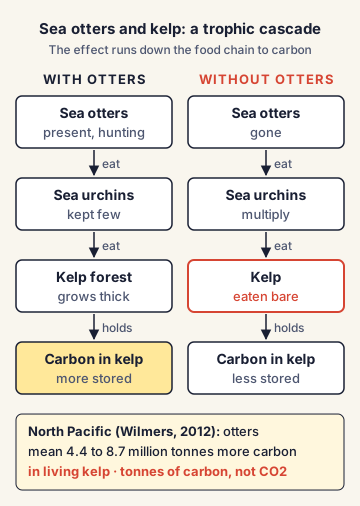
- 1980: Paine brought the term trophic cascade into science. "Trophic" means related to feeding. A trophic cascade is a chain effect that runs down the food chain: a top predator changes the number or behaviour of plant-eaters, which then changes the plants.
- 2009 to 2019: Studies began to measure the carbon side of these effects (examples below).
- 2023: A study led by Yale University scientist Oswald Schmitz, titled "Trophic rewilding can expand natural climate solutions" (published in Nature Climate Change), pulled this together. "Rewilding" means bringing back natural processes, often by restoring missing animals.
- 2026 (June): The Scientific Consensus on Wildlife and Climate, a statement signed by scientists, was first announced at the mid-year session (SB64) of the UNFCCC (United Nations Framework Convention on Climate Change, the UN climate treaty). By COP31 (the 31st yearly UN climate summit, November 2026) it had more than 350 scientist supporters from 47 countries.
- 2026 (November): At COP31, a group of governments launched the Wildlife for Climate Declaration, a political promise to treat wildlife protection as part of climate action. It is endorsed by countries, not by scientists, and it is not legally binding.
How do animals change carbon storage?
There are a few main pathways.
- Eating plants (grazing and browsing): Plant-eaters decide which plants survive. This changes how much carbon is stored in plants and soil.
- Hunting (predation): Predators control plant-eaters, which protects plants. This is the trophic cascade.
- Spreading seeds (seed dispersal): Many big, heavy-wooded trees have large seeds that only big animals can swallow and carry. Without these animals, such trees cannot spread.
- Moving nutrients: Animals move nutrients like nitrogen and iron through dung, urine and their bodies. This feeds plant and phytoplankton growth.
- Changing soil and fire: Trampling, digging and grazing change soils and can reduce how much dry grass is left to burn.
Real examples UPSC can ask about
- Sea otters and kelp forests (North Pacific): Kelp is a large seaweed that grows in underwater "forests". Sea urchins eat kelp, and sea otters eat sea urchins. Where otters are present, urchins are kept in check and kelp forests grow thick. A 2012 study (Wilmers and others) estimated that, from southern Vancouver Island to the Aleutian Islands, otters' effect on living kelp means about 4.4 to 8.7 million tonnes (teragrams) more carbon stored. This figure is in tonnes of carbon, not tonnes of CO2. The authors also noted that some of this carbon may return to the air.
- African forest elephants (Congo Basin): Elephants eat and trample many small, soft-wooded trees. This leaves more space and light for fewer but bigger, denser-wooded trees, which hold more carbon. A 2019 study in Nature Geoscience (Berzaghi and others) modelled that losing forest elephants would cut the above-ground biomass of central African rainforests by about 7%. "Biomass" means the total weight of living material, and about half of dry plant biomass is carbon.
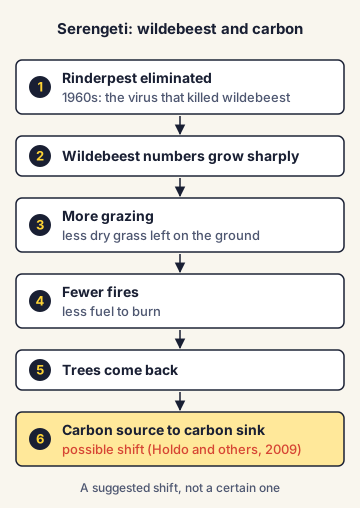
- Wildebeest in the Serengeti (Tanzania): Rinderpest is a viral disease that killed cattle and also wild hoofed animals such as wildebeest. In the 1960s, it was eliminated from the area. With the disease gone, the wildebeest population grew sharply. More grazing meant less dry grass, so fewer fires, and trees came back. A 2009 study (Holdo and others, PLoS Biology) suggested this may have shifted the Serengeti from a net carbon source to a net carbon sink.
- Great whales (oceans): Whales feed in the deep and release nutrient-rich waste near the surface. This feeds phytoplankton, which take in CO2. This is called the "whale pump". When a whale dies, its body sinks and takes its carbon to the sea floor. A 2019 article by International Monetary Fund (IMF) economists estimated that a great whale stores about 33 tonnes of CO2 on average over its life. Its authors framed this as a rough estimate.
- Grey wolves (Yellowstone, USA): Wolves were reintroduced to Yellowstone National Park in 1995 after about 70 years of absence. Fewer and more watchful elk ate less of the young willows and aspens along rivers, and these trees began to recover. Scientists still debate how much of this recovery is due to the wolves alone, so this example is a good reminder that cascades are not always simple.
- Large-seeded trees and fruit-eating animals (tropical forests): A 2015 study in Science Advances (Bello and others) simulated the loss of large fruit-eating animals in 31 forest communities of Brazil's Atlantic Forest. It found that losing even a small share of large-seeded trees can reduce the carbon the forest stores.
How big could the effect be?
The 2023 Yale-led study looked at nine animal groups: marine fish, whales, sharks, grey wolves, wildebeest, sea otters, musk oxen, African forest elephants and American bison. It estimated that protecting or restoring their populations could help capture about 6.41 billion tonnes of CO2 a year. The authors said this equals about 95% of the CO2 that must be removed from the air each year to meet the Paris Agreement's 1.5°C goal. These are model estimates with large uncertainty, and the effect depends on the species and the place.
India's position and Indian examples
India has no national policy that counts animals as climate actors, and it is not an endorser of the Wildlife for Climate Declaration. But several Indian links exist.
- Hornbills as "farmers of the forest": In Pakke Tiger Reserve, Arunachal Pradesh, research by the Nature Conservation Foundation tracked great and wreathed hornbills. Half of the seeds were dropped within about 300 m (great hornbill) or about 1.35 km (wreathed hornbill) of the parent tree. The longest trips carried seeds up to about 13 km from the parent tree. Hornbills are key dispersers of large-seeded trees. A great hornbill raises only one chick a year, so hunting can quickly reduce their numbers.
- Asian elephants, tigers and other large animals live in forests that also store a lot of carbon, such as the Western Ghats and the North-East.
- Third National Wildlife Action Plan (2017 to 2031): Released by the Ministry of Environment, Forest and Climate Change on 2 October 2017, it was the first Indian wildlife plan to deal with climate change, through a chapter on integrating climate change into wildlife planning.
- India's NDC (Nationally Determined Contribution, the climate plan each country submits under the Paris Agreement) counts an extra carbon sink from forests and tree cover, but it is measured in trees and land, not in wildlife.
Commonly confused concepts
- Keystone species vs flagship species: A keystone species has a very large effect on how its ecosystem works (the starfish, the sea otter). A flagship species is a popular animal used to draw public support for conservation (the tiger, the giant panda). One animal can be both, but the two ideas are different.
- Trophic cascade vs food chain: A food chain is simply "who eats whom". A trophic cascade is the knock-on effect when a change at one level (like adding a predator) spreads down to plants.
- Animating the carbon cycle vs nature-based solutions: Nature-based solutions are a broad idea of using nature (forests, wetlands, mangroves) to tackle problems like climate change. The wildlife idea is a narrower part of it, focused on animals.
- Blue carbon vs the whale pump: Blue carbon usually means carbon stored in coastal plant ecosystems like mangroves, seagrasses and salt marshes. The whale pump is about whales moving nutrients that feed phytoplankton in the open sea.
- Carbon sink vs carbon source: A sink takes in more carbon than it gives out. A source gives out more than it takes in. The same place (like the Serengeti) can switch from one to the other.
- Tonnes of carbon vs tonnes of CO2: Some studies count carbon, others count CO2. One tonne of carbon is about 3.67 tonnes of CO2. So the sea otter figure (carbon) and the whale and Yale figures (CO2) cannot be compared directly.
- Scientific Consensus vs the Declaration: The Scientific Consensus on Wildlife and Climate is a statement signed by scientists. The Wildlife for Climate Declaration is a promise endorsed by governments.
- Declaration vs treaty: The Wildlife for Climate Declaration is a political promise and is not legally binding. A treaty, like the Paris Agreement, creates legal duties for countries that join it.
Issues, criticism and the way forward
- Hard to measure: Animal effects on carbon change a lot by species, place and time. Many numbers come from models, not direct measurements, so they are harder to count in national carbon accounts.
- Debated cases: Some famous examples, like the Yellowstone wolves, are still argued over by scientists. Overselling can damage trust.
- Not a substitute for cutting emissions: Critics warn that nature-based ideas must not become an excuse for slow cuts in fossil fuel use.
- Carbon market risks: Selling "wildlife carbon credits" could harm local and indigenous communities if their rights are not protected. This is why the Wildlife for Climate Declaration asks for safeguards and fair benefit-sharing.
- Gap between climate and nature treaties: The groups backing the Wildlife for Climate Declaration say that the biodiversity and migratory species conventions (the CBD, Convention on Biological Diversity, and the CMS, Convention on Migratory Species) already recognise wildlife's role, but the UNFCCC does not yet.
- Way forward: Experts suggest adding wildlife actions to NDCs and NBSAPs (National Biodiversity Strategies and Action Plans, each country's plan under the CBD), funding anti-poaching and habitat corridors, reducing human-wildlife conflict, and supporting long-term field studies so that the carbon effects can be measured better.
Concepts to Know
- Photosynthesis: The process by which green plants use sunlight to turn CO2 and water into food, storing the carbon in their bodies.
- Phytoplankton: Tiny, mostly single-celled plant-like living things that float in water. Together, they take in a huge amount of CO2.
- Biomass: The total weight of living material in an area, such as all the trees in a forest.
- Defaunation: The loss of animals, especially large animals, from an ecosystem, often due to hunting or habitat loss, even when the forest itself still stands.
- Rewilding: Restoring nature by bringing back natural processes and missing species, especially large animals, and then letting nature run with little human control.
- Rinderpest: A deadly viral disease of cattle and wild hoofed animals. It was declared eradicated worldwide in 2011.
- Kelp: A large brown seaweed that grows in cool coastal seas and forms underwater forests.
- Non-binding declaration: A public promise by governments with no legal penalty if they do not follow it.
- Keystone species concept: named by Robert Paine, 1969 (from experiments removing the starfish Pisaster ochraceus)
- Trophic cascade term: brought into science by Robert Paine, 1980
- Sea otters: about 4.4 to 8.7 million tonnes more carbon (not CO2) in living kelp (Wilmers and others, 2012; southern Vancouver Island to the Aleutians)
- African forest elephants: losing them would cut above-ground biomass of central African rainforests by about 7% (Berzaghi and others, Nature Geoscience, 2019)
- Serengeti: rinderpest eliminated in the 1960s, wildebeest boom, fewer fires; possible shift from carbon source to carbon sink (Holdo and others, PLoS Biology, 2009)
- Great whale: about 33 tonnes of CO2 stored on average over its life (IMF economists' estimate, 2019)
- Yellowstone: grey wolves reintroduced in 1995 after about 70 years
- Schmitz and others, Nature Climate Change, 2023: nine animal groups; about 6.41 billion tonnes of CO2 a year of extra capture possible, about 95% of the yearly removal needed for the 1.5°C goal
- Scientific Consensus on Wildlife and Climate (scientists): first announced June 2026; more than 350 scientists from 47 countries by COP31 (November 2026)
- Wildlife for Climate Declaration (governments): launched at COP31, November 2026; not legally binding; India is not an endorser
- Pakke hornbills: half of the seeds dropped within about 300 m (great) or 1.35 km (wreathed) of the parent tree; longest trips up to about 13 km from the parent tree
- India's Third National Wildlife Action Plan (2017 to 2031): first Indian wildlife plan to include climate change
● Tracked since November 18, 2026 · last seen November 18, 2026 · updates as the daily brief publishes