Agasthyamalai Biosphere Reserve
The Agasthyamalai Biosphere Reserve is a large protected forest landscape at the southern tip of the Western Ghats. It is shared by Kerala and Tamil Nadu and covers about 3,500 square kilometres. It is one of India's 18 biosphere reserves and has been part of UNESCO's World Network of Biosphere Reserves since 2016. It is known for its rich plant life, especially medicinal plants, and for its tribal communities.
What is a biosphere reserve?
A biosphere reserve is a large area where the goal is to protect nature and also let local people live and earn a living in a sustainable way. Sustainable simply means using resources without using them up. A National Park tries to keep people out. A biosphere reserve instead tries to show how people and nature can live together. You can think of it as a "living laboratory" for this balance.
Why do biosphere reserves exist?
Strict protected areas can save wildlife, but they often clash with the people who have lived in forests for centuries. If you only fence forests off, local people lose their livelihoods and may stop supporting conservation. Biosphere reserves try to solve this. They protect the most precious core of the forest strictly, and allow controlled human use around it.
Where did the idea come from?
The idea comes from UNESCO's Man and the Biosphere (MAB) Programme, launched in 1971. UNESCO is the United Nations body for education, science and culture. In 1995, UNESCO adopted the Seville Strategy and a Statutory Framework, which set the rules for the World Network of Biosphere Reserves. India started its own national biosphere reserve scheme in 1986. Its first biosphere reserve was the Nilgiri Biosphere Reserve (1986), which was also India's first to enter the UNESCO network, in 2000.
How is a biosphere reserve divided?
Every biosphere reserve has three zones, like rings around a target:
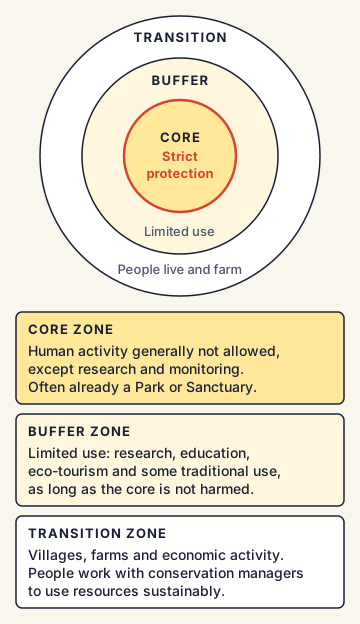
- Core zone: The heart of the reserve. It gets strict protection. Human activity is generally not allowed, except research and monitoring. In India, core zones are usually already National Parks or Wildlife Sanctuaries.
- Buffer zone: The area around the core. Limited activities like research, education, eco-tourism and some traditional use are allowed, as long as they do not harm the core.
- Transition zone: The outermost area. Villages, farms and other economic activities exist here. People work with conservation managers to use resources sustainably.
What is the legal status in India?
This is an important exam point. India has no separate law for biosphere reserves. The Wildlife (Protection) Act, 1972 does not even define them. A biosphere reserve is set up by the central government (Ministry of Environment, Forest and Climate Change) under a scheme, through an executive notification. So the protection actually comes from the laws covering the areas inside it, for example National Parks and Sanctuaries under the Wildlife (Protection) Act, and forest land under the Forest (Conservation) Act, 1980 and state forest laws. UNESCO recognition is also not a law. It is international recognition that brings prestige and scientific cooperation.
India's biosphere reserves in numbers
India has 18 notified biosphere reserves. Of these, 13 are in UNESCO's World Network. Agasthyamalai was added to the UNESCO network in 2016, as India's 10th. Later additions were Khangchendzonga (2018), Panna (2020) and Cold Desert in Himachal Pradesh (2025).
Agasthyamalai: the key facts
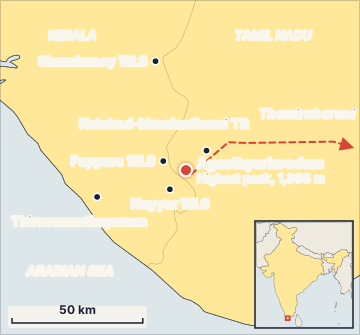
- Location: The southernmost end of the Western Ghats, across Kerala (Thiruvananthapuram, Kollam and Pathanamthitta districts) and Tamil Nadu (Tirunelveli and Kanyakumari districts).
- Notified: On 12 November 2001 by the Government of India, at first covering only the Kerala portion. Tamil Nadu areas were added later, taking the total to about 3,500.36 sq km.
- UNESCO MAB recognition: 2016.
- Highest point: Agasthyarkoodam (Agastya Mala) peak, about 1,868 metres high. It is linked in tradition with the sage Agastya.
- Rivers: The Thamirabarani river of Tamil Nadu rises on the eastern side of the range. The Karamana river of Kerala also starts here.
- Protected areas inside: The Neyyar, Peppara and Shendurney Wildlife Sanctuaries in Kerala, and the Kalakad-Mundanthurai Tiger Reserve in Tamil Nadu. Kalakad-Mundanthurai was Tamil Nadu's first tiger reserve.
- World Heritage link: The Agasthyamalai hills are one of the sub-clusters of the Western Ghats UNESCO World Heritage Site, inscribed in 2012. A World Heritage Site (protecting outstanding natural or cultural value) is a different UNESCO list from a biosphere reserve.
- Wildlife: Tigers, Asian elephants, the lion-tailed macaque and the Nilgiri tahr (a mountain goat found only in the Western Ghats), along with thousands of flowering plants, many found nowhere else.
The Kani tribe and the Jeevani story
The Kani (also called Kanikkar) are the main tribal community of these hills. Their elders knew that the plant arogyapacha (Trichopus zeylanicus) fights tiredness. Scientists at the Tropical Botanic Garden and Research Institute (TBGRI), Thiruvananthapuram, used this knowledge to develop a herbal medicine called Jeevani, launched in the 1990s. TBGRI agreed to share 50% of the licence fee and royalty with the Kani community.
A trust, the Kerala Kani Samudaya Kshema Trust, was formed in 1997 to receive the money. This is often quoted as one of the world's first examples of benefit sharing: paying a community when its traditional knowledge is used commercially. This idea later became part of the Nagoya Protocol (2010) and India's Biological Diversity Act, 2002.
What threatens the reserve?
The main pressures are encroachment (people occupying forest land without permission), conversion of forest into plantations of cash crops like silk cotton, cardamom and cashew, tourism and resorts, roads and other projects, and conflicts between humans and wild animals. In Tamil Nadu, the Tamil Nadu Hill Areas (Preservation of Trees) Act, 1955 also controls tree cutting on hill slopes. The Supreme Court has found that large forest areas here were turned into such cultivation over many decades.
Commonly confused concepts
- Biosphere Reserve vs National Park: A National Park is created under the Wildlife (Protection) Act, 1972 and allows almost no human rights inside. A biosphere reserve is created under a scheme, has no special law, and openly allows people to live in its buffer and transition zones.
- Biosphere Reserve vs Wildlife Sanctuary: A sanctuary is also made under the Wildlife (Protection) Act. It allows some regulated activities. A biosphere reserve is usually much bigger and may contain several sanctuaries and parks.
- Biosphere Reserve vs Tiger Reserve: Tiger Reserves are notified under Section 38V of the Wildlife (Protection) Act on the advice of the National Tiger Conservation Authority (NTCA). They have a core (critical tiger habitat) and a buffer. Biosphere reserves have three zones and are linked to UNESCO's MAB programme.
- UNESCO MAB recognition vs World Heritage Site: MAB recognition is for biosphere reserves (people plus nature). World Heritage status, under the 1972 World Heritage Convention, is for places of "outstanding universal value". Agasthyamalai has both, but they are separate lists.
- Notified vs UNESCO-listed: A reserve can be notified by India without being on UNESCO's list. Nilgiri was notified in 1986 but entered the UNESCO network only in 2000.
Issues, criticism and the way forward
- No legal backing: Because there is no biosphere reserve law, the label alone cannot stop harmful activity. Experts have long suggested a clear legal framework.
- People versus protection: Eviction drives can hurt genuine forest dwellers, while outsiders and commercial growers may misuse forest land. The challenge is to separate the two fairly, using laws like the Forest Rights Act.
- Plantation pressure: Turning natural forest into a single cash crop destroys the mixed forest that wildlife needs.
- Two states, one landscape: Since the reserve spans Kerala and Tamil Nadu, management needs coordination between both states.
- Way forward: Experts suggest community participation, fair settlement of rights, restoration of degraded land, and strict control over new projects in core areas.
Concepts to Know
- UNESCO: The United Nations Educational, Scientific and Cultural Organization, a UN body based in Paris that works on education, science and culture.
- Executive notification: An official order issued by the government under its own powers, not a law passed by Parliament. It can be changed more easily than a law.
- Encroachment: Occupying or using land that legally belongs to someone else, here forest land owned by the government, without permission.
- Endemic species: A plant or animal that is found naturally only in one particular region and nowhere else in the world.
- Benefit sharing: The rule that when a company or institute earns money from a community's traditional knowledge or local plants, a fair share of that money must go back to the community.
- UNESCO MAB Programme: launched 1971; Seville Strategy and Statutory Framework: 1995
- India's biosphere reserve scheme: 1986; first reserve: Nilgiri (1986), UNESCO-listed 2000
- India: 18 biosphere reserves, 13 in UNESCO's World Network (latest: Cold Desert, 2025)
- Agasthyamalai: notified 12 November 2001; UNESCO-listed 2016 (India's 10th); about 3,500.36 sq km; Kerala and Tamil Nadu
- Inside: Neyyar, Peppara, Shendurney WLS (Kerala); Kalakad-Mundanthurai Tiger Reserve (Tamil Nadu)
- Highest peak: Agasthyarkoodam, about 1,868 m; Thamirabarani river rises here
- Part of the Western Ghats World Heritage Site (2012)
- Kani tribe, arogyapacha, Jeevani: 50% benefit sharing; Kani trust formed 1997
- No specific law for biosphere reserves in India
● Tracked since November 06, 2026 · last seen November 06, 2026 · updates as the daily brief publishes