Minor Forest Produce (MFP)
Minor forest produce means all the useful things people collect from a forest other than timber (wood from cut trees). It includes leaves, fruits, seeds, flowers, gums, honey, lac, bamboo, canes and medicinal plants. For millions of tribal and forest-dwelling families, collecting and selling these items is a main source of cash income. The word "minor" is misleading: the produce is small in size, but its importance to forest people is very large.
Why does it matter so much?
About 100 million forest dwellers in India depend on minor forest produce for food, shelter, medicine and cash income, according to the Ministry of Tribal Affairs. Many tribal households earn about 20% to 40% of their yearly income from MFP. Women do a large share of the collecting and selling. Unlike a farmer's crop, MFP needs no land ownership, seeds or fertiliser, so it is often the main safety net for the poorest families, especially in the lean months between harvests.
What counts as MFP? The legal definition
The Forest Rights Act, 2006 (full name: the Scheduled Tribes and Other Traditional Forest Dwellers (Recognition of Forest Rights) Act, 2006) defines MFP in Section 2(i). It covers all non-timber forest produce of plant origin, and it names examples such as bamboo, brushwood, stumps, cane, tussar, cocoons, honey, wax, lac, tendu or kendu leaves, medicinal plants and herbs, roots and tubers. Common examples in India:
- Tendu (kendu) leaves: Used to roll beedis. Mainly from Chhattisgarh, Madhya Pradesh, Odisha, Jharkhand and Maharashtra.
- Mahua flowers and seeds: Flowers are eaten and used for drinks; seeds give oil.
- Sal leaves and sal seeds: Leaves are used to make plates; seeds give fat used in food and cosmetics.
- Lac: A resin made by tiny insects on trees, used in bangles, polish and dyes.
- Others: Tamarind, chironji, wild honey, harad (myrobalan), karanj seeds and natural gums.
Bamboo: a special case
For a long time, the Indian Forest Act, 1927 treated bamboo as a "tree", so forest departments controlled it and tribal people could not freely sell it. The Forest Rights Act, 2006 treated it as MFP. In 2017, Parliament amended the Indian Forest Act to remove bamboo grown outside forest areas from the definition of "tree", which made it easier to grow and sell.
Who owns MFP? The rights framework
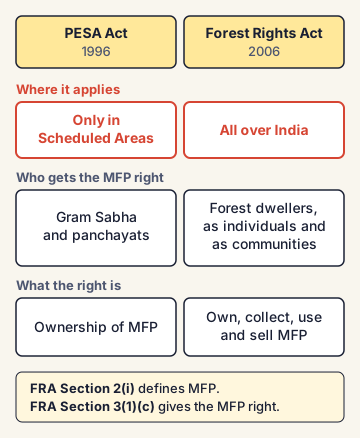
- PESA Act, 1996 (the Panchayats (Extension to Scheduled Areas) Act): It gives the Gram Sabha (village assembly) and panchayats in Scheduled Areas the ownership of minor forest produce.
- Forest Rights Act, 2006, Section 3(1)(c): It recognises the right of ownership, access to collect, use and sell MFP that forest dwellers have traditionally collected, from inside or outside village boundaries.
- In practice, many states long kept monopoly control over valuable items like tendu leaves, selling them through state corporations. This is called "nationalised" MFP.
Where did MSP for MFP come from?
Tribal gatherers usually sell small amounts, need cash quickly and live far from markets. So traders and middlemen often buy their produce at very low prices. To fix this:
- In 2011, the Ministry of Panchayati Raj set up a committee under Prof. T. Haque. It recommended MSP for MFPs, an end to the state monopoly over most MFPs, and ownership rights for gatherers.
- On 1 August 2013, the Union Cabinet approved the Centrally Sponsored Scheme called "Mechanism for Marketing of Minor Forest Produce through Minimum Support Price and Development of Value Chain for MFP", starting from 2013-14. It was designed as a social safety net for MFP gatherers, who are mostly from Scheduled Tribes.
- The scheme started with about 10 to 12 items, including tendu, bamboo, mahua seed, sal leaf, sal seed, lac, chironji, wild honey, myrobalan, tamarind, gums and karanj. It covered only non-nationalised MFPs in each state.
- More items were added over the years. As of 2026, the government has notified MSP for 87 MFP items.
- In 2021-22, the scheme was merged with the scheme for Institutional Support for Development and Marketing of Tribal Products into a single Central Sector Scheme called the Pradhan Mantri Janjatiya Vikas Mission (PMJVM), run by the Ministry of Tribal Affairs.
How does MSP for MFP work, step by step?
- A Pricing Cell set up in TRIFED studies the cost of collecting each item and market conditions, and recommends a price.
- The Ministry of Tribal Affairs decides and notifies the MSP. Rules say the MSP is to be revised once every three years.
- State Implementing Agencies (often state forest or tribal development corporations) set up procurement centres, often at local village markets (haats).
- If the market price falls below the MSP, the state agency buys the produce at the MSP. If the market price is higher, gatherers are free to sell in the market.
- Losses suffered by state agencies are shared between the Centre and the states.
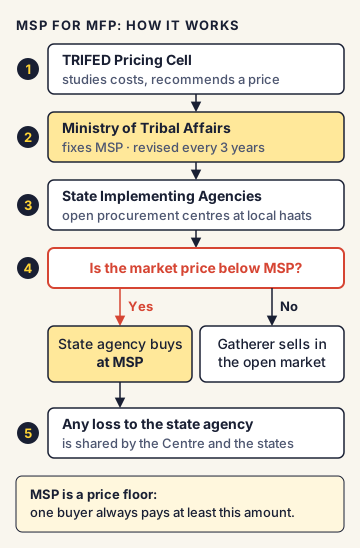
Think of it like a floor under a price. The gatherer knows that, whatever happens in the market, there is at least one buyer who will pay this minimum amount.
What is TRIFED?
The Tribal Cooperative Marketing Development Federation of India (TRIFED) was set up in August 1987 under the Multi-State Cooperative Societies Act, 1984. It is a national-level cooperative body under the Ministry of Tribal Affairs. It is the nodal agency for MSP for MFP and for Van Dhan. It also sells tribal products through its Tribes India shops (116 outlets as of early 2026) and online.
From selling raw produce to adding value: Van Dhan
MSP only protects the price of raw produce. Real income rises when gatherers process the produce themselves, for example turning tamarind into paste or honey into bottled honey. For this:
- The Pradhan Mantri Van Dhan Yojana was launched on 14 April 2018 at Bijapur, Chhattisgarh.
- Tribal gatherers form self-help groups, which come together in a Van Dhan Vikas Kendra (VDVK) of about 300 members, with at least 60% Scheduled Tribe members.
- A VDVK can get up to ₹15 lakh to set up, plus training in scientific harvesting, processing and packaging.
- As of 31 July 2026, 4,172 VDVKs had been sanctioned, linking about 12.48 lakh tribal members.
Commonly confused concepts
- MSP for MFP vs MSP for crops: Crop MSP is recommended by the Commission for Agricultural Costs and Prices (CACP) and approved by the Cabinet Committee on Economic Affairs (CCEA), under the Ministry of Agriculture. MFP MSP is recommended by TRIFED's Pricing Cell and fixed by the Ministry of Tribal Affairs.
- Minor forest produce vs major forest produce: Major forest produce means timber and wood. MFP is everything non-timber of plant origin.
- PESA vs FRA on MFP: PESA (1996) gives ownership of MFP to Gram Sabhas and panchayats in Scheduled Areas only. FRA (2006) gives individual and community rights over MFP to forest dwellers across India.
- Van Dhan vs MSP for MFP: MSP fixes a floor price for raw produce. Van Dhan helps gatherers process and sell value-added products. Both now come under PMJVM.
- Central Sector Scheme vs Centrally Sponsored Scheme: A Central Sector Scheme is fully funded and run by the Centre. A Centrally Sponsored Scheme is shared between the Centre and states. The old MSP for MFP scheme was centrally sponsored; PMJVM is a central sector scheme.
Issues, criticism and the way forward
- Stagnant prices: The three-year revision cycle is often delayed. When MSPs stay low while market prices and costs rise, the MSP stops working as a real safety net. This is the problem the new restructuring wants to fix.
- Low and falling procurement: Procurement fell over 92% in 2024-25. Many gatherers do not even know the MSP exists, and procurement centres are few and far.
- State monopoly: Items like tendu are still controlled by state corporations in many states, which critics say limits the rights given by PESA and FRA.
- Middlemen and late payment: Gatherers need cash on the spot. If state agencies pay late, gatherers sell to traders below MSP.
- Sustainability: Higher prices can encourage over-harvesting, which can damage the forest. TERI's earlier studies stressed sustainable harvesting along with fair prices.
- Way forward: Experts suggest automatic, regular MSP revision linked to costs and inflation, more procurement centres at local haats, quick digital payments, awareness drives, ending monopolies where FRA rights exist, and stronger links between MSP and Van Dhan processing so that gatherers earn more per kilogram.
Concepts to Know
- Scheduled Areas: Tribal-majority areas notified under the Fifth Schedule of the Constitution, where special rules apply to protect tribal people.
- Gram Sabha: The assembly of all adult voters of a village. It is the base level of local self-government.
- Nationalised MFP: Forest produce that only the state government (or its corporation) is allowed to buy and trade.
- Value addition: Doing some work on raw produce (cleaning, drying, grinding, packing) so that it sells for a higher price.
- Procurement: The government buying produce directly from producers at a set price.
- TERI: The Energy and Resources Institute, a research organisation based in New Delhi that works on energy, environment and sustainable development.
- MFP defined in Section 2(i) of the Forest Rights Act, 2006 (non-timber forest produce of plant origin; includes bamboo, tendu, honey, lac, medicinal plants)
- FRA Section 3(1)(c): right of ownership, access to collect, use and dispose of MFP
- PESA Act, 1996: ownership of MFP with Gram Sabhas/panchayats in Scheduled Areas
- T. Haque Committee (2011, Ministry of Panchayati Raj): recommended MSP for MFP
- MSP for MFP scheme approved 1 August 2013 (from 2013-14); MSP now notified for 87 items
- Pricing Cell in TRIFED recommends; Ministry of Tribal Affairs fixes; revision every 3 years
- Merged into Pradhan Mantri Janjatiya Vikas Mission (PMJVM) in 2021-22 (Central Sector Scheme)
- TRIFED: set up August 1987 under the Multi-State Cooperative Societies Act, 1984
- Van Dhan Yojana: launched 14 April 2018, Bijapur (Chhattisgarh); VDVK of about 300 members, up to ₹15 lakh support
- About 100 million forest dwellers depend on MFP
● Tracked since November 02, 2026 · last seen November 06, 2026 · updates as the daily brief publishes