2+2 Ministerial Dialogue Mechanism
Updated 19 Nov 2026: Added exact India-Japan 2+2 dates, its 2018 origin, and the 2024 round's results, including the revised 2025 security declaration.
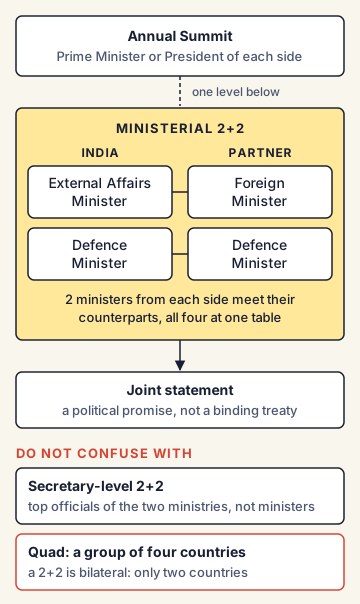
A 2+2 Ministerial Dialogue is a meeting in which two ministers from one country sit with two ministers from another country at the same table. Usually these are the foreign minister and the defence minister of each side. So, for India, the External Affairs Minister and the Defence Minister meet their counterparts together. It is called "2+2" because two ministers from each side take part.
Why does it exist?
Earlier, foreign ministers met foreign ministers, and defence ministers met defence ministers, separately. But today, foreign policy and defence policy are closely linked. A decision about a naval exercise is also a diplomatic signal, and a diplomatic deal often needs military follow-up. The 2+2 format lets both ministries look at security and strategy together, in one room.
You can think of it like a family meeting where both parents sit together to plan, instead of each making separate plans. It is also a sign of deep trust: countries hold 2+2s only with close strategic partners.
Where did it come from?
The idea was used earlier by countries like the US and Japan, which have held a "Security Consultative Committee" in this format for decades. India began its first ministerial 2+2 with the United States in September 2018 in New Delhi. Before that, India held some 2+2 talks at the level of senior officials (secretaries), not ministers.
India's ministerial 2+2 partners
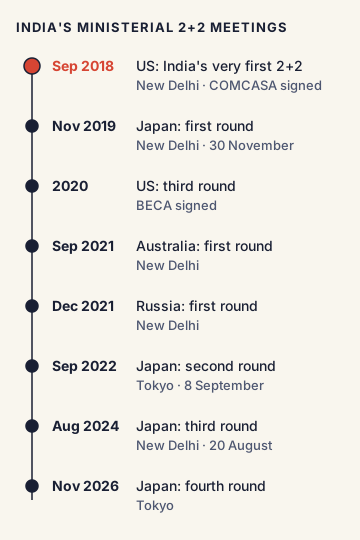
- United States: first meeting in September 2018 (New Delhi). India's oldest and most active 2+2 partner.
- Japan: first meeting on 30 November 2019 (New Delhi); second on 8 September 2022 (Tokyo); third on 20 August 2024 (New Delhi); fourth in November 2026 (Tokyo). The two Prime Ministers agreed to start this ministerial 2+2 at their Annual Summit in Tokyo in October 2018. Before that, India and Japan held their 2+2 talks only at the level of officials.
- Australia: first meeting in September 2021 (New Delhi).
- Russia: first meeting in December 2021 (New Delhi).
Some sources also count a 2+2 format with the United Kingdom. India also holds 2+2 talks at the level of officials with several other countries.
How does a 2+2 work?
The four ministers meet, usually once in one to two years, taking turns hosting. They review defence ties, regional security and diplomatic cooperation. A joint statement is issued at the end, listing agreements and next steps. Officials of both ministries prepare the agenda months in advance. Many major defence agreements are signed during or soon after 2+2 meetings.
What have 2+2s produced?
With the US, the 2+2 era saw India sign the "foundational agreements": COMCASA (2018, at the first 2+2) and BECA (2020, at the third 2+2). With Japan, the first 2+2 (2019) pushed forward the ACSA (signed 2020), and the 2022 round agreed to hold the first fighter-jet exercise between the two air forces. The 2024 round noted progress on India's plan to buy Japan's UNICORN (Unified Complex Radio Antenna), an advanced antenna system for warships.
It also agreed to update the 2008 India-Japan Joint Declaration on Security Cooperation. The two Prime Ministers signed the revised declaration in Tokyo on 29 August 2025. It adds newer areas such as cyber security and economic security.
Commonly confused concepts
- 2+2 Dialogue vs Quad: a 2+2 is a bilateral meeting (between two countries). The Quad is a group of four countries (India, US, Japan, Australia).
- Ministerial 2+2 vs secretary-level 2+2: the ministerial version has ministers; the secretary-level one has top officials of the two ministries.
- 2+2 vs Annual Summit: an Annual Summit is between heads of government (Prime Minister or President). A 2+2 is one level below, between ministers.
Issues, criticism and the way forward
- Irregular timing: the meetings are meant to be regular, but gaps can stretch to two years or more (for example, there was no India-US 2+2 in 2021).
- Statements vs results: critics say joint statements sometimes repeat broad goals without clear deadlines.
- Way forward: experts suggest fixed calendars, follow-up groups to track promises, and adding economic security and technology to the 2+2 agenda, which the recent India-Japan rounds have started doing.
Concepts to Know
- Counterpart: The person holding the same job in another country. Japan's Defence Minister is the counterpart of India's Defence Minister.
- Bilateral vs multilateral: Bilateral means between two countries. Multilateral means among three or more.
- Joint statement: A written document issued by both sides after a meeting, saying what they agreed. It is a political promise, not a legally binding treaty.
- Joint Declaration on Security Cooperation: A document in which India and Japan set out how they will work together on security. The first was signed in 2008. A revised one was signed in August 2025.
- COMCASA and BECA: India-US defence agreements. COMCASA (2018) allows secure communication between the two militaries. BECA (2020) allows sharing of geospatial (map and satellite) information.
- Format: foreign minister + defence minister of each country
- India's first ministerial 2+2: with the US, September 2018
- India-Japan 2+2: 30 November 2019 (New Delhi), 8 September 2022 (Tokyo), 20 August 2024 (New Delhi), November 2026 (Tokyo, fourth round); agreed at the October 2018 Annual Summit
- India-Australia first 2+2: September 2021; India-Russia first 2+2: December 2021
- COMCASA signed at the first India-US 2+2 (2018); BECA at the third (2020)
- 19 Nov 2026Added exact India-Japan 2+2 dates, its 2018 origin, and the 2024 round's results, including the revised 2025 security declaration.
● Tracked since July 13, 2026 · last seen November 18, 2026 · updates as the daily brief publishes