Humanitarian Assistance and Disaster Relief (HADR)
Humanitarian Assistance and Disaster Relief, or HADR, means the help given to people after a disaster or crisis to save lives and reduce suffering. It includes search and rescue, medical care, food, water, shelter, and the evacuation of people from danger. The help may come from civil agencies, from the armed forces, or from other countries. When the armed forces of one country help another country after a disaster, this is also a tool of foreign policy, because it builds trust and goodwill.
Why does it exist?
Big disasters like earthquakes, cyclones, tsunamis and floods can destroy roads, airports, power and hospitals in a few minutes. In such moments, a country's normal system may break down. The first 72 hours are the most important for saving trapped people. Armed forces have things that civilians usually do not: aircraft that can land on short strips, ships that carry hospitals, helicopters, engineers and thousands of trained people ready to move at once. HADR is the system that puts these resources to work quickly and in an orderly way.
Where did the rules come from?
Over time, the world agreed on some basic rules for disaster help:
- 1991: The UN General Assembly passed Resolution 46/182. It set three humanitarian principles: humanity (save lives and reduce suffering wherever it is found), neutrality (do not take sides in a conflict) and impartiality (help based on need alone, without discrimination). It also created the post of the UN Emergency Relief Coordinator, whose office later became UN OCHA (Office for the Coordination of Humanitarian Affairs).
- 2003: Resolution 58/114, adopted in December 2003, added a fourth principle: independence (humanitarian aims must stay separate from political, military or economic aims).
- 1994, revised 2007: The Oslo Guidelines set the rules for using foreign military and civil defence assets in disaster relief.
- 2015: The Sendai Framework for Disaster Risk Reduction 2015–2030 was adopted in Sendai, Japan. It shifts the focus from only responding to disasters to reducing disaster risk in advance.
The Oslo Guidelines in simple words
Using foreign soldiers in another country's disaster is sensitive. So the Oslo Guidelines say:
- Foreign military help should be a last resort. It should be used only when there is no comparable civilian option and only military assets can meet a critical need in time.
- The affected country stays in charge. Foreign forces come only when it asks for or accepts help.
- The relief work must keep its civilian character. Military assets support relief agencies; they do not replace them.
How does HADR work in practice?
A typical response follows these steps:
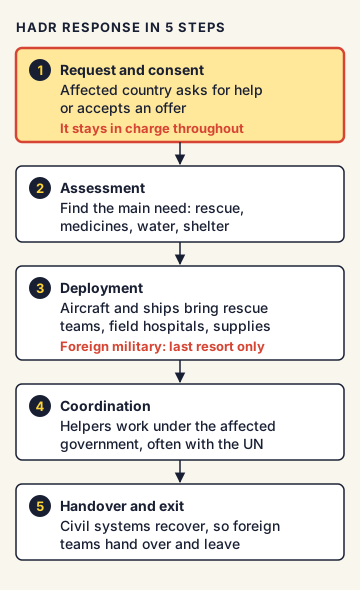
- Request and consent: the affected country asks for help or accepts an offer.
- Assessment: teams find out what is needed most: rescue, medicines, water, shelter or evacuation.
- Deployment: aircraft and ships carry rescue teams, field hospitals and relief material.
- Coordination: the helpers work under the affected government, often with the UN and other countries, so that work is not duplicated.
- Handover and exit: once civil systems recover, the foreign teams hand over and leave.
India's own system for disasters
India built a legal and institutional system after the 2004 tsunami:
- Disaster Management Act, 2005: created the National Disaster Management Authority (NDMA), chaired by the Prime Minister; State Disaster Management Authorities chaired by Chief Ministers; and District Disaster Management Authorities chaired by the District Collector (also called the District Magistrate or Deputy Commissioner).
- National Disaster Response Force (NDRF): raised on 19 January 2006 under the Act. It started with 8 battalions (two each from the BSF, CRPF, ITBP and CISF) and now has 16 battalions.
- National Disaster Management Plan (2016): India's first national plan, aligned with the Sendai Framework.
- The armed forces are often the first responders in big disasters, at home and abroad.
India as a regional "first responder"
India's HADR abroad has grown a lot. Some well-known operations:
- 2004: relief after the Indian Ocean tsunami to Sri Lanka, the Maldives and Indonesia, even while India itself was hit
- Operation Rahat (2015): an evacuation operation, strictly an NEO (see Commonly confused concepts), from war-hit Yemen, run through Djibouti; about 4,640 Indians and 960 foreigners from 41 countries were brought out
- Operation Maitri (2015): rescue and relief after the Nepal earthquake
- Operation Dost (2023): search and rescue teams and an Army field hospital after the February 2023 earthquakes in Türkiye and Syria
- Operation Brahma (2025): relief after the March 2025 earthquake in Myanmar, including a 60-bed Army field hospital
- Operation Sagar Bandhu (2025): relief to Sri Lanka after Cyclone Ditwah in late 2025
These efforts link to India's ideas of SAGAR (Security and Growth for All in the Region, 2015) and its wider form MAHASAGAR (2025), and to the view of India as a net security provider in the Indian Ocean.
International HADR cooperation and exercises
- Quad: the four countries began as the 2004 "Tsunami Core Group". On 23 September 2022 they signed the Guidelines for Quad Partnership on HADR in the Indo-Pacific, which follow the principles of Resolution 46/182 and act only after the affected country requests help.
- Information Fusion Centre-Indian Ocean Region (IFC-IOR): set up by the Indian Navy in Gurugram in 2018 to share maritime information with partner countries, including on disasters at sea.
- Coalition for Disaster Resilient Infrastructure (CDRI): launched by India on 23 September 2019 at the UN Climate Action Summit in New York, with its secretariat in New Delhi. It helps countries build roads, power and hospitals that survive disasters.
- Exercises: India holds an Annual Joint HADR Exercise with all three services, the Coast Guard, NDMA and friendly foreign countries (the IAF-led 2022 edition, called Samanvay, was at Agra; the 2026 edition is at Jamnagar). Bilateral HADR exercises include Tiger Triumph with the US (first held in November 2019 at Visakhapatnam and Kakinada).
Commonly confused concepts
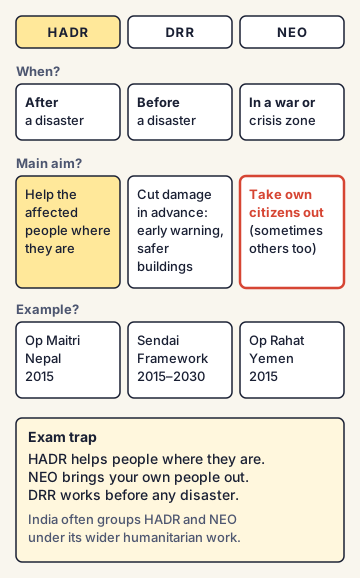
- HADR vs Disaster Risk Reduction (DRR): HADR is the response after a disaster. DRR is the work before a disaster to reduce the damage, such as early warning, safer buildings and planning. The Sendai Framework is about DRR.
- HADR vs Non-combatant Evacuation Operation (NEO): An NEO takes a country's own citizens (and sometimes others) out of a crisis zone, like Operation Rahat in Yemen or Operation Kaveri in Sudan (2023). HADR mainly helps the people of the affected country where they are. India often groups both under its wider humanitarian work.
- NDMA vs NDRF: The NDMA makes policies, plans and guidelines and is chaired by the Prime Minister. The NDRF is the specialised force that does the rescue work on the ground.
- Humanitarian principles: neutrality means not taking sides in a conflict; impartiality means giving help only by need; independence means keeping relief free from political or military aims.
Issues, criticism and the way forward
- Sovereignty concerns: Some countries are wary of foreign troops on their soil, even for relief. This is why consent and the "last resort" rule matter.
- Mixing aid and strategy: Critics say HADR by armed forces can become a tool for winning influence, which may clash with the principle of independence. Supporters say goodwill is a fair outcome of genuine help.
- Coordination gaps: When many countries rush in, they can block airports and duplicate work. Shared procedures, like the Quad guidelines and joint exercises, try to fix this.
- Capacity limits: Large HADR needs ships, aircraft and stockpiles ready in advance. Experts suggest pre-positioning relief stores in the region and building common logistics with partners.
- Way forward: More joint exercises, shared early-warning data, regional stockpiles, and investment in disaster-resilient infrastructure (the CDRI approach) so that less relief is needed in the first place.
Concepts to Know
- Humanitarian: Related to saving human lives and reducing suffering, without any other aim.
- UN OCHA: The UN office that coordinates emergency relief work by different agencies and countries.
- Military and civil defence assets: Relief people, equipment, supplies and services that come from armed forces or civil defence organisations, such as transport aircraft, naval ships and field hospitals.
- Field hospital: A temporary hospital set up in tents or containers near a disaster site.
- Tabletop exercise: A practice session held around a table, where officials talk through how they would respond to an imagined disaster, without moving real troops.
- Net security provider: A country that gives more security to its region than it takes from it, for example by helping neighbours in disasters and guarding sea lanes.
- Interoperability: The ability of forces from different services or countries to work together smoothly, using shared procedures and communication.
- UNGA Resolution 46/182 (1991): humanity, neutrality, impartiality; created the Emergency Relief Coordinator role (later UN OCHA)
- UNGA Resolution 58/114 (December 2003): added independence as the fourth principle
- Oslo Guidelines: 1994, revised 2007; foreign military assets as a last resort, with the affected state's consent
- Sendai Framework 2015–2030: adopted in Sendai, Japan, in 2015
- Disaster Management Act, 2005: NDMA chaired by the Prime Minister
- NDRF: raised 19 January 2006 with 8 battalions; now 16 battalions
- Quad HADR Guidelines: signed 23 September 2022
- CDRI: launched 23 September 2019, New York; secretariat in New Delhi
- Operations: Rahat (Yemen, 2015, an evacuation or NEO), Maitri (Nepal, 2015), Dost (Türkiye-Syria, 2023), Brahma (Myanmar, 2025), Sagar Bandhu (Sri Lanka, 2025)
- Tiger Triumph: India-US HADR exercise, first held November 2019
● Tracked since February 20, 2026 · last seen November 18, 2026 · updates as the daily brief publishes