Writ of Quo Warranto
Challenging the Right to Hold a Public Office
A writ of quo warranto is a court order that asks a person holding a public office: "By what authority are you holding this office?" The words are Latin and mean exactly that: "by what warrant". If the person cannot show a valid legal basis for holding the post, the court can remove them from it and declare the office vacant. In India, the Supreme Court can issue it under Article 32 and the High Courts under Article 226 of the Constitution.
Why does it exist?
Public offices, like the chairperson of a regulator or a member of a commission, carry real power over citizens. The law sets rules for who can hold them: qualifications, age limits, a fixed selection process. If the government appoints someone in breach of these rules, the public is harmed. Quo warranto lets any citizen ask the court to check this.
Think of it like a ticket checker on a train. The checker does not ask whether you are a good passenger. He only asks whether you have a valid ticket for that seat.
Where did it come from?
The writ comes from English common law. Kings in medieval England used it to demand that a person claiming a right or an office show where that right came from. Over time, it became a tool to stop people from holding public posts without legal right. In England, the old form was abolished in 1938 and replaced with a court injunction that does the same job.
India adopted the writ system in the Constitution in 1950. Article 32(2) names five writs: habeas corpus, mandamus, prohibition, certiorari and quo warranto.
How does it work, step by step?
- A person files a writ petition in the Supreme Court (Article 32) or a High Court (Article 226), asking for quo warranto against the office holder.
- The court first checks whether the office is a public office and whether the person is actually holding it.
- The court then examines whether the appointment broke the Constitution or a statute (a law made by a legislature or rules having the force of law), for example the qualifications or the selection procedure.
- The office holder (and the government) must show the legal authority for the appointment.
- If the appointment is found illegal, the court can declare it invalid and the office vacant. If not, the petition is dismissed.
What conditions must be met?
The courts have laid down clear tests:
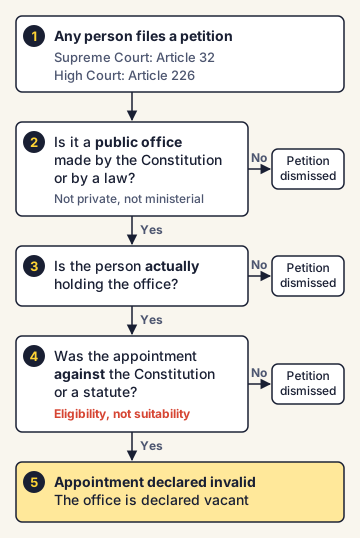
- The office must be a public office with duties of public nature.
- It must be a substantive office created by the Constitution or by a law, and of a permanent character. The writ is not available for a private office (such as a post in a private company or a private club) or for a ministerial office, meaning a post of a servant who simply carries out orders of a superior (here "ministerial" has nothing to do with Union ministers).
- The person must be actually in possession of the office, that is, already appointed and working.
- The appointment must be contrary to the law: a breach of a constitutional provision, a statute or binding statutory rules.
Who can file it?
This writ is special because the petitioner does not need to be personally harmed. Any member of the public can ask for it, because the wrong is done to the public as a whole. Courts may still check that the petitioner is acting in good faith and is not a front for someone else. Courts can refuse relief if there has been unreasonable delay, though some courts have said that holding an office illegally is a continuing wrong.
Important Supreme Court cases
- University of Mysore v. C.D. Govinda Rao (1964): The Court explained that quo warranto lets the court ask the holder of a public office to show his right to it. If he has no legal title, he can be ousted. The petitioner must show the office is public and that the holder has no legal authority to hold it.
- B. Srinivasa Reddy v. Karnataka Urban Water Supply and Drainage Board Employees' Association (2006): The Court said the jurisdiction is narrow. Quo warranto can be issued only when the appointment is contrary to statutory rules.
- Mahesh Chandra Gupta v. Union of India (2009): In a case on the appointment of a High Court judge, the Court separated eligibility from suitability. Eligibility (does the person meet the legal qualifications?) is an objective fact that courts can check, and quo warranto is the right remedy if it is missing. Suitability (is this the best person?) is a matter of opinion and outside judicial review.
- Centre for PIL v. Union of India (2011): A petition under Article 32 sought quo warranto against the appointment of P.J. Thomas as Central Vigilance Commissioner. The Court held that the High Powered Committee's recommendation was "non est" (of no legal effect) and quashed the appointment. It stressed institutional integrity: the integrity of the institution matters, not just the individual.
- Rajesh Awasthi v. Nand Lal Jaiswal (2013): The Court quashed the appointment of the chairperson of the Uttar Pradesh Electricity Regulatory Commission because a mandatory condition under the Electricity Act, 2003 had not been met.
The five writs, in one place
- Habeas corpus ("you may have the body"): orders that a detained person be produced in court, to check whether the detention is legal.
- Mandamus ("we command"): orders a public authority to perform a duty it is legally bound to perform.
- Prohibition ("to forbid"): a higher court stops a lower court or tribunal from going beyond its powers in a pending case.
- Certiorari ("to be certified"): a higher court cancels an order already passed by a lower court or tribunal beyond its powers.
- Quo warranto ("by what authority"): tests the legal right of a person to hold a public office.
Commonly confused concepts
- Quo warranto vs mandamus: Mandamus asks an authority to do something it must do. Quo warranto asks a person to justify holding an office.
- Quo warranto vs removal (impeachment-like process): Removal deals with what the officer did after appointment (misbehaviour or incapacity). Quo warranto deals with whether the appointment was valid in the first place. For example, Article 324(5) protects the CEC from removal except like a Supreme Court judge; whether that protection also limits a quo warranto challenge to the appointment is one of the questions raised in the current petition.
- Article 32 vs Article 226: Article 32 is itself a Fundamental Right and lets you go straight to the Supreme Court, but only to enforce Fundamental Rights. Article 226 lets a High Court issue writs for Fundamental Rights and "for any other purpose", such as enforcing ordinary legal rights. So a High Court's writ power is wider in scope. In practice, the Supreme Court also hears quo warranto petitions under Article 32 in matters of serious public importance.
- Quo warranto vs Public Interest Litigation (PIL): A PIL is a kind of case in which any public-spirited person can approach the court for the public good. Quo warranto has always allowed any person to apply, even before PIL became common.
- Eligibility vs suitability: Courts check eligibility (legal qualifications and procedure). They usually do not check suitability (who is the best choice).
Issues, criticism and the way forward
- Narrow scope: Courts do not use quo warranto to second-guess the government's choice among eligible people. Some argue this is right, because the executive is accountable for its choices. Others argue it lets weak or unfair selections pass as long as the paperwork is in order.
- Delay: Writ petitions can take years to decide. By then the officer's term may be over, and the challenge loses meaning.
- Risk of misuse: Since anyone can file, the writ can be used to harass officials or for political purposes. Courts guard against this by checking good faith.
- Transparency in selection: Many quo warranto cases arise because selection processes are not open. Experts and courts have suggested clear published criteria, recorded reasons and proper panels for key constitutional and statutory posts, which would reduce such litigation.
Concepts to Know
- Writ: A formal written order issued by a court, directing someone to do or not to do something.
- Article 32: The right to approach the Supreme Court directly to enforce Fundamental Rights. B.R. Ambedkar called it the "heart and soul" of the Constitution.
- Statute: A law passed by Parliament or a state legislature.
- Public office: A post created by the Constitution or a law, whose holder performs duties for the public, such as a judge, a commissioner or the head of a regulator.
- Judicial review: The power of courts to check whether an action of the government or legislature follows the Constitution and the law.
- Non est: A Latin legal term meaning "does not exist" in law; an act that is non est is treated as if it never legally happened.
- Notification: An official order published by the government (in the Gazette) to bring a decision, like an appointment, into effect.
- Quo warranto means "by what authority/warrant"; tests the legal right to hold a public office
- Issued by the Supreme Court under Article 32 and by High Courts under Article 226
- Article 32(2) names five writs: habeas corpus, mandamus, prohibition, certiorari, quo warranto
- Conditions: public, substantive office created by Constitution or law; holder in office; appointment contrary to law
- Any person can apply; the petitioner need not be personally aggrieved
- Not available for private offices or ministerial (subordinate servant) posts
- Cases: University of Mysore v. C.D. Govinda Rao (1964); B. Srinivasa Reddy (2006); Mahesh Chandra Gupta (2009, eligibility vs suitability); Centre for PIL (2011, CVC P.J. Thomas); Rajesh Awasthi (2013, UPERC chairperson)
● Tracked since October 08, 2026 · last seen October 08, 2026 · updates as the daily brief publishes