Wild Water Buffalo (Bubalus arnee)
The wild water buffalo is a huge, wild member of the cattle family that lives in wet grasslands, swamps and river floodplains of South and Southeast Asia. Its scientific name is Bubalus arnee. It is the wild cousin, and most likely the ancestor, of the domestic buffalo that gives milk in Indian villages. It is Endangered, and India is home to the large majority of the world's surviving wild buffaloes.
Why does it matter?
The wild buffalo is a grazer: it eats grasses and sedges in wet grasslands. By grazing, trampling and wallowing in mud, it keeps grasslands open and creates small water pools that other animals use. It is also prey for the tiger. So a healthy wild buffalo population is a sign of a healthy wet grassland. It also holds wild genes that may one day help improve domestic buffalo breeds, for example to resist disease.
What does it look like, and how does it live?
- Size: It is one of the heaviest wild bovids (cattle-family animals) in the world, only a little smaller than the gaur (Indian bison). It weighs about 600 to 1,200 kg, and its head-and-body length is about 2.4 to 3 metres.
- Horns: Both males and females have heavy horns. The horns curve out and up and can spread up to 2 metres from tip to tip, among the widest of any living animal.
- Colour: Ash-grey to black skin with very little hair.
- Groups: Females and young live in herds (clans) of up to about 30, usually led by an old female. Adult males live alone or in small "bachelor" groups.
- Breeding: Breeding peaks in October and November. A female carries her calf for about 10 to 11 months. Wild buffaloes can live up to about 25 years.
- Enemies: Tigers are its main natural predator. Mugger crocodiles may take calves.
Where is it found?
The species once lived across a large part of South and Southeast Asia. Today it survives only in small, scattered pockets:
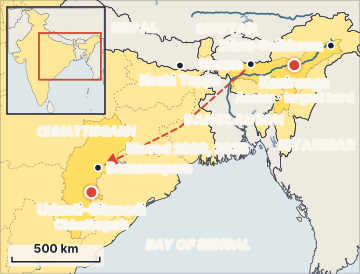
- India: mainly in Assam, in and around Kaziranga, Manas and Dibru-Saikhowa National Parks, and in some other parts of the Northeast (Arunachal Pradesh, Meghalaya). A small central Indian population survives in Chhattisgarh, mainly around the Udanti-Sitanadi Tiger Reserve.
- Other countries: Nepal (Koshi Tappu), Bhutan, Thailand and Cambodia; possibly Myanmar (not confirmed).
- Gone from: Bangladesh, Laos, Vietnam and Sri Lanka, where it has died out in the wild.
The global population is estimated at fewer than 4,000 mature animals. One estimate puts the total at about 3,400, with roughly 9 out of 10 of them in India, mostly in Assam. Kaziranga alone holds the largest single population in the world.
What threatens it?
- Hybridisation: Wild buffaloes mate with domestic and stray buffaloes grazing near forests. Their calves are mixed (hybrid), so the pure wild gene pool slowly gets diluted. Experts consider this the most serious threat.
- Diseases from livestock: Domestic cattle and buffaloes can pass on diseases, such as foot-and-mouth disease, to wild herds.
- Loss of wet grasslands: Floodplains are turned into farms, and dams and invasive plants change wetlands.
- Competition and conflict: Livestock eat the same grass. Wild buffaloes sometimes raid rice, sugarcane and jute fields and are then killed.
- Hunting in the past, for meat and horns.
Because of these threats, the population is believed to have fallen by at least half over the last three generations (about 24 to 30 years).
How is it protected?
- IUCN Red List: Endangered, a status it has held since 1986.
- Wildlife (Protection) Act, 1972: listed in Schedule I, which gives the highest level of legal protection in India. Hunting it is a serious crime.
- CITES: listed in Appendix III (international trade is watched, at the request of a range country).
- State animal of Chhattisgarh: declared in 2001, soon after the state was formed.
- Protected areas: Kaziranga, Manas and Dibru-Saikhowa (Assam), and Udanti-Sitanadi (Chhattisgarh) shelter most of India's wild buffaloes.
Bringing it back: how a reintroduction works
When a species has died out in a place it once lived, conservationists can move animals from a healthy population to that place. This is called reintroduction, one kind of conservation translocation. The IUCN's guidelines (2013) say it should be done step by step:
- Check the history and habitat: prove the species once lived there and that the threats which killed it off have been removed.
- Pick a healthy source population: ideally genetically pure animals from a large population, so the source is not harmed.
- Quarantine and health checks: to avoid carrying disease into the new forest.
- Soft release: keep the animals in an enclosure (often called a boma) first, so they get used to the new place, and then open the gates.
- Monitor for years: with radio-collars and field teams, to see if they survive, breed and stay.
Chhattisgarh has already tried this to save its own tiny population. Wild buffaloes were moved from Manas National Park in Assam to the Barnawapara Wildlife Sanctuary in two batches, in 2020 and 2023, for conservation breeding.
Commonly confused concepts
- Wild water buffalo vs domestic buffalo: The wild one is Bubalus arnee, lives free in forests and is Endangered. The domestic buffalo (often written Bubalus bubalis) is a farm animal kept for milk and work. India's domestic buffaloes belong mostly to the "river buffalo" type, while Southeast Asia has the "swamp buffalo" type.
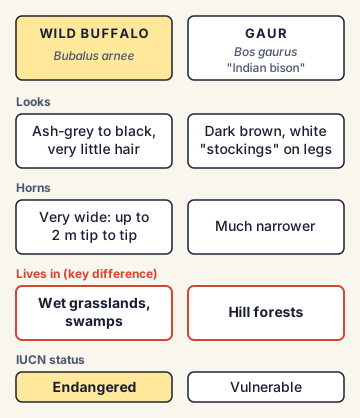
- Wild buffalo vs gaur: The gaur (Bos gaurus, "Indian bison") is a different animal from a different genus. It is dark brown with white "stockings" on its legs and lives in hill forests. The wild buffalo is grey-black, has much wider horns and lives in wet grasslands and swamps. The gaur is listed as Vulnerable by the IUCN.
- Wild buffalo vs African buffalo: The African (Cape) buffalo, Syncerus caffer, is a completely different species found only in Africa.
- Reintroduction vs augmentation: Reintroduction brings a species back to a place where it has died out (Madhya Pradesh). Augmentation adds animals to a place where a few still survive (Chhattisgarh).
Issues, criticism and the way forward
- Genetic purity: Many surviving herds near villages have mixed with domestic buffaloes. Experts warn that moving animals without genetic testing can spread hybrid genes.
- Small numbers: A population started from a few animals can suffer from inbreeding (breeding among close relatives), which weakens the herd. Regular additions from the source help.
- Disease and livestock: Villages around reserves keep cattle and buffaloes. Vaccinating livestock and keeping them away from release sites is needed.
- Human conflict: Wild buffaloes can damage crops. Quick compensation for farmers builds local support.
- Way forward: Experts suggest genetic screening of founders, protecting wet grasslands and floodplains, controlling stray livestock near reserves, long-term radio monitoring, and close cooperation between source and receiving states.
Concepts to Know
- Bovid: An animal of the cattle family (Bovidae), such as cows, buffaloes, gaur, goats and antelopes. They have hollow horns that are never shed.
- Grazer vs browser: A grazer mainly eats grass close to the ground. A browser mainly eats leaves, shoots and twigs of shrubs and trees.
- Hybridisation: When two different but related kinds of animals mate and produce mixed offspring. In wild species it can slowly erase the pure wild form.
- IUCN Red List: A global list, kept by the International Union for Conservation of Nature, that grades how close a species is to extinction (for example Vulnerable, Endangered, Critically Endangered).
- CITES Appendix III: A list under the Convention on International Trade in Endangered Species of species that one country protects and asks other countries to help by monitoring trade.
- Quarantine: Keeping newly moved animals separate for some time and testing them, so that they do not bring disease into a new area.
- Scientific name: Bubalus arnee (described by Robert Kerr in 1792)
- IUCN: Endangered (since 1986); fewer than 4,000 mature individuals worldwide
- India holds most of the world's wild buffaloes; largest population in Kaziranga (Assam)
- Wildlife (Protection) Act, 1972: Schedule I; CITES: Appendix III
- State animal of Chhattisgarh (declared 2001); key central Indian site: Udanti-Sitanadi Tiger Reserve
- Weight about 600 to 1,200 kg; horn spread up to about 2 m
- Main threat: hybridisation with domestic buffalo; others: livestock disease, habitat loss, crop conflict
● Tracked since October 11, 2026 · last seen October 11, 2026 · updates as the daily brief publishes