Kanha Tiger Reserve
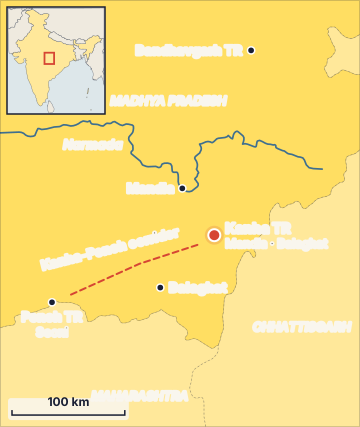
Kanha Tiger Reserve is one of India's best-known tiger reserves. It lies in the Maikal hills of the Satpura range in Madhya Pradesh, spread over the Mandla and Balaghat districts. It is famous for its open grassy meadows and sal forests, and above all for saving the hard-ground barasingha (swamp deer) from extinction. Its national park, Kanha National Park, is the largest national park in Madhya Pradesh.
Why is it important?
Kanha is a large, connected block of forest in the heart of central India. It shelters tigers and the animals they hunt, and it is the only natural home of the hard-ground barasingha. It is also linked by forest corridors to other reserves such as Pench, so tigers can move between them. Because of its good management, it is often used as a model for other reserves.
Where did it come from?
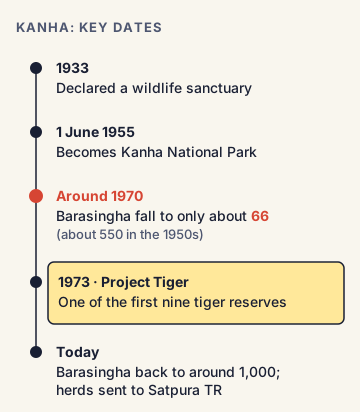
- 1933: The area was declared a wildlife sanctuary.
- 1 June 1955: It became Kanha National Park.
- 1973: It became one of the first nine tiger reserves under Project Tiger, launched that year to save the tiger.
- 1960s and 1970s: The barasingha population crashed, and a long recovery effort began (see below).
How is it laid out?
Like every tiger reserve, Kanha has two zones:
- Core (critical tiger habitat): about 940 sq km. Here wildlife comes first and human use is kept to a minimum. The core includes two river valleys, Banjar and Halon, named after the rivers that drain the area.
- Buffer zone: a ring of about 1,000 to 1,070 sq km around the core (official figures vary slightly) where villages and limited use of forest are allowed.
- Phen Wildlife Sanctuary (about 110 sq km), next door, is managed as part of the reserve.
What lives there?
- Forests: Lower areas have sal (Shorea robusta) and mixed forests with large open meadows, locally called maidans. Higher slopes have dry and moist deciduous forest with bamboo.
- Big animals: tiger, leopard, dhole (wild dog), sloth bear, gaur, sambar, chital (spotted deer) and the hard-ground barasingha.
- Birds: about 300 species have been recorded.
The barasingha success story
The hard-ground barasingha (Rucervus duvaucelii branderi) is a type of swamp deer that, unlike its cousins in wet northern swamps, lives on firm grassland. It is the state animal of Madhya Pradesh. Hunting, disease from cattle and loss of grassland cut its numbers in Kanha from about 550 in the 1950s to only about 66 around 1970. The reserve then:
- built predator-proof enclosures (bomas) where the deer could breed safely;
- restored grasslands and water sources;
- moved villages out of key habitat and controlled cattle diseases.
The population recovered to several hundred and then to around a thousand. Kanha has since sent barasingha to other reserves, such as Satpura Tiger Reserve, to start new herds. The reserve's mascot, Bhoorsingh the Barasingha, is reported to be the first official mascot of any tiger reserve in India.
People of Kanha
The Baiga and Gond tribal communities live in and around Kanha. The Baiga are a Particularly Vulnerable Tribal Group (PVTG). Villages inside the park were relocated from the late 1960s onward to protect wildlife habitat. These relocations have been criticised for poor compensation and their effect on tribal livelihoods.
Kanha and Madhya Pradesh's tiger network
Madhya Pradesh had the most tigers of any state in the All India Tiger Estimation 2022 (785). It has a large network of tiger reserves, including Kanha, Pench, Bandhavgarh, Panna, Satpura, Sanjay-Dubri, Veerangana Durgavati (Nauradehi), Ratapani and Madhav. Kanha is also linked to Pench Tiger Reserve through the Kanha-Pench corridor, one of the important tiger corridors of central India.
Commonly confused concepts
- National park vs wildlife sanctuary vs tiger reserve: A national park has stricter protection; no rights of people (such as grazing) are allowed inside. A wildlife sanctuary can allow some regulated rights. A tiger reserve is notified under Section 38V of the Wildlife (Protection) Act, 1972, on the advice of the National Tiger Conservation Authority (NTCA). It usually has a national park or sanctuary as its core, plus a buffer.
- Kanha vs Pench: Both are in the Satpura region. Kanha is in Mandla and Balaghat districts; Pench lies on the Madhya Pradesh–Maharashtra border (Seoni and Chhindwara in MP).
- Hard-ground barasingha vs other swamp deer: The central Indian type (branderi) lives on firm grassland in Kanha. The wetland types live in the Terai swamps of the north (for example Dudhwa) and in Kaziranga.
Issues, criticism and the way forward
- Human-wildlife conflict in the buffer, with livestock losses and crop damage.
- Corridor breaks from roads, railways and mining that cut the forest links between Kanha and other reserves.
- Tourism pressure in the core zone.
- Tribal rights: balancing relocation and conservation with rights under the Forest Rights Act, 2006.
- Way forward: safe wildlife crossings on linear projects, better compensation and community-based tourism, and long-term monitoring of reintroduced species such as the wild buffalo.
Concepts to Know
- Core and buffer zone: The core is the inner, most protected part of a tiger reserve. The buffer is the outer ring where people can live and use resources in limited ways, which reduces pressure on the core.
- Boma: A fenced enclosure where animals are kept for some time, to breed safely or to get used to a new place before release.
- Wildlife corridor: A strip of forest or natural land that connects two protected areas, so animals can move between them and populations do not become isolated.
- Particularly Vulnerable Tribal Group (PVTG): A government category for tribal groups that are especially vulnerable, for example because of declining population or very low literacy. India lists 75 PVTGs.
- Location: Mandla and Balaghat districts, Madhya Pradesh; Maikal hills (Satpura range)
- Wildlife sanctuary 1933; national park 1 June 1955; tiger reserve 1973 (one of the first nine under Project Tiger)
- Core about 940 sq km (Banjar and Halon valleys); buffer roughly 1,000 to 1,070 sq km; Phen Sanctuary (about 110 sq km) attached
- Flagship: hard-ground barasingha (Rucervus duvaucelii branderi), state animal of Madhya Pradesh; fell to about 66 around 1970 and has since recovered
- Mascot: Bhoorsingh the Barasingha
- Madhya Pradesh: highest tiger count in the 2022 estimation (785)
● Tracked since October 11, 2026 · last seen October 11, 2026 · updates as the daily brief publishes