Whistle Blowers Protection Act, 2014
The Whistle Blowers Protection Act, 2014 is a law meant to protect people who report corruption or misuse of power by public servants. A whistleblower is someone who "blows the whistle", like a referee who stops a game when a foul happens. The law sets up a system where such a person can complain to a proper authority, keeps their identity secret, and protects them from being punished for speaking up.
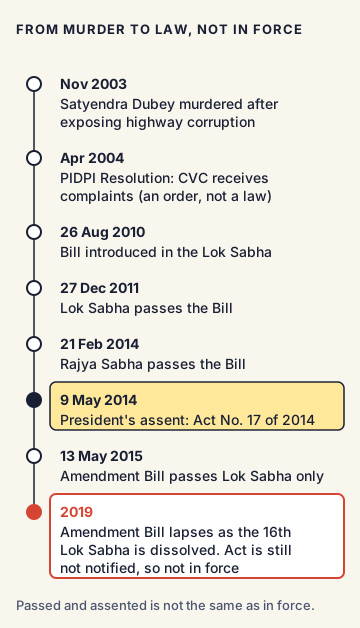
Parliament passed it and the President gave assent on 9 May 2014, but it has not yet been brought into force.
Why does it exist?
People inside government offices often see corruption first. But if they report it, they may be transferred, suspended, harassed or even attacked. Without legal protection, most people stay silent, and corruption goes unchecked. A whistleblower law tells them: "If you report honestly, the State will protect you." This helps clean governance, because honest officials become the eyes and ears of the system.
Where did it come from?
Two murders shocked the country and pushed the idea forward.
- Satyendra Dubey: an Indian Engineering Service officer working with the National Highways Authority of India (NHAI). He reported corruption in the Golden Quadrilateral highway project and was murdered in Gaya, Bihar, in November 2003.
- Shanmughan Manjunath: an Indian Oil Corporation officer, murdered in Uttar Pradesh in 2005 after he sealed a petrol pump selling adulterated (mixed, impure) fuel.
After Dubey's death, the Supreme Court pressed the government to act. The government issued the Public Interest Disclosure and Protection of Informers (PIDPI) Resolution in April 2004. It made the Central Vigilance Commission (CVC) the agency to receive such complaints. A resolution is only an executive order, not a law, so a proper Act was still needed.
The Law Commission of India, in its 179th Report (2001) [Unverified], and the Second Administrative Reforms Commission in its 4th Report, Ethics in Governance (January 2007), both recommended a whistleblower law.
How did the law pass?
- The Public Interest Disclosure and Protection to Persons Making the Disclosures Bill, 2010 was introduced in the Lok Sabha on 26 August 2010.
- The Lok Sabha passed it on 27 December 2011.
- The Rajya Sabha passed it on 21 February 2014.
- The President gave assent on 9 May 2014. It became Act No. 17 of 2014.
- The Repealing and Amending Act, 2015 gave it its present short title: the Whistle Blowers Protection Act, 2014.
How does it work?
The Act sets out a step-by-step process:
- Who can complain (Section 4): any public servant, any other person, or any NGO can make a "public interest disclosure". It can be about corruption, wilful misuse of power or discretion, or a criminal offence by a public servant.
- How: in writing or by email, with full details and supporting documents, and with a declaration that the person believes it is true. The complainant must reveal their identity to the authority. Anonymous complaints are not accepted.
- To whom: a Competent Authority decided by who the complaint is against (see the list below).
- Secrecy (Sections 5 and 13): the authority must hide the complainant's identity and documents, unless the complainant has revealed them or a court orders otherwise.
- Inquiry: the authority inquires and can recommend action, such as starting prosecution or taking steps to make good the loss.
- Interim orders (Section 14): during an inquiry, the authority can pass orders to stop a corrupt practice immediately.
Who is the Competent Authority?
It depends on whom the complaint is about:
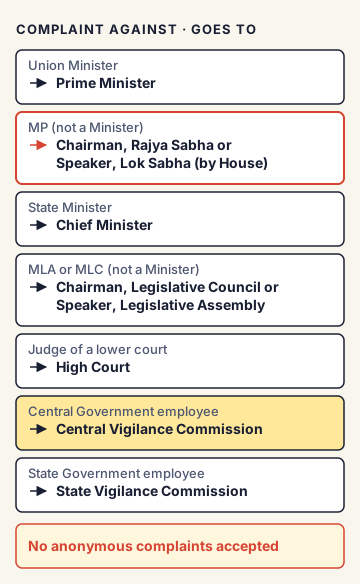
- A Union Minister: the Prime Minister
- A Member of Parliament who is not a Minister: the Chairman of the Rajya Sabha or the Speaker of the Lok Sabha, depending on the House
- A State Minister: the Chief Minister
- A State legislator who is not a Minister: the Chairman of the Legislative Council or the Speaker of the Legislative Assembly
- Judges of lower courts (not the Supreme Court or High Courts): the High Court
- Central Government employees: the Central Vigilance Commission (CVC)
- State Government employees: the State Vigilance Commission
Protection and penalties
These are the facts UPSC likes to ask:
- Section 6: no inquiry into a complaint made more than seven years after the action complained about, or into matters already decided by a court.
- Section 8: some information cannot be disclosed, such as information that harms India's sovereignty, security or friendly relations with foreign countries, and Cabinet proceedings.
- Section 11 (against victimisation): the Central Government must make sure no complainant is victimised. A complainant who is targeted can approach the Competent Authority. The burden of proof is on the public authority to show the action was not victimisation. Wilful non-compliance with the authority's directions: penalty up to Rs 30,000.
- Section 15: delay in giving a report: up to Rs 250 per day, up to Rs 50,000 in total.
- Section 16: revealing a complainant's identity negligently or with bad intent: up to 3 years in jail and a fine up to Rs 50,000.
- Section 17: making a false complaint knowingly and with bad intent: up to 2 years in jail and a fine up to Rs 30,000.
- Section 20: appeals against penalty orders go to the High Court within 60 days.
- The Act does not apply to the Special Protection Group (SPG).
Why is it still not in force?
Section 1(3) of the Act says it will come into force on the date the Central Government notifies in the Official Gazette. That notification has never been issued. In 2015, the government brought the Whistle Blowers Protection (Amendment) Bill, 2015 to add safeguards on national security. It barred disclosures in 10 categories copied from Section 8(1) of the Right to Information (RTI) Act, 2005.
The Lok Sabha passed it on 13 May 2015, but it never passed the Rajya Sabha, and it lapsed when the 16th Lok Sabha was dissolved in 2019. The Act itself has stayed un-notified since then.
What have the courts said?
Courts have been careful. In 2022, the Delhi High Court dismissed a petition seeking a direction to bring the Act into force, saying that bringing a law into force is a sovereign function of the government. Courts generally hold that they cannot order the government to notify a law, though they can ask it to explain the delay. In August 2013, the Supreme Court did rule that a whistleblower's identity cannot be revealed to an accused facing prosecution under the Prevention of Corruption Act, 1988.
India's international commitment
India signed the United Nations Convention against Corruption (UNCAC) on 9 December 2005 and ratified it on 9 May 2011. Article 33 of UNCAC asks countries to consider measures to protect people who report corruption in good faith from unfair treatment.
Commonly confused concepts
- Whistle Blowers Act vs RTI Act: The RTI Act, 2005 lets any citizen ask for government information. The Whistle Blowers Act protects a person who reports wrongdoing. RTI is about access; whistleblowing is about disclosure and protection.
- Whistle Blowers Act vs Lokpal and Lokayuktas Act, 2013: The Lokpal investigates corruption complaints against high public officials. The Whistle Blowers Act focuses on protecting the person who complains.
- Act vs PIDPI Resolution, 2004: The resolution is an executive order with the CVC as the agency. It is still the working arrangement, but it has no legal penalties, unlike the Act.
- Assent vs commencement: A law gets "passed" when Parliament votes and the President assents. It becomes "operational" only from its commencement date, which, for this Act, needs a government notification.
Issues, criticism and the way forward
- Not in force: The biggest problem is that the law has never started working, so whistleblowers have only the 2004 resolution.
- No anonymous complaints: Critics say forcing people to reveal their identity discourages those who fear for their safety.
- Weak protection: The Act has no clear definition of "victimisation" and no strong penalty for those who harass or attack whistleblowers.
- Limited powers: The Competent Authority mostly recommends action; it cannot punish the wrongdoer itself.
- Private sector left out: Corporate whistleblowers, as in big corporate frauds, are not covered. The 2nd ARC had suggested covering the private sector too.
- Dilution fears: The 2015 Amendment Bill was criticised for blocking disclosures in many categories and, critics said, exposing whistleblowers to prosecution under the Official Secrets Act.
- Way forward: Experts suggest notifying the Act, allowing protected anonymous complaints, clearly defining victimisation with strict penalties, offering rewards, and covering the private sector, in line with UNCAC Article 33.
Concepts to Know
- Public servant: A person who works for the government or a public body and is paid from public money, such as a government officer or a minister.
- Victimisation: Unfair punishment of a person for doing something right, such as a sudden transfer or suspension after reporting corruption.
- Burden of proof: The duty to prove something. Here, the government office must prove that its action was not revenge, instead of the whistleblower proving it was.
- Central Vigilance Commission (CVC): India's top anti-corruption watchdog for Central Government employees. It became a statutory body under the CVC Act, 2003.
- Notification in the Official Gazette: A formal government announcement printed in the Gazette of India, the government's official record. Many laws start working only after such a notice.
- Lapse of a Bill: When the Lok Sabha is dissolved, Bills that were passed by the Lok Sabha but are still pending in the Rajya Sabha end, or "lapse".
- Introduced 26 August 2010 (as the Public Interest Disclosure Bill); passed Lok Sabha 27 December 2011; Rajya Sabha 21 February 2014; assent 9 May 2014 (Act No. 17 of 2014)
- Commencement: Section 1(3), on a date notified by the Central Government; not yet notified as of November 2026
- No anonymous complaints; complaint barred if more than 7 years after the act
- Identity disclosure penalty: up to 3 years plus fine up to Rs 50,000 (Section 16)
- False complaint penalty: up to 2 years plus fine up to Rs 30,000 (Section 17)
- Appeal to the High Court within 60 days (Section 20)
- Does not apply to the Special Protection Group
- Amendment Bill, 2015: passed Lok Sabha 13 May 2015; lapsed 2019
- PIDPI Resolution: April 2004; CVC designated agency
- UNCAC: signed 9 December 2005, ratified 9 May 2011; Article 33 on protecting reporting persons
● Tracked since November 14, 2026 · last seen November 14, 2026 · updates as the daily brief publishes