Warehouse Receipt System and the WDRA
A warehouse receipt is a document that a warehouse gives a farmer or trader when they store goods there. It says what was stored, how much and of what quality. When such a receipt can be transferred to someone else (sold or pledged), it is called a Negotiable Warehouse Receipt (NWR). Today these receipts are mostly electronic, called e-NWRs. The Warehousing Development and Regulatory Authority (WDRA) is the body that registers warehouses and regulates this system.
Why does it exist?
Most small farmers sell right after harvest, when supply is high and prices are low, because they need cash immediately for loans, school fees or the next crop. If a farmer can store grain in a trusted warehouse and take a bank loan using the receipt as security, the farmer gets cash now and can sell later when prices are better.
This is called pledge financing or post-harvest credit. The receipt also lets the goods be sold without moving them: the buyer simply gets the receipt, and with it the ownership of the stored grain. Think of it like a bank locker slip that is so trusted that a bank lends against it and a buyer pays for it.
Where did it come from?
Step by step:
- Warehousing (Development and Regulation) Act, 2007: Parliament passed this law to create a regulated warehouse receipt system.
- October 2010: the Act came into force, and the WDRA was set up under it. The WDRA works under the Department of Food and Public Distribution (Ministry of Consumer Affairs, Food and Public Distribution).
- 2011: the Negotiable Warehouse Receipt system was launched.
- 2017: WDRA issued regulations for electronic NWRs (e-NWRs), and the e-NWR system started.
- December 2024: the Credit Guarantee Scheme for e-NWR based Pledge Financing (CGS-NPF) was launched with a corpus of ₹1,000 crore.
How does the system work?
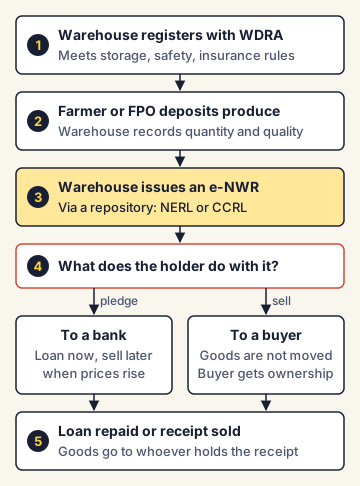
- A warehouse gets registered with WDRA after meeting rules on storage quality, safety and insurance.
- A farmer or FPO deposits produce. The warehouse checks and records quantity and quality.
- The warehouse issues an e-NWR through one of two electronic repositories: NERL (National E-Repository Ltd) or CCRL (CDSL Commodity Repository Ltd). These work much like the depositories that hold shares in electronic form.
- The farmer can pledge the e-NWR to a bank for a loan, or sell it to a buyer, including through trading platforms.
- When the loan is repaid or the receipt is sold, the receipt is transferred or released, and the goods are delivered to whoever holds it.
Key facts for loans
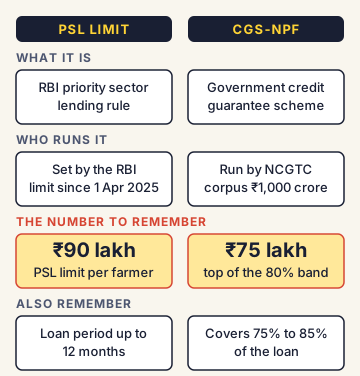
- Bank loans to individual farmers against NWRs and e-NWRs count as priority sector lending (lending that the RBI requires banks to do for important sectors), if the loan period does not exceed 12 months. The RBI has raised the limit per borrower twice:
- 2021: from ₹50 lakh to ₹75 lakh.
- From 1 April 2025: ₹90 lakh. This is the limit today. Loans against ordinary warehouse receipts (not NWRs or e-NWRs) have a lower limit of ₹60 lakh.
- Under CGS-NPF, managed by the National Credit Guarantee Trustee Company (NCGTC), the government guarantees part of the loan if the borrower fails to repay. How much is covered depends on who borrows and how big the loan is:
- Small and marginal farmers, women, SC/ST and persons with disabilities: 85% for loans up to ₹3 lakh, and 80% for loans above ₹3 lakh and up to ₹75 lakh.
- All other borrowers: 75%.
- The guarantee reduces the bank's risk, so banks are more willing to lend against stored produce.
India's position and examples
Big public warehouse operators include the Central Warehousing Corporation (CWC) and State Warehousing Corporations, along with many private operators. Private agri-warehousing companies digitise small warehouses near the farm gate so that stored produce can be linked to lenders and buyers. The Model Agricultural Produce and Livestock Marketing Act, 2017 is a model law that the Centre shared with states for them to adopt.
It suggests allowing private market yards and other channels outside the traditional mandi, which opens the door for warehouses to act as trading points.
Commonly confused concepts
- Warehouse receipt vs negotiable warehouse receipt: an ordinary receipt only proves storage. A negotiable one can be transferred, so it can be sold or pledged.
- e-NWR vs e-NAM: e-NWR is about storing goods and using the receipt for loans or sale. e-NAM is about selling goods through online bidding in mandis. They work best together: e-NAM's warehouse-based trading lets an e-NWR lot be sold online.
- WDRA vs FCI: WDRA is a regulator of warehouses. The Food Corporation of India (FCI) buys, stores and distributes foodgrains for the public distribution system.
- NERL/CCRL vs NSDL/CDSL: NERL and CCRL hold commodity receipts electronically. NSDL and CDSL hold shares and securities electronically.
- PSL limit vs CGS-NPF limit: these are two different rules. ₹90 lakh (since 1 April 2025) is the RBI's priority sector limit for one individual farmer's loan against an NWR or e-NWR. ₹75 lakh is the top of the 80% guarantee band under CGS-NPF. Do not mix them up.
Issues, criticism and the way forward
- Low use by small farmers: many small farmers live far from registered warehouses and do not know about e-NWR loans.
- Bank caution: banks worry about quality loss, price falls and fraud, so lending against e-NWRs has grown slowly.
- Too few registered warehouses near villages, especially in eastern and north-eastern India.
- Quality assurance: trust in the receipt depends entirely on honest grading and safe storage.
- Way forward: more registered warehouses near farms, digital inventory and quality records, links with e-NAM and FPOs, the credit guarantee to cut bank risk, and awareness among farmers.
Concepts to Know
- Pledge: giving something valuable to a lender as security for a loan. The lender can sell it if the loan is not repaid.
- Collateral: the asset a borrower offers as security for a loan.
- Repository: an organisation that keeps records in electronic form, like a digital store of receipts.
- Credit guarantee: a promise by a third party (here, a government trust) to pay part of a loan if the borrower fails to repay.
- Priority sector lending: RBI rules that require banks to give a fixed share of loans to important sectors such as agriculture and small businesses.
- Warehousing (Development and Regulation) Act, 2007; in force from October 2010; WDRA set up in 2010
- WDRA works under the Department of Food and Public Distribution
- NWR system launched in 2011; e-NWR system started in 2017
- e-NWR repositories: NERL and CCRL
- CGS-NPF: launched December 2024; corpus ₹1,000 crore; run by NCGTC; cover 85% (loans up to ₹3 lakh) and 80% (loans above ₹3 lakh and up to ₹75 lakh) for small and marginal farmers, women, SC/ST, PwD; 75% for all other borrowers
- RBI priority sector limit for an individual farmer's loan against NWR/e-NWR (loan period not exceeding 12 months): raised from ₹50 lakh to ₹75 lakh per borrower in 2021; ₹90 lakh from 1 April 2025 (the limit today)
● Tracked since November 17, 2026 · last seen November 17, 2026 · updates as the daily brief publishes