National Agriculture Market (e-NAM)
The National Agriculture Market (e-NAM) is an online trading platform that links the government-regulated wholesale markets for farm produce, called mandis, across India. A farmer brings produce to a mandi connected to e-NAM, the produce is weighed and tested, and traders bid for it online, not only in person. Because traders from other mandis, and even other states, can see the lot and bid, the farmer can in theory get a better price. Its motto is "One Nation, One Market".
Why was it needed?
Before e-NAM, each mandi was like a small closed room. Only traders who held a licence for that mandi could buy there. In many mandis, a few traders and commission agents controlled bidding, and farmers had little idea what prices were in the next district. A farmer selling onions in one town might get much less than a farmer selling the same onions 100 km away.
This is called market fragmentation, and the lack of price information is called information asymmetry (the buyer knows more than the seller). e-NAM was built to open these closed rooms and put price information in the open.
Where did it come from?
The Union Budget for 2014-15 talked about a national market, and the Union Cabinet approved e-NAM in July 2015. It was launched on 14 April 2016 with 21 mandis in 8 states. It is run by the Small Farmers' Agribusiness Consortium (SFAC), the lead implementing agency, under the Ministry of Agriculture and Farmers' Welfare. It is a Central Sector Scheme, which means the Centre pays the full cost. Major additions over the years:
- 2016 to 2018: quick expansion to hundreds of mandis.
- 2020: new features such as warehouse-based trading and trading by Farmer Producer Organisations (FPOs) from their own collection centres.
- July 2022: the "Platform of Platforms" (PoP) was launched, linking e-NAM with other service providers for logistics, quality testing, warehousing, payments and market information.
- 2026: ten years completed, with 1,656 mandis as of March 2026.
How does a sale work on e-NAM, step by step?
- Gate entry: the farmer arrives at the mandi and the lot is registered, often in advance through the mobile app.
- Assaying: a sample is tested for quality (moisture, size, damage) in the mandi's lab. A quality certificate is put online.
- Online bidding: registered traders, from this mandi or elsewhere, place bids electronically. The highest bid is shown openly.
- Sale agreement: the farmer can accept or reject the winning bid.
- Weighing and payment: the produce is weighed on electronic scales, and payment is sent online, ideally straight to the farmer's bank account.
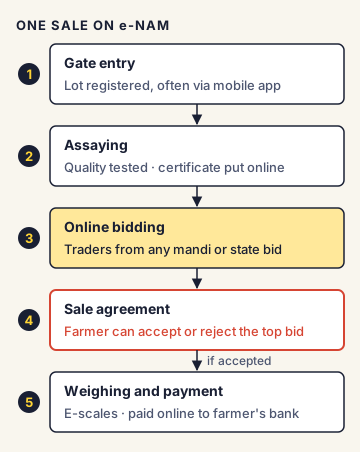
A simple picture: e-NAM turns a mandi's shouting auction into something like an online auction site, where buyers from far away can also bid.
What must a state do to join?
Agricultural marketing is a state subject, so the Centre cannot force a state to join. Each state runs its mandis under its own APMC law (APMC means Agricultural Produce Market Committee, the body that runs a mandi). To get e-NAM support, a state must change its APMC law in three ways:
- A single trading licence valid across the whole state (instead of a separate licence for each mandi).
- Market fee charged only once in the state (single-point levy), at the first wholesale sale.
- E-auction allowed as a way of price discovery.
The Centre gives a one-time grant to each mandi for computers, internet, assaying equipment and cleaning and grading facilities. At first the limit was ₹30 lakh per mandi. After the Union Budget 2017-18, the limit was raised to a maximum of ₹75 lakh per mandi, which also covers cleaning, grading and packaging units. So ₹75 lakh is the current limit, not an extra amount on top of ₹30 lakh.
India's position and scale (as of March 2026)
- 1,656 mandis in 23 States and 4 UTs are integrated.
- Over 1.80 crore farmers registered; lakhs of traders and thousands of FPOs onboarded.
- Cumulative trade since 2016: about 13.25 crore tonnes, worth about ₹4.84 lakh crore.
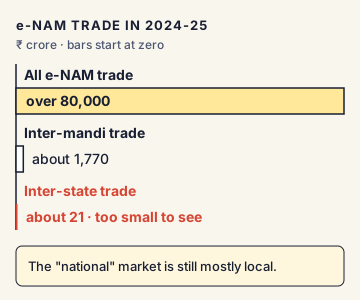
- Trade on e-NAM in 2024-25: over ₹80,000 crore, but inter-state trade only about ₹21 crore.
Commonly confused concepts
- e-NAM vs APMC mandi: an APMC mandi is a physical market run under a state law. e-NAM is an online layer that connects these mandis. e-NAM does not replace mandis; it works through them.
- e-NAM vs commodity exchanges (like NCDEX): commodity exchanges mainly trade futures (contracts to buy or sell later at a fixed price), regulated by SEBI. e-NAM is for selling actual produce now (spot trade) in mandis.
- e-NAM vs PM-KISAN or MSP: e-NAM is about where and how produce is sold. MSP is a price floor at which the government buys some crops. PM-KISAN is direct income support. They are separate tools.
- Inter-mandi vs inter-state trade: in e-NAM figures, inter-mandi trade means a buyer in one mandi buys from another mandi in the same state. Inter-state trade means a buyer in one state buys from a mandi in another state. The two are counted separately, so the inter-mandi figure does not include inter-state trade. The second is the real test of a national market.
Issues, criticism and the way forward
- Weak inter-state trade: inter-state trade is a tiny share of e-NAM trade. A trader in another state rarely buys a lot he cannot see, because of doubts about quality, transport costs, delays in payment and no easy way to settle disputes.
- Assaying and grading: many mandis lack working labs and trained staff, so quality certificates are not trusted by distant buyers.
- Physical auction continues: in many mandis, deals still happen offline and are only entered on the portal later.
- State-level hurdles: different market fees, licences and rules across states slow down a national market.
- Farmers' holding power: knowing that prices will rise later is of little use if a farmer needs cash today. Without storage and post-harvest loans, farmers sell at harvest, when prices are lowest.
- Way forward: suggestions include strong, trusted assaying (including AI-based checks), linking e-NAM with e-NWR (electronic Negotiable Warehouse Receipt: an online receipt for crops kept in a registered warehouse, which a farmer can use to get a loan) based warehouses and loans, common inter-state trading rules, a fast dispute system, timely online payment, and more FPO participation so small farmers can sell in bulk.
Concepts to Know
- Mandi: a regulated wholesale market where farmers sell produce to licensed traders through auction.
- Assaying: testing a sample of produce to measure its quality, such as moisture, purity and size.
- Price discovery: the process by which buyers and sellers arrive at a price, for example through bidding.
- FPO (Farmer Producer Organisation): a company or cooperative owned by farmers, which buys inputs and sells produce together to get better deals.
- Central Sector Scheme: a scheme fully paid for and run by the central government (unlike a Centrally Sponsored Scheme, where states share the cost).
- Launched: 14 April 2016, with 21 mandis in 8 states
- Implementing agency: Small Farmers' Agribusiness Consortium (SFAC), under the Ministry of Agriculture and Farmers' Welfare
- Type: Central Sector Scheme
- Three reforms needed to join: single state-wide trading licence, single-point levy of market fee, e-auction for price discovery
- Grant: up to ₹75 lakh per mandi (raised from ₹30 lakh after the Union Budget 2017-18)
- Platform of Platforms (PoP): launched July 2022
- As of March 2026: 1,656 mandis, 23 States and 4 UTs, over 1.80 crore farmers; cumulative trade about 13.25 crore tonnes worth about ₹4.84 lakh crore
- 2024-25: over ₹80,000 crore traded; inter-state only about ₹21 crore; inter-mandi (between mandis in the same state) about ₹1,770 crore
● Tracked since November 17, 2026 · last seen November 17, 2026 · updates as the daily brief publishes