Virtual Water Trade
Green, Blue and Grey Water Footprints
Virtual water is the water that was used to make a product but is not visible in the final product. A kilogram of rice weighs one kilogram, but growing it may have used well over a thousand litres of water. When a country exports that rice, it is in effect also exporting the water that went into it. This hidden flow of water between countries, through trade in goods, is called virtual water trade.
Why does this idea matter?
Water is very hard to move across long distances, but food is easy to ship. So a country short of water can "import water" by buying water-hungry crops from abroad instead of growing them. A country with plenty of water can do the opposite. The idea helps us see that a country's trade choices also decide how fast it uses up its own rivers and underground water.
For India, which has about 18% of the world's people but only about 4% of its freshwater, this is a serious question.
Where did the idea come from?
- The term "virtual water" was coined in 1993 by the British geographer John Anthony (Tony) Allan. He was studying the dry countries of the Middle East and noticed that they avoided water crises by importing food grains, which carried "hidden" water with them.
- In 2002, the Dutch scientist Arjen Hoekstra built on this idea and introduced the water footprint: a way to measure the total freshwater used to make a product, or used by a person, a company or a country.
- Allan received the Stockholm Water Prize in 2008 for the virtual water concept. In the same year, the Water Footprint Network was set up as an international non-profit body to promote this method.
- In July 2014, the International Organization for Standardization published ISO 14046, a standard for water footprint assessment based on life-cycle thinking (looking at a product from raw material to final use).
The three colours of water
The water footprint splits water use into three types. This is the most important part for exams.
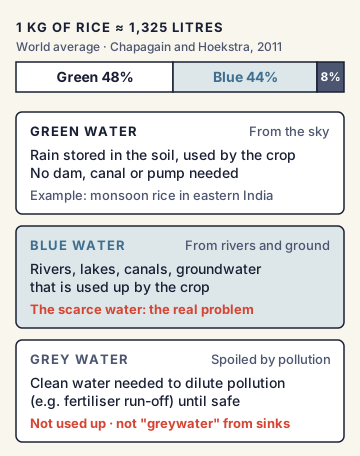
- Green water footprint: rainwater that is stored in the soil and used by the crop. It does not need dams, canals or pumps. Rice grown with monsoon rain uses mainly green water.
- Blue water footprint: water taken from rivers, lakes, canals, reservoirs and groundwater (surface and underground water) that is used up, for example lost through evaporation or taken into the plant. This is the scarce water that people, cities and industries also need.
- Grey water footprint: the amount of clean water that would be needed to dilute the pollution (for example, fertiliser running off a field) until the water is safe again by quality standards.
A simple way to remember it: green is from the sky, blue is from the ground and rivers, grey is the water spoiled by pollution.
How is it measured for a crop?
Scientists calculate how much water the crop uses while growing (mainly through evaporation from the plant and the soil). They then divide this by the yield (how much crop is produced per hectare). The result is shown in cubic metres per tonne. 1 cubic metre per tonne is the same as 1 litre per kilogram, which makes the numbers easy to read.
- A widely cited global study (Chapagain and Hoekstra, 2011) estimated the average water footprint of rice at about 1,325 litres per kilogram, of which about 48% is green, 44% blue and 8% grey.
- Indian studies using other methods give higher figures for India. One study by the Indian Agricultural Research Institute estimated about 3,572 cubic metres per tonne (about 3,572 litres per kilogram). Different methods give different numbers, so the exact figure always depends on the study.
How much water does India export through rice?
Because India is the world's largest rice exporter, it is a large net exporter of virtual water. One estimate by NCAER (National Council of Applied Economic Research) says that when India exported about 16 million tonnes of rice in 2023-24, it in effect sent out roughly 40 billion cubic metres of virtual water. Other studies give different totals, but all agree that rice is the biggest carrier of India's virtual water exports.
Why is blue water the real problem?
Not all virtual water is equal. Rice grown with monsoon rain in eastern India mainly uses green water, which places little strain on local water stocks. But in Punjab, Haryana and western Uttar Pradesh, a lot of rice is grown with groundwater pumped by tubewells. Here, every tonne exported carries water from aquifers that are already falling.
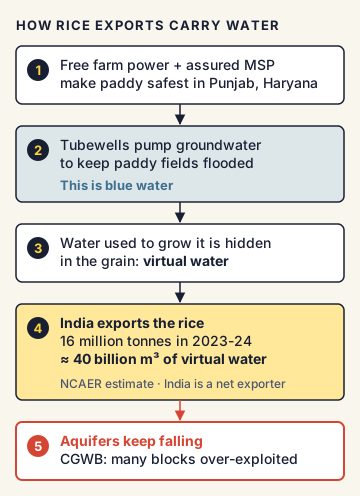
The Central Ground Water Board (CGWB) classifies a large share of the assessment blocks in these states as over-exploited, meaning people take out more groundwater every year than rain puts back. So the policy question shifts from "how much rice do we export?" to "how much scarce blue water do our exports carry?"
India's position and Indian examples
- Why rice is grown in dry regions: Assured government buying at the Minimum Support Price (MSP), free or very cheap farm electricity (Punjab has given free farm power since 1997), and high, steady yields have made paddy the safest crop in Punjab and Haryana, even though these are not naturally wet regions.
- Laws and schemes: The Punjab Preservation of Subsoil Water Act, 2009 stops farmers from transplanting paddy too early in the hot summer, when evaporation is highest. The Atal Bhujal Yojana (launched on 25 December 2019, outlay ₹6,000 crore, in 7 states) supports community-led groundwater management. The Per Drop More Crop part of the Pradhan Mantri Krishi Sinchayee Yojana (2015) promotes drip and sprinkler irrigation.
- Farming methods: Alternate wetting and drying (AWD) and direct-seeded rice (DSR) use less water than keeping fields flooded all season.
- Export policy: India has at times restricted rice exports for food-security reasons. For example, exports of non-Basmati white rice were banned from 20 July 2023 and opened again on 28 September 2024. These decisions were about domestic food prices, not water, but they show that export volumes are a policy choice.
Commonly confused concepts
- Virtual water vs water footprint: Virtual water is the water hidden in a traded product. The water footprint is the full measure of water used by a product, person or country, split into green, blue and grey. Virtual water trade is the flow of water footprints between countries through trade.
- Blue water footprint vs grey water footprint: Blue is water actually used up from rivers or aquifers. Grey is not used up; it is an estimate of how much water is polluted.
- Green water vs "green water" in other contexts: In the water footprint, green water means soil moisture from rain. Do not confuse it with green hydrogen or green energy, which are about low-carbon sources.
- Grey water footprint vs greywater: Greywater (one word) is used household water from sinks, showers and washing machines that can be reused. The grey water footprint is a pollution measure.
- Water footprint (ISO 14046) vs Water Footprint Network method: ISO 14046 focuses on the impact of water use; the Water Footprint Network method focuses on the volume of water used.
Issues, criticism and the way forward
- Too simple a number: Critics say a single litres-per-kilogram figure treats all water as equal, though rainwater in a wet region and groundwater in a dry region have very different value. This is why experts now separate blue water from green water.
- Trade is not only about water: Countries choose what to grow based on land, labour, jobs, food security and farmer incomes, not water alone. Cutting rice exports suddenly could hurt farmers and India's place in world markets.
- Hidden subsidy: When groundwater is pumped with free power and the rice is exported, India is in effect giving away subsidised water and electricity to foreign buyers. Some experts call this an "invisible drain".
- Way forward suggested by experts: grow crops that suit the local water situation (crop diversification away from paddy in water-stressed areas); improve irrigation efficiency; spread AWD and DSR; earn more per tonne through quality, branding, traceability and geographical indications (like Basmati); and track new measures such as export value per cubic metre of blue water, groundwater used per tonne and farmer income per unit of water.
Concepts to Know
- Aquifer: A layer of soil or rock under the ground that holds water, like a sponge. Wells and tubewells pull water from aquifers.
- Evaporation (evapotranspiration): Water turning into vapour and going into the air, from the soil and from the leaves of plants. This is the main way a crop "uses up" water.
- Cubic metre: A box 1 metre long, 1 metre wide and 1 metre high, holding 1,000 litres of water.
- Net exporter: A country that sends out more of something than it brings in.
- Over-exploited block: An area where people take out more groundwater each year than rainfall and other sources put back (stage of extraction above 100%).
- Life-cycle assessment: A way of measuring the environmental effect of a product over its whole life, from raw materials to making, using and throwing it away.
- "Virtual water" coined by John Anthony (Tony) Allan in 1993; Stockholm Water Prize 2008
- "Water footprint" introduced by Arjen Hoekstra in 2002; Water Footprint Network set up in 2008
- ISO 14046 (water footprint standard): published July 2014
- Green = rainwater in soil; Blue = surface water and groundwater used up; Grey = water needed to dilute pollution
- Global average water footprint of rice: about 1,325 litres/kg (about 48% green, 44% blue, 8% grey; Chapagain and Hoekstra, 2011)
- India: about 16 million tonnes of rice exports in 2023-24 ≈ about 40 billion cubic metres of virtual water (NCAER estimate)
- 1 cubic metre per tonne = 1 litre per kilogram
- Atal Bhujal Yojana: 25 December 2019, ₹6,000 crore, 7 states
● Tracked since November 15, 2026 · last seen November 15, 2026 · updates as the daily brief publishes