Groundwater Depletion in India
Groundwater is the water stored underground in the cracks and pores of soil and rock, in layers called aquifers. Farmers and towns pull it up using wells and tube wells. Groundwater depletion means taking out more groundwater than rain and rivers can put back over time. When this happens year after year, the water table (the level below which the ground is full of water) keeps falling, and wells have to go deeper or run dry.
Why does it matter?
India is the largest user of groundwater in the world, accounting for about a quarter of all groundwater pumped globally. Groundwater supports roughly two-thirds of India's irrigation needs and most of its rural drinking water. If it runs out, both food production and drinking water are at risk.
How did India get here?
Until the 1960s, most irrigation came from canals and traditional wells. Then the Green Revolution, cheap tube-well technology and electric pumps made it easy to pump water from deep underground. Many states began giving free or very cheap electricity to farmers. Since pumping cost almost nothing, farmers grew water-hungry crops like paddy and sugarcane even in dry regions.
Government procurement of rice and wheat at assured prices made these crops even more attractive. Over decades, pumping far exceeded natural recharge in many areas, especially in the northwest.
How is groundwater measured?
The Central Ground Water Board (CGWB), under the Ministry of Jal Shakti, works with states to prepare the Dynamic Ground Water Resources Assessment. It compares how much water is recharged each year with how much is extracted. The key measure is the stage of groundwater extraction:
Stage of extraction (%) = (annual extraction ÷ annual extractable resource) × 100
Each assessment unit (block, taluk or mandal) is put in a category:
- Safe: up to 70%
- Semi-critical: above 70% and up to 90%
- Critical: above 90% and up to 100%
- Over-exploited: above 100% (more water is taken out than is replenished)
What does the latest assessment show (2025)?
- Total annual recharge: about 448.5 billion cubic metres (BCM); annual extractable resource: about 407.8 BCM.
- Total annual extraction: about 247.2 BCM, of which roughly 87 per cent goes to irrigation.
- National stage of extraction: about 60.6 per cent.
- Out of 6,762 assessment units: 730 (10.8%) over-exploited, 201 (3.0%) critical, 758 (11.2%) semi-critical and 4,946 (73.1%) safe; 127 units are saline.
- Over-exploitation is concentrated in states like Punjab, Haryana and Rajasthan, and in parts of western Uttar Pradesh, Gujarat, Tamil Nadu and Karnataka.
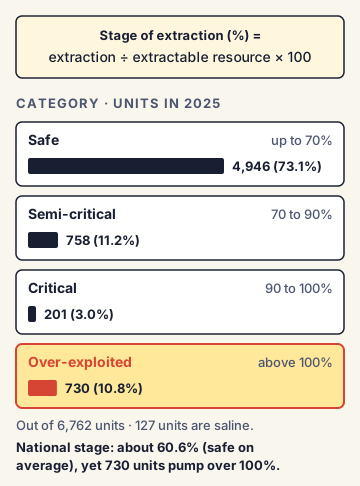
Note that the national average of about 60 per cent hides sharp local stress. Some blocks in Punjab and Rajasthan extract far more than 100 per cent of their annual recharge.
Who governs groundwater?
Under the Constitution, water is mainly a State subject (Entry 17 of the State List), which covers water supply, irrigation, canals, drainage and water storage, subject to Entry 56 of the Union List (inter-state rivers). So each state makes its own groundwater laws. Key bodies and laws:
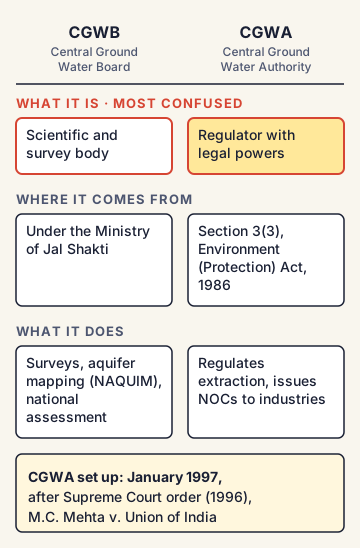
- Central Ground Water Board (CGWB): the Centre's main scientific body for groundwater; does surveys, mapping and the national assessment.
- Central Ground Water Authority (CGWA): set up in January 1997 under Section 3(3) of the Environment (Protection) Act, 1986, following a Supreme Court order (1996) in the M.C. Mehta v. Union of India case. It regulates groundwater extraction, for example by issuing "no objection certificates" to industries.
- Model Groundwater Bill: the Centre has circulated model bills to guide states in writing their own groundwater laws. Many states have passed such laws, but enforcement is weak.
- Under traditional common law, groundwater was treated as belonging to the owner of the land above it. This makes regulation hard, because each landowner feels entitled to pump as much as they want.
What is the government doing?
- Atal Bhujal Yojana (Atal Jal): launched on 25 December 2019, with an outlay of ₹6,000 crore (half a World Bank loan, half from the Government of India). It focuses on community-led groundwater management in water-stressed gram panchayats of seven states: Gujarat, Haryana, Karnataka, Madhya Pradesh, Maharashtra, Rajasthan and Uttar Pradesh. Villages prepare water budgets and security plans, and get incentives for reducing water use.
- Jal Shakti Abhiyan (Catch the Rain): a campaign for rainwater harvesting and recharge structures.
- Micro-irrigation (Per Drop More Crop) to cut water use on farms.
- Aquifer mapping under the National Aquifer Mapping and Management programme (NAQUIM) by the CGWB.
- State actions: for example, the Punjab Preservation of Subsoil Water Act, 2009 bans early transplanting of paddy, so that farmers do not pump water during the hottest weeks before the monsoon.
Commonly confused concepts
- CGWB vs CGWA: CGWB is the scientific and survey body. CGWA is the regulatory authority with legal powers under the Environment (Protection) Act. (CGWA works from within the CGWB setup, but their roles differ.)
- Water table vs aquifer: An aquifer is the underground layer that holds water. The water table is the top level of the water in that layer.
- Shallow (unconfined) vs deep (confined) aquifers: Shallow aquifers are refilled quickly by rain. Deep aquifers are trapped between rock layers and refill very slowly, sometimes over thousands of years. Pumping deep aquifers is like spending savings that cannot be refilled.
- Water scarcity vs water stress: Water stress means demand is close to or more than available supply. Scarcity is the actual shortage that people face.
Issues, criticism and the way forward
- Free power and crop choices: Free electricity and assured procurement of paddy encourage over-pumping. But removing free power is politically and socially difficult because farmers depend on it.
- Weak regulation: Millions of private wells make monitoring and control very hard.
- Water quality: Over-pumping can draw up water with arsenic, fluoride, uranium or salt, harming health.
- Equity: Rich farmers who can drill deeper wells get more water, while small farmers' shallow wells dry up first.
- Way forward suggested by experts and official bodies: community management of aquifers (as in Atal Bhujal Yojana); separate electricity feeders for farms with fixed supply hours; solar pumps with incentives to sell surplus power instead of pumping water; crop diversification away from paddy and sugarcane in water-short areas; rainwater harvesting and recharge; and wider use of micro-irrigation.
Concepts to Know
- Aquifer: An underground layer of rock, sand or gravel that holds water and allows it to flow, from which wells draw water.
- Recharge: The natural refilling of groundwater when rain or river water seeps down into the ground.
- BCM (billion cubic metres): A unit for very large volumes of water. One cubic metre equals 1,000 litres.
- Assessment unit: The small administrative area (block, taluk, mandal or watershed) for which groundwater is measured.
- Common law (riparian/land-ownership principle): A traditional legal idea, carried over from British times, that the person who owns land also controls the groundwater under it.
- India: world's largest groundwater user, about 25% of global extraction
- 2025 assessment: recharge about 448.5 BCM; extractable 407.8 BCM; extraction 247.2 BCM; stage about 60.6%
- 730 of 6,762 units (10.8%) over-exploited; 201 critical; 758 semi-critical; 4,946 safe
- About 87% of groundwater extraction is for irrigation
- Categories: safe ≤70%, semi-critical 70–90%, critical 90–100%, over-exploited >100%
- Water: Entry 17, State List; inter-state rivers: Entry 56, Union List
- CGWA: January 1997, Section 3(3), Environment (Protection) Act, 1986, after Supreme Court order in M.C. Mehta case
- Atal Bhujal Yojana: 25 December 2019, ₹6,000 crore (50% World Bank), seven states
● Tracked since October 11, 2026 · last seen October 11, 2026 · updates as the daily brief publishes