Value of Supply under GST (Section 15, CGST Act)
The value of supply is the amount on which GST is charged. If a shirt is sold for ₹1,000 and the GST rate is 5%, the value is ₹1,000 and the tax is ₹50. Section 15 of the Central Goods and Services Tax (CGST) Act, 2017 lays down how this value is worked out: what must be added to the price, which discounts can be taken out, and what to do when the price cannot be trusted. Getting the value right matters as much as getting the rate right, because tax = value × rate.
Why does it exist?
A tax rate means nothing if businesses can play with the base on which it is charged. Without clear rules, a seller could show a low price on the bill and collect other charges separately, or two related companies could set a fake low price between themselves to pay less tax. At the same time, honest businesses need clear rules so that a genuine discount does not get taxed. Section 15 balances these two needs: it stops tax leakage and protects real price cuts.
Where does the law come from?
- GST came into force on 1 July 2017, after the Constitution (101st Amendment) Act, 2016.
- Section 15 of the CGST Act sets the valuation rules. The Integrated GST (IGST) Act uses the same rules for supplies between states, and each state's SGST Act has a matching section.
- When Section 15's basic rule cannot be used, Chapter IV (Rules 27 to 35) of the CGST Rules, 2017 gives the method.
- Changes are first discussed in the GST Council and then made by Parliament (for the Act) or by the Central Board of Indirect Taxes and Customs (CBIC) and the government (for rules and circulars).
The basic rule: transaction value (Section 15(1))
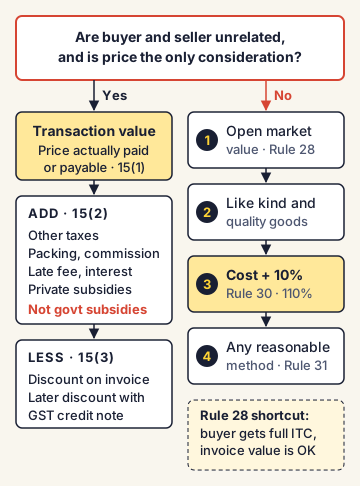
The value is the transaction value, which means the price actually paid or payable for the supply. This rule applies only when two conditions are both met:
- the supplier and the buyer are not related to each other, and
- the price is the only consideration (the buyer gives nothing else in return, such as free goods or services).
Think of it like this: when two strangers bargain at arm's length, the price they agree on is a fair, market price. So the law trusts that price.
What must be added to the price (Section 15(2))
Some amounts must be included in the value even if the bill shows them separately:
- Other taxes and charges under other laws (anything other than GST itself), if the supplier charges them separately.
- Any amount the supplier was supposed to pay but the buyer paid instead, if it is not already in the price.
- Incidental expenses charged by the supplier for anything done at or before delivery, such as commission and packing.
- Interest, late fee or penalty for delayed payment.
- Subsidies directly linked to the price, except subsidies given by the Central and State Governments. So a private company's subsidy that lowers the price is added back, but a government subsidy is not.
Discounts: when can they be taken out? (Section 15(3))
A discount reduces the value, and so reduces the tax, only in two cases:
- Discount given before or at the time of sale: allowed if it is shown on the invoice. Example: a dealer sells a fridge marked ₹30,000 at ₹27,000 and the bill shows the ₹3,000 discount. Tax is on ₹27,000.
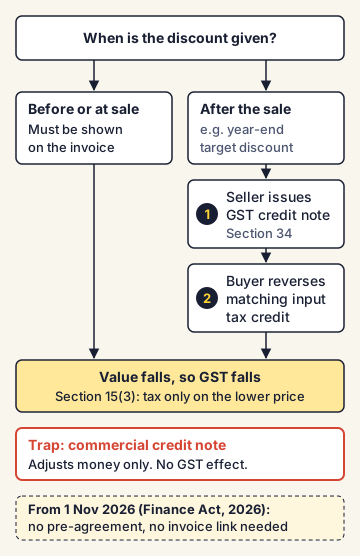
- Discount given after the sale (post-supply discount): this is where the rules changed.
How did the post-supply discount rule change?
Many companies give discounts after the sale, for example a year-end discount to a dealer who crosses a sales target. The old and new conditions are:
| Condition | Until 31 October 2026 | From 1 November 2026 |
|---|---|---|
| Discount agreed at or before the time of sale | Required | Not required |
| Discount linked to specific invoices | Required | Not required |
| Supplier issues a GST credit note | Not a separate condition | Required |
| Buyer reverses the matching input tax credit | Required | Required |
Under the old rule, a target discount decided at year-end often failed the "agreed before the sale" and "linked to invoices" tests, so it could not reduce the tax. Businesses then issued "commercial" or "financial" credit notes with no GST effect. The 56th GST Council (3 September 2025) recommended removing the pre-agreement condition and linking the discount to a GST credit note under Section 34.
Parliament made the change through the Finance Act, 2026, and it took effect on 1 November 2026. Section 34(1) now expressly lists a Section 15(3)(b) discount as a reason to issue a credit note.
Why must the buyer reverse credit?
GST works through input tax credit: the buyer subtracts the GST it paid on purchases from the GST it collects on sales. If the seller reduces its tax because of a discount, the buyer must also reduce the credit it took on that purchase. Otherwise the government would lose tax on both sides. That is why both the old and new rules insist on the buyer's reversal.
When the price cannot be trusted: related persons and the Valuation Rules
- The Explanation to Section 15 lists who counts as related persons: officers or directors of each other's businesses, legally recognised partners, employer and employee, a person holding 25% or more of the voting shares of both, one controlling the other, members of the same family, and similar links. Under GST, two branches of one company in different states are distinct persons too.
- For such cases, Rule 28 says to use the open market value. If that is not available, use the value of goods of like kind and quality, then Rule 30 (cost plus 10%, that is 110% of cost), and finally Rule 31 (any reasonable method). Rule 28 also has two shortcuts: the supplier may use 90% of the price at which the buyer resells to unrelated customers, and if the buyer can claim full input tax credit, the invoice value itself is accepted as open market value.
- Rule 32 gives special methods for some trades, such as money changing (buying and selling foreign currency), air travel agents, life insurance and dealers in second-hand goods. Rule 31A covers lottery, betting, gambling, horse racing, online gaming and casinos.
India's position and examples
- CBIC Circular No. 92/11/2019-GST (7 March 2019) explained how common sales offers are treated. Free samples are not a "supply" for consideration, and input tax credit on them must be reversed. Buy-one-get-one-free offers are treated as two goods sold for one price, not as free goods, so credit is allowed.
- CBIC Circular No. 251/08/2025-GST (12 September 2025) clarified that ordinary post-sale discounts given by a manufacturer to a dealer are generally not payment for a separate service by the dealer. Only when a dealer is paid for a clearly defined service, like a specific advertising campaign, is GST charged on that service separately.
- Credit notes have a time limit under Section 34(2): they must be declared by 30 November after the end of the financial year, or the date of filing the annual return, whichever is earlier. (The Finance Act, 2022 moved this date from September to 30 November.)
Commonly confused concepts
- Pre-supply discount vs post-supply discount: A pre-supply discount is shown on the invoice itself and simply lowers the bill. A post-supply discount comes later and needs a credit note plus the buyer's credit reversal.
- GST credit note vs commercial (financial) credit note: A GST credit note under Section 34 reduces the seller's tax and makes the buyer reverse credit. A commercial credit note only adjusts money between the two businesses and has no GST effect.
- Transaction value vs MRP: GST is charged on the price actually charged, not on the Maximum Retail Price printed on the pack, unless a special rule says so.
- Discount vs free goods: A discount lowers the price. Truly free goods (like free samples) are not sold at all, so the seller must reverse the credit on them.
- Related persons vs distinct persons: Related persons are separate people or firms with a special link (shareholding, family, control). Distinct persons are branches of the same business registered in different states.
Issues, criticism and the way forward
- Years of disputes: For eight years, the "agreed before the sale" test led to many tax notices on year-end and target discounts. The new rule removes this test, but some questions remain, such as how it applies to discounts on sales made before 1 November 2026.
- Dependence on the buyer: The seller's tax cut still depends on the buyer reversing credit. Small sellers find it hard to check this for hundreds of dealers. The 56th Council recommended withdrawing Circular 212/06/2024-GST, which had set a paperwork method to prove the reversal, and moving to a credit-note-based system on the portal.
- Related-party valuation: Branch transfers and group-company deals are still a frequent source of disputes about "open market value", though the full-credit shortcut in Rule 28 reduces the problem.
- Way forward: Experts suggest matching credit notes and reversals automatically on the GST portal (for example through the Invoice Management System), issuing clear rules on old discounts, and keeping valuation rules simple so that the same deal is not valued differently in different states.
Concepts to Know
- Consideration: Anything a buyer gives in return for a supply, usually money, but it can also be goods or services.
- Input tax credit (ITC): The GST a business paid on its purchases, which it can subtract from the GST it collects on its sales.
- Credit note: A document a seller gives a buyer to reduce the amount of an earlier bill, for example because of a discount or returned goods.
- Annual return: The yearly GST statement a business files, summarising its whole year's sales, purchases and tax.
- Open market value: The full price a supply would fetch between two unrelated parties dealing normally, at the same time and place.
- CBIC circular: An official clarification by the Central Board of Indirect Taxes and Customs that tells tax officers and businesses how to apply the law.
- Value of supply: Section 15, CGST Act, 2017; Valuation Rules: Rules 27 to 35, CGST Rules, 2017
- Basic rule: transaction value when parties are not related and price is the sole consideration
- Inclusions (Section 15(2)): other taxes, amounts paid by buyer on supplier's behalf, incidental expenses (commission, packing), interest/late fee/penalty, non-government subsidies linked to price
- Government (Centre and State) subsidies are excluded from value
- Post-supply discount reform: recommended by the 56th GST Council (3 September 2025); made by Finance Act, 2026 (Sections 153 to 155); in force from 1 November 2026 (Notification No. 03/2026-Central Tax)
- New conditions: GST credit note by supplier + ITC reversal by buyer; no pre-agreement or invoice-linking needed
- Related person test includes holding 25% or more of voting shares
- Rule 30: 110% of cost; Rule 28 option: 90% of the buyer's resale price to unrelated customers
- Credit note deadline (Section 34(2)): 30 November after the year ends, or the annual return date, whichever is earlier
- Circulars: 92/11/2019-GST (sales promotion schemes); 251/08/2025-GST (post-sale discounts)
● Tracked since October 31, 2026 · last seen October 31, 2026 · updates as the daily brief publishes