Usual Residence in the Census
De Jure and De Facto Enumeration
A census must decide one simple thing for every person: where should this person be counted? There are two main answers. In the de facto method, a person is counted where they are physically found at the census moment. In the de jure method, a person is counted at their usual residence, the place where they normally live, even if they are away that day. India uses a middle path called the extended de facto method.
Why does this question matter?
Imagine a student from Patna who studies in Delhi and is visiting home during the census. If both homes count her, she is counted twice. If neither counts her, she disappears from the data. Every rule about "where to count" exists to make sure each person is counted once, and only once. This matters because census numbers decide seats in Parliament, money for states, and the size of welfare schemes in each district.
How does each method work?
- De facto (where you are found): Everyone is counted at the place they spend the census night. It is simple and leaves little room for guesswork. But a tourist town or a pilgrimage site may look much bigger than it really is, and a village whose men have gone to the city for work may look smaller.
- De jure (where you usually live): Everyone is counted at their normal home, even if they are travelling. This gives a truer picture of where people live, work and need services. But it depends on people honestly reporting who usually lives in a house, and it needs clear rules for people who move a lot.
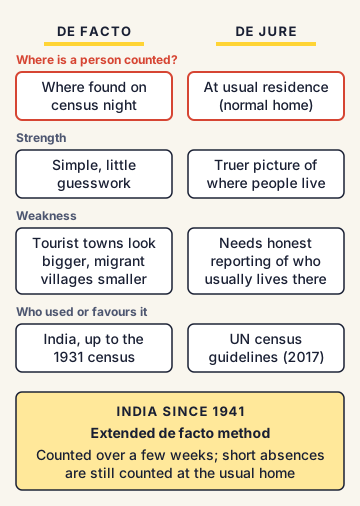
The United Nations guidelines for censuses (the Principles and Recommendations for Population and Housing Censuses, Revision 3, published in 2017) favour counting people by usual residence. Many countries, such as Ireland for its 2027 census, have moved to this method.
Where did India's method come from?
Up to the 1931 census, India counted everyone on a single night, at the place they were found: a pure de facto, one-day count. From the 1941 census, this changed. Counting the whole country in one night had become too difficult. So India moved to counting over a longer period of a few weeks. Officials call this the extended de facto method, though some early reports described it as moving towards de jure.
How does the extended de facto method work in India?
Think of it as a de facto count stretched over a few weeks, with a home-based rule to avoid gaps.
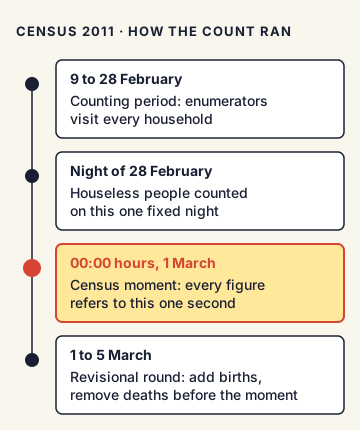
- A counting period: Enumerators (census workers) visit every household over about three to five weeks. In 2011, this ran from 9 to 28 February 2011.
- Who belongs to a household: A person is counted in a household if they normally live there and are present during the counting period. People who normally live there but are away for a short time are also counted there, if they are expected to return before the counting period ends.
- Night count for the houseless: People who live in the open, on pavements or under flyovers, have no house to visit. They are counted on one fixed night just before the census moment. In 2011, this was the night of 28 February.
- The census moment and the revisional round: All figures are brought up to one exact reference time, called the census moment. In 2011, it was 00:00 hours on 1 March 2011. In a short revisional round afterwards (1 to 5 March in 2011), enumerators go back to add babies born and remove people who died before that moment.
So the final figure is like a photograph of India at one exact second, even though it took weeks to take.
The usual residence rules in practice
- Short trips: A person who usually lives in a house but is away briefly (a visit, a business trip, a short trip abroad) is counted at that home if they come back within the counting period.
- Long absences: A person who has gone away for a long time (for example, for a job abroad) is not counted in the Indian household, because they are not a usual resident of India at that time.
- Members of a household: The main test is "normally living together", not "eating from the same kitchen". A live-in domestic worker or a paying guest is counted with the household they stay in. An ordinary tenant who lives separately forms their own household.
- Foreigners living in India: The census counts people living in India, not only citizens. The count is about residence, not citizenship.
Commonly confused concepts
- Census vs National Population Register (NPR): The census is done under the Census Act, 1948, and its individual data is confidential. The NPR is a register of "usual residents" prepared under the Citizenship Act, 1955 and the Citizenship Rules, 2003. For the NPR, a usual resident is someone who has lived in an area for 6 months or more, or intends to live there for the next 6 months or more. The census does not use this 6-month test.
- Census moment vs counting period: The counting period is the weeks of field work. The census moment is the single reference second that all numbers are adjusted to.
- Usual residence vs place of birth vs last residence: The census also asks where a person was born and where they lived before, to measure migration. These are separate questions. They do not change where the person is counted.
- De facto vs de jure (in census terms): In law and international relations, these words also mean "in fact" vs "by law" (for example, de facto recognition of a government). In a census, they only describe where a person is counted.
Issues, criticism and the way forward
- Migrant workers: Seasonal and circular migrants (who move between village and city many times a year) can be double-counted or missed. Cities may get less money for services than their real population needs.
- Long counting period: People who move during the weeks of counting may be missed or counted twice. The revisional round fixes births and deaths, but not every move.
- Self-enumeration: Online self-counting is new in Census 2027. It is quick and convenient, but people must apply the residence rules correctly themselves. Clear guidance and checks are needed.
- Way forward: Experts suggest clear public guidance on residence rules, strong post-enumeration checks to measure missed and double counts, and better tracking of migrants through migration questions.
Concepts to Know
- Enumeration: Simply means counting and recording people one by one. An enumerator is the person who does it.
- Census moment (reference date): The exact time to which all census figures refer, like the time stamp on a photograph.
- Revisional round: A short return visit after the main counting, to add births and remove deaths that happened before the census moment.
- Houseless population: People who do not live in any building or "census house", for example those sleeping on pavements or in the open.
- Self-enumeration: A facility where a household fills in its own census details online before the enumerator visits. The enumerator then checks and records it.
- Usual resident: A person who normally lives in a particular place, even if they are away for a short time.
- De facto = counted where found; de jure = counted at usual residence; India uses the extended de facto method
- Single-night de facto count used up to the 1931 census; extended counting period since the 1941 census
- Census 2011: counting from 9 to 28 February 2011; houseless counted on the night of 28 February; census moment 00:00 hours, 1 March 2011; revisional round 1 to 5 March 2011
- Household test: "normally living together" matters more than a common kitchen
- NPR "usual resident" test (6 months) comes from the Citizenship Rules, 2003, not from the Census Act, 1948
- UN Principles and Recommendations for Population and Housing Censuses, Revision 3: endorsed in 2015, published in 2017
● Tracked since November 14, 2026 · last seen November 14, 2026 · updates as the daily brief publishes