UNSC 1267 Sanctions Committee
How the UN Lists Terrorists
The UNSC 1267 Sanctions Committee is a committee of the United Nations Security Council (UNSC) that keeps a list of terrorists and terror groups linked to ISIL (also called ISIS or Da'esh) and Al-Qaida. Anyone on this list faces three punishments that every UN member country must apply: their money and property are frozen, they cannot travel across borders, and nobody may sell or give them weapons.
When news says "the UN has declared someone a global terrorist", it usually means this committee has added that person to its list.
Why does it exist?
A terrorist living in one country may raise money in a second country and plan attacks in a third. One country's ban does not stop them elsewhere. The UN Security Council is the only body whose decisions bind every UN member. So a listing by the Council means the whole world must freeze the person's bank accounts and stop their travel. It is like a "wanted" notice that every police station in the world must follow.
Where did it come from?
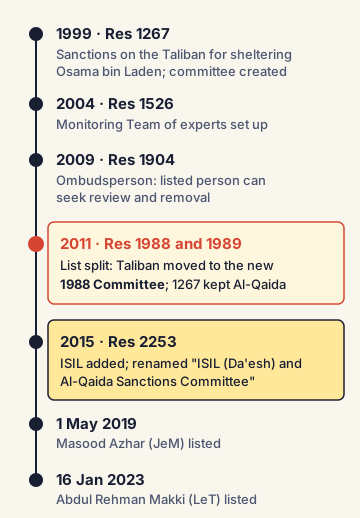
- 15 October 1999, Resolution 1267: The Security Council put sanctions on the Taliban, who then ruled Afghanistan, for sheltering Osama bin Laden. It created a committee to manage these sanctions, named after the resolution number.
- 2000 onwards: Later resolutions added Al-Qaida and bin Laden's network, and the list grew after the 9/11 attacks in 2001.
- 2004, Resolution 1526: A Monitoring Team of experts was set up to help the committee and report on terror threats.
- 2009, Resolution 1904: An Office of the Ombudsperson was created, so that a listed person can ask an independent official to review their case and seek removal.
- 17 June 2011, Resolutions 1988 and 1989: The list was split into two. Taliban-related sanctions went to a new 1988 Committee. The 1267 Committee kept the Al-Qaida list.
- 2015, Resolution 2253: ISIL was added. The committee's full name is now the "ISIL (Da'esh) and Al-Qaida Sanctions Committee", also called the 1267/1989/2253 Committee.
Who sits on it and how does it decide?
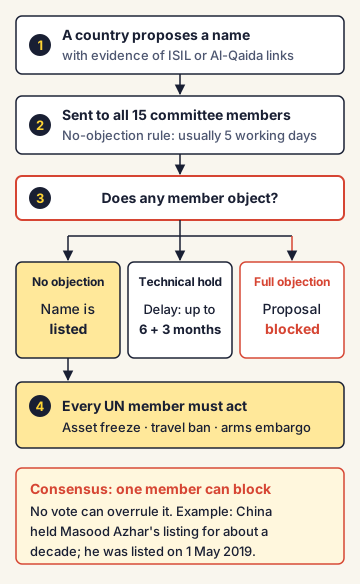
All 15 members of the Security Council sit on the committee: the 5 permanent members (US, UK, France, Russia, China) and 10 elected members. It decides by consensus, meaning every member must agree. This is the key point: a single member can block a listing, and no vote can overrule it.
How does a listing happen? Step by step
- A UN member country (or a group of countries) sends a proposal with evidence linking the person or group to ISIL or Al-Qaida.
- The proposal is circulated to all 15 committee members under a "no-objection" procedure. If no member objects within the deadline (usually five working days), the listing is approved.
- Any member can instead put a "technical hold", saying it needs more information. A hold can last up to six months, and the member can ask for three more months.
- If the hold is turned into a full objection, the proposal is blocked.
- Once listed, the person's name, details and reasons are published on the UN's sanctions list, and all countries must act.
The three sanctions (the key measures)
- Asset freeze: Countries must freeze, without delay, all money, bank accounts and property of the listed person or group, and stop anyone from giving them funds.
- Travel ban: Listed persons cannot enter or pass through any country.
- Arms embargo: Nobody may supply them weapons, military equipment or training.
India's experience
India has used this committee for years against Pakistan-based groups. Lashkar-e-Taiba (LeT) and Jaish-e-Mohammed (JeM) are both on the list. The most famous case is Masood Azhar, the JeM chief. China placed technical holds on proposals to list him at least four times. On 1 May 2019, China lifted its hold and he was listed, about a decade after India first asked.
In June 2022, India and the US jointly proposed listing LeT's deputy chief Abdul Rehman Makki; China put a hold, then lifted it, and he was listed on 16 January 2023. Other proposals by India have been held up in the same way. In July 2025, the committee's Monitoring Team report mentioned The Resistance Front (TRF), an LeT proxy, in connection with the Pahalgam attack of 22 April 2025, in which 26 civilians were killed. Indian officials saw this as an important step because such reports are also adopted by consensus.
Commonly confused concepts
- 1267 Committee vs 1988 Committee: 1267 covers ISIL and Al-Qaida. 1988 covers the Taliban (since the 2011 split).
- 1267 Committee vs Counter-Terrorism Committee (CTC): The CTC was set up by Resolution 1373 (2001) after 9/11. It does not list anyone. It checks whether countries have the right laws and systems against terrorism. India chaired the CTC in 2022 and hosted its special meeting in Mumbai and New Delhi on 28–29 October 2022, which adopted the CTC's own "Delhi Declaration" on new technologies. That is different from the 2026 BIMSTEC Delhi Declaration.
- UN listing vs national listing: India also bans groups and names individual terrorists under the UAPA, 1967. That applies only within India. A 1267 listing binds every UN member.
- UN 1267 list vs FATF lists: The 1267 list names people and groups. The FATF grey and black lists name countries.
Issues, criticism and the way forward
- The veto by another name: Because decisions need consensus, one member can protect a terrorist through repeated holds. Critics say technical holds are used for political reasons, and the reasons for holds are not made public.
- Fairness to listed persons: Listed people often cannot see the evidence against them. The Ombudsperson process was created after courts (notably the European Court of Justice in the Kadi case, 2008) raised concerns about due process, but it applies only to this list.
- Weak implementation: Many countries are slow to freeze assets, or listed groups simply change their names and continue, as front groups like TRF show.
- Way forward: India has long asked for more transparency in holds, time-bound decisions, and the adoption of the Comprehensive Convention on International Terrorism (CCIT), which India proposed at the UN in 1996 and which still awaits agreement on a common definition of terrorism.
Concepts to Know
- UN Security Council (UNSC): The UN body responsible for world peace and security. Its decisions under Chapter VII of the UN Charter are binding on all member countries.
- Sanctions: Penalties, such as freezing money or banning travel, used to pressure a person, group or country without using force.
- Consensus: A decision is taken only when no member objects. It is different from a vote, where the majority wins.
- Technical hold: A temporary block on a listing proposal by a committee member who says it needs more time or information.
- Proxy group: A new group with a different name that works for an older, banned group, often to escape sanctions.
- Ombudsperson: An independent official who hears complaints and reviews decisions fairly.
- Resolution 1267 adopted on 15 October 1999 (Taliban sanctions)
- Monitoring Team: Resolution 1526 (2004); Ombudsperson: Resolution 1904 (2009)
- Split on 17 June 2011: Resolution 1989 (Al-Qaida) and Resolution 1988 (Taliban, separate committee)
- Resolution 2253 (2015): renamed "ISIL (Da'esh) and Al-Qaida Sanctions Committee"
- Members: all 15 UNSC members; decisions by consensus; technical hold up to 6 months + 3 months
- Sanctions: asset freeze, travel ban, arms embargo
- Masood Azhar (JeM) listed 1 May 2019; Abdul Rehman Makki (LeT) listed 16 January 2023
- Counter-Terrorism Committee: Resolution 1373 (2001); India chaired it in 2022
- CCIT proposed by India at the UN in 1996
● Tracked since October 13, 2026 · last seen October 13, 2026 · updates as the daily brief publishes