Financial Action Task Force (FATF)
The Global Watchdog on Money Laundering and Terror Financing
The Financial Action Task Force, or FATF, is an international body that sets the global rules for stopping money laundering (making dirty money look clean) and terror financing (giving money to terrorists). It does not make laws and it cannot punish anyone directly. Instead, it writes a set of standards, checks how well each country follows them, and publicly names countries that are weak.
Because banks and investors around the world pay close attention to these lists, being named by the FATF hurts a country's economy and reputation.
Why does it exist?
Criminals and terrorists need money, and they need to move it without getting caught. A drug gang wants to use its cash to buy property without anyone asking where the cash came from. A terror group wants donors in one country to send money to fighters in another. Money moves across borders in seconds, but every country has its own laws.
If one country is careless, criminals simply route their money through it. So the world needed one common rulebook and one body to check that every country follows it. That is the FATF's job.
Where did it come from?
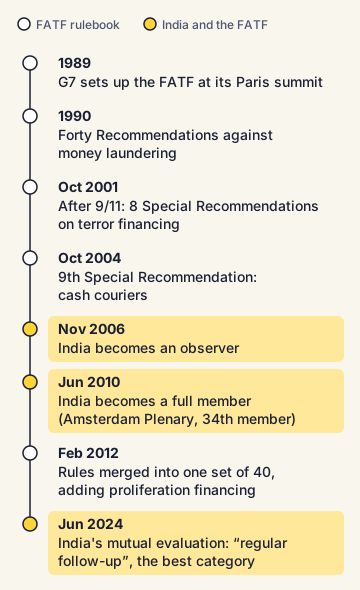
- 1989: The G7 group of rich countries set up the FATF at its summit in Paris, because they were worried that drug money was entering the world's banking system.
- 1990: The FATF issued its Forty Recommendations, a full action plan against money laundering.
- October 2001: After the 9/11 attacks in the United States, the FATF added eight Special Recommendations on terror financing.
- October 2004: A ninth Special Recommendation was added, on cash couriers (people who physically carry cash across borders).
- February 2012: The rules were rewritten into one combined set of 40 Recommendations covering money laundering, terror financing and also the financing of weapons of mass destruction (called proliferation financing).
How is it organised?
Its secretariat (office) is in Paris, inside the OECD building, but it is a separate body. Its decision-making body is the Plenary, a meeting of all members. The Plenary usually meets three times a year, in February, June and October. A President, chosen from among the members, leads it for a fixed term. A UK presidency began in July 2026, and India's Vivek Aggarwal was appointed Vice-President for July 2026 to June 2027. Members decide by consensus, which means everyone must agree.
Who are its members?
The FATF has 40 members: 38 countries and 2 regional organisations (the European Commission and the Gulf Cooperation Council). Indonesia became the 40th member in October 2023. Russia's membership was suspended in February 2023 after its invasion of Ukraine; it is still counted as a member but cannot take part. Most other countries are covered through FATF-Style Regional Bodies (FSRBs), such as the Asia/Pacific Group on Money Laundering (APG). Together, the FATF network covers more than 200 countries and territories.
How does it check countries? (mutual evaluation)
The FATF checks each member through a mutual evaluation, which is a peer review. Experts from other member countries visit, study the laws, meet officials and write a report. It has two parts:
- Technical compliance: Are the right laws and institutions in place? Each of the 40 Recommendations is rated Compliant, Largely Compliant, Partially Compliant or Non-Compliant.
- Effectiveness: Do the laws actually work in practice? This is judged on 11 Immediate Outcomes (for example, are terror financing cases investigated and punished, is criminal money confiscated). Each is rated High, Substantial, Moderate or Low.
Think of it like a school inspection. The first part checks whether the school has a syllabus and teachers. The second checks whether the students are actually learning.
The grey list and the black list
These are the FATF's two public lists, and UPSC loves them:
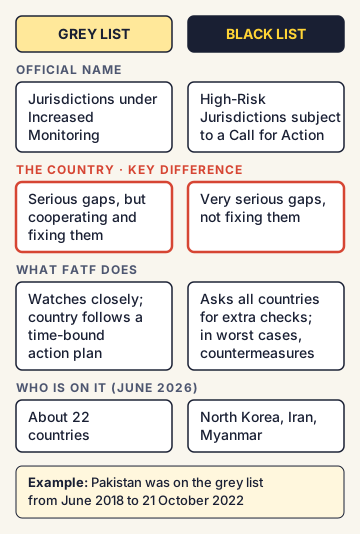
- Grey list, officially "Jurisdictions under Increased Monitoring": countries that have serious weaknesses but have promised to fix them under a time-bound action plan. The FATF watches them closely. As of June 2026, the list has about 22 countries.
- Black list, officially "High-Risk Jurisdictions subject to a Call for Action": countries with very serious weaknesses that are not fixing them. The FATF asks all countries to apply extra checks on them and, in the worst cases, countermeasures. As of June 2026, only North Korea, Iran and Myanmar are on it.
Being grey-listed can make foreign banks slower and more careful with that country's payments. It can also scare away foreign investment and make loans from bodies like the IMF and World Bank harder to get.
A famous example: Pakistan
Pakistan was put on the grey list in June 2018 for weaknesses in fighting terror financing. It was given action plans with a total of 34 action items. It was removed from the grey list on 21 October 2022, after an on-site visit confirmed its progress.
India and the FATF
India joined the APG in March 1998. It became an observer of the FATF on 27 November 2006 and a full member in June 2010, at the Amsterdam Plenary, as its 34th member country. India's latest mutual evaluation was adopted at the June 2024 Plenary in Singapore. India was placed in "regular follow-up", the best category, which only a few G20 countries have.
The report praised India's laws but said it must speed up the prosecution of money laundering and terror financing cases and protect non-profit groups from misuse by terrorists.
India's own system rests on a few key pieces:
- Prevention of Money Laundering Act (PMLA), 2002: came into force on 1 July 2005. The Enforcement Directorate investigates money laundering under it.
- Unlawful Activities (Prevention) Act (UAPA), 1967: makes raising or giving money for terrorism a crime.
- Financial Intelligence Unit-India (FIU-IND): set up on 18 November 2004 under the Department of Revenue, Ministry of Finance. Banks and other firms must report suspicious transactions to it.
Commonly confused concepts
- FATF vs UN 1267 Committee: The FATF sets standards for countries' financial systems and lists countries. The UN 1267 Committee lists individual terrorists and groups and orders their money frozen. The FATF rules (Recommendation 6) require countries to carry out such UN freezes quickly.
- FATF vs FIU: The FATF is a global standard-setter. An FIU (like FIU-IND) is a national agency inside one country that receives and studies suspicious transaction reports.
- Grey list vs black list: Grey means "weak but cooperating, under watch". Black means "high risk, not fixing problems, take action".
- Money laundering vs terror financing: In money laundering, dirty money is made to look clean. In terror financing, the money may be clean (for example, donations or business profits) but it is used for a dirty purpose. So terror financing is harder to spot.
Issues, criticism and the way forward
- Politics in listing: Critics say grey-listing decisions are sometimes shaped by the interests of powerful members, since decisions need consensus.
- Harm to genuine charities: Strict rules have sometimes led countries to over-regulate non-profit groups, cutting off honest charities. The FATF revised its guidance on non-profits in 2023 to reduce this.
- "De-risking": Banks sometimes simply stop serving whole regions or sectors rather than check them carefully, which hurts poor countries and migrant workers sending money home.
- New technologies: Crypto assets, online payment apps and crowdfunding make money harder to trace. The FATF has extended its rules to virtual asset service providers (the "travel rule"), but many countries have yet to apply them fully.
- Way forward: Experts suggest faster information sharing between national FIUs, better checks on who really owns companies (beneficial ownership), and stronger regional cooperation, which is exactly what regional platforms like BIMSTEC are now trying to build.
Concepts to Know
- Money laundering: Hiding where illegal money came from, by passing it through banks, shell companies or property deals, so that it looks like honest income.
- Terror financing: Collecting or moving money, from any source, to support terrorist acts or groups.
- Proliferation financing: Funding the making or spread of nuclear, chemical or biological weapons.
- G7: A group of seven rich democracies: the US, UK, France, Germany, Italy, Japan and Canada.
- Observer: A country that can attend meetings and learn, but cannot vote or take decisions.
- Beneficial owner: The real person who finally owns or controls a company, even if the company is registered in someone else's name.
- Peer review: A check done by equals. Here, experts from other member countries assess one country.
- Set up: 1989, G7 Summit, Paris; secretariat in Paris (at the OECD)
- 40 Recommendations: first 1990; 8 Special Recommendations on terror financing October 2001; 9th in October 2004; merged and revised February 2012
- Members: 40 (38 jurisdictions + European Commission + Gulf Cooperation Council); Indonesia 40th member, October 2023; Russia suspended February 2023
- Plenary meets 3 times a year (February, June, October); decisions by consensus
- Mutual evaluation: technical compliance on 40 Recommendations + effectiveness on 11 Immediate Outcomes
- Black list as of June 2026: North Korea, Iran, Myanmar
- Pakistan: grey-listed June 2018, removed 21 October 2022 (34 action items)
- India: APG member since March 1998; FATF observer 27 November 2006; full member June 2010; mutual evaluation adopted June 2024 (Singapore), "regular follow-up"
- India's laws/bodies: PMLA 2002 (in force 1 July 2005), UAPA 1967, FIU-IND (18 November 2004)
● Tracked since March 28, 2026 · last seen October 13, 2026 · updates as the daily brief publishes